
Home » Articles posted by New England Blogger (Page 3)
Author Archives: New England Blogger
Sign of the times: college students can’t read books

The Elite College Students Who Can’t Read Books: To read a book in college, it helps to have read a book in high school.
Rose Horowitch writes in The Atlantic
Nicholas Dames has taught Literature Humanities, Columbia University’s required great-books course, since 1998. He loves the job, but it has changed. Over the past decade, students have become overwhelmed by the reading. College kids have never read everything they’re assigned, of course, but this feels different. Dames’s students now seem bewildered by the thought of finishing multiple books a semester. His colleagues have noticed the same problem. Many students no longer arrive at college—even at highly selective, elite colleges—prepared to read books.
This development puzzled Dames until one day during the fall 2022 semester, when a first-year student came to his office hours to share how challenging she had found the early assignments. Lit Hum often requires students to read a book, sometimes a very long and dense one, in just a week or two. But the student told Dames that, at her public high school, she had never been required to read an entire book. She had been assigned excerpts, poetry, and news articles, but not a single book cover to cover.
“My jaw dropped,” Dames told me. The anecdote helped explain the change he was seeing in his students: It’s not that they don’t want to do the reading. It’s that they don’t know how. Middle and high schools have stopped asking them to.
In 1979, Martha Maxwell, an influential literacy scholar, wrote, “Every generation, at some point, discovers that students cannot read as well as they would like or as well as professors expect.” Dames, who studies the history of the novel, acknowledged the longevity of the complaint. “Part of me is always tempted to be very skeptical about the idea that this is something new,” he said. And yet, “I think there is a phenomenon that we’re noticing that I’m also hesitant to ignore.”
Twenty years ago, Dames’s classes had no problem engaging in sophisticated discussions of Pride and Prejudice one week and Crime and Punishment the next. Now his students tell him up front that the reading load feels impossible. It’s not just the frenetic pace; they struggle to attend to small details while keeping track of the overall plot.
No comprehensive data exist on this trend, but the majority of the 33 professors I spoke with relayed similar experiences. Many had discussed the change at faculty meetings and in conversations with fellow instructors. Anthony Grafton, a Princeton historian, said his students arrive on campus with a narrower vocabulary and less understanding of language than they used to have. There are always students who “read insightfully and easily and write beautifully,” he said, “but they are now more exceptions.” Jack Chen, a Chinese-literature professor at the University of Virginia, finds his students “shutting down” when confronted with ideas they don’t understand; they’re less able to persist through a challenging text than they used to be.
You can read the full article here
– The Elite College Students Who Can’t Read Books, Rose Horowitch, The Atlantic, 11/2024
Related articles
Teachers should require our students to use textbooks
Suggested books for a well rounded life
Fun books to inspire science teachers as well as students
Examples of close reading strategies
This website is educational. Materials within it are being used in accord with the Fair Use doctrine, as defined by United States law.
§107. Limitations on Exclusive Rights: Fair Use. Notwithstanding the provisions of section 106, the fair use of a copyrighted work, including such use by reproduction in copies or phone records or by any other means specified by that section, for purposes such as criticism, comment, news reporting, teaching (including multiple copies for classroom use), scholarship, or research, is not an infringement of copyright. In determining whether the use made of a work in any particular case is a fair use, the factors to be considered shall include: the purpose and character of the use, including whether such use is of a commercial nature or is for nonprofit educational purposes; the nature of the copyrighted work; the amount and substantiality of the portion used in relation to the copyrighted work as a whole; and the effect of the use upon the potential market for or value of the copyrighted work. (added pub. l 94-553, Title I, 101, Oct 19, 1976, 90 Stat 2546)
Columbus Day, Italian American Heritage Day, and anti-racism

Navigating controversial topics, such as Columbus Day, can be challenging in any climate. Social media has made issues like this even more more difficult due to the prevelance of virtue signaling on social media. We as teachers don’t want to inhibit discussion – we see challenges as an opportunity to facilitate open and respectful dialogues that help students and parents understand diverse perspectives.
Those of us who grew up celebrating Columbus Day did so with the best of intentions. Columbus Day was Italian American heritage day, honoring contributions of Italians to the world and to the United States of America. It began in 1792 as a project of the Society of St. Tammany, a predominantly Irish American political group.
Why did this day eventually become an American holiday? Surprising as it may be to hear, Columbus day was an anti-racist holiday! Modern days sometimes don’t realize that racism against Italians was a strong, dangerous force at the time.:
“Anti-Italian sentiment was racial as well as religious. Southern Italians and Sicilians were viewed as non European in racial origin, and in the old pseudo-scientific BS, considered part of a half way primitive “Mediterranean race”. Basically, they were seen as a middle race between sub Saharan peoples and white Europeans. So there was both anti-Catholic sentiment and racial fear encountered by early Italian migrants “- source

Italian Americans spent decades working to educate their fellow Americans about their culture and heritage. In response, for the 400th anniversary of Christopher Columbus’s voyage President Benjamin Harrison declared Columbus Day as a national celebration of Italian Americans. Who was against it? The Ku Klux Klan, as they considered Italians and Sicilians to be non-white, Hispanics.
In recent years, especially due to discourse on social media, many groups have come to see Columbus Day as a day only about Columbus and what his expeditions did in the Americas. I have seen people even in my own hometown charge that folks who observe Columbus Day are “racist” and are “promoting white supremacy.” Seeing neighbor say such things against other neighbor breaks my heart. And as a teacher, seeing students in school falsely attack other students as racists essentially because of their Italian ancestry is hurtful.
In agreement with my Italian American neighbors, yes: picking one ethnic group (Italians) and removing the pride day for them, and them alone, is an act of intolerance and bigotry.
But in agreement with critics of Columbus day, yes: we are obligated to note that the historical record is clear. Columbus and his crew engaged in kidnapping, murder, rape, and importing a system of slavery that devasted this area of the world for centuries.
Also, Columbus didn’t discover this area: Native Americans were indigenous to that region for thousands of years before Columbus. And Columbus wasn’t even the first European to discover North America, that would be Viking Leif Erikson, who discovered it in 1003 AD.
So here is where we are: Columbus and his crew didn’t discover the Americas, they were guilty of crimes including slavery and sex trafficking. This is why many people want to remove Columbus Day and replace it with Indigenous Peoples Day.
But instead of criticizing Columbus and his crew, the situation has become one of targeting Italian Americans. As a teacher I am obligated to promote historical literacy: We must teach the truth – and were you even taught that Italian Americans were being lynched in the USA?
Controversy is unavoidable, but anger and virtue-signaling are unnecessary. We can learn about both of these topics:
* Some Americans have been uneducated about the history of Native Americans, and the way that our country was founded upon such indigenous lands.
* Italian Americans deserve the same respect, and the same opportunity to have a heritage day as other peoples, honoring Italian contributions in architecture, art, literature, science, and philosophy.
We can have both. Don’t “cancel” Columbus Day – just rename it as Italian American Day, which is what it always was to begin with. And let’s widen our scope of teaching, from Columbus to the many great Italians who gave so much to Italian and world culture. Just a few examples could include –
The great poet Dante Alighieri, 14th century
Scholar and poet of early Renaissance Italy, Petrarch, 14th century
Leonardo Da Vinci, 15th century
Michelangelo di Lodovico Buonarroti Simoni, sculptor, painter, architect and poet of the High Renaissance, 15th century
Ovadia Sforno, Italian Jewish Bible commentator, 16th century
Galileo Galilei, astronomer, physicist and enginee, 17th century
Antonio Vivaldi, composer, virtuoso violinist and impresario of Baroque music, 18th century
Cesare, Marquis of Beccaria, 18th century. One of the first to criticize the ad hoc barbarism of eighteenth century criminal justice, founding father of criminology. Modern criminal systems in democratic countries are based on his ideas.
Giuseppe Mazzini, activist for the unification of Italy, 19th century
Giuseppe Verdi, 19th century, Opera composer
Enrico Caruso, early 20th century, Italian tenor who sang at the major opera houses of Europe and North and South America
Arturo Toscanini, conductor, 20th century
Traditionalists can understand that for many liberals, Columbus Day represents a celebration of colonialism and the suffering of Indigenous peoples. The acknowledgment of this historical context is crucial in appreciating why the holiday can be deeply uncomfortable for some. It’s not about erasing history, but about recognizing and respecting the experiences of those who suffered. In discussing this, we aim to foster empathy and awareness without resorting to hurtful rhetoric.
Liberals can understand why Columbus Day holds significance for Italian Americans. The holiday is a source of cultural pride and a way to combat historical anti-Italian bigotry. Celebrating Italian heritage and contributions to American society is a legitimate and important endeavor. By acknowledging this, we can foster a sense of mutual respect and recognition for their struggles and achievements.
In bridging these perspectives, we aim to promote understanding and compassion.
Already existing days celebrating native American culture
National Native American Heritage Day, USA, Friday after Thanksgiving
In 2008 Congress passed a law signed by President Bush to create National Native American Heritage Day. This was the first nationally appointed day for Native Americans and was huge for their culture. Donald Trump in 2020 made an annual proclamation for Native American Heritage Month
Native American Day, several American states
Observed in several US states in celebration of Native American culture. In California and Nevada, the holiday is designated on the fourth Friday of September, whereas in South Dakota and Wisconsin, it falls on the second Monday of October. Within each of these states, Native American Day honors the cultural contributions of Native American communities to the respective state’s history, as well as to the overall country.
National American Indian Heritage Month, USA, November
The month of November is National American Indian Heritage Month, also referred to as Native American Heritage Month.
Indigenous Peoples’ Day (United States) 2nd Monday in October
The city council of Berkeley, California created this day in 1992. Two years later the city of Santa Cruz, California instituted the holiday. Over the next two decades many other towns and states also started observing this day. In 2021, Joe Biden formally commemorated the holiday with a presidential proclamation. It is not a recognized holiday under U.S. Federal Law. This day celebrates Indigenous American peoples.
International Day of the World’s Indigenous Peoples (international) Aug 9
A day to raise awareness and protect the rights of the world’s indigenous population. This event also recognizes the achievements and contributions that indigenous people make to improve world issues such as environmental protection. It was first pronounced by the United Nations General Assembly in December 1994.
Related articles
As the Columbus Day Debate Rages On, So do the Time-Worn Stereotypes: In response to Lauren LoGiudice article “Are Italian Americans the White’s Clowns?”: there cannot be an identity crisis when there is no single identity
Donna Chirico, 4/3/2018, VNY La Voce di New York
Conversations on Columbus with John M. Viola, Italian American Podcast
Anti-Italianism, Wikipedia
Anti-Italianism, Fabio Girelli-Carasi, Brooklyn College, CUNY
Italian American and Their Communities of Cleveland, Gene Veronesi, Chapter 6: Anti-Italian Sentiment in America, MSL Academic Endeavors
“People of Italian descent in the United States had their civil liberties crushed in the name of threat mitigation. As Salvatore LaGumina described in In Search of Heroes: Italian Americans in World War II, Italians were viewed as “a potentially subversive population in the United States.” As such, by January 1942, at least 600,000 Italians and Italian Americans, among them who were legal residents and American citizens, were classified as “enemy aliens.”
Moreover, about 1,600 Italian citizens — among them my great-grandfather — were put into internment camps in Missoula, Montana and Ellis Island. As a result of security concerns in coastal areas, about 10,000 Italian Americans were forced to relocate from their homes along the California coast, moving inland.”
Crushing of civil liberties of Italian Americans
Australian Tasmanian oral traditions link ancient history
Historians have discovered that some Australian and Tasmanian aboriginal oral traditions accurately conveyed real-world knowledge dating back to the end of the last ice-age.
Australian aboriginals have transmitted the history of how Australia’s ancient coast was inundated by rising sea levels going back 7000 years!
And a Tasmanian aboriginal group has transmitted the history of how their ancient coast was inundated going back to almost 12,000 years ago – and they even have an accurate oral tradition about the position of some stars going back to that era!
Perhaps more shockingly, historians working together with astronomers have revealed that some Australian tribes share knowledge of the constellation Orion that they seemingly couldn’t possibly know – unless they had passed down a story from their most-distant ancestors – from a time before Europeans, Africans, Asians, Indonesians, Native Americans and Aboriginal Australians had even split apart.
In other words, we have some tantalizing evidence of a story about the constellation of Orion from 100,000 years ago that became a shared feature of human civilization – the world’s oldest story?
Indigenous peoples transmitting stories with accurate geological information for thousands of years
Aboriginal society has preserved memories of Australia’s coastline dating back more than 7,000 years. That’s the conclusion that University of the Sunshine Coast Professor of Geography Patrick Nunn reached in a ground-breaking paper published today in renowned academic journal, Australian Geographer.
Professor Nunn and collaborator Nick Reid, a University of New England linguist, had their research paper accepted into the journal after three years of painstaking research. The article describes the pair’s study of Aboriginal stories from 21 places around Australia’s coastline, each describing a time when sea levels were significantly lower than today.
Professor Nunn said present sea levels in Australia were reached 7,000 years ago and as such any stories about the coastline stretching much further out to sea had to pre-date that time. “These stories talk about a time when the sea started to come in and cover the land, and the changes this brought about to the way people lived – the changes in landscape, the ecosystem and the disruption this caused to their society,” he said.
“It’s important to note that it’s not just one story that describes this process. There are many stories, all consistent in their narrative, across 21 diverse sites around Australia’s coastline.” In recognition of the importance of the research, Australian Geographer editors chose to publish the paper unabridged, despite it being nearly three times the length of the journal’s normal articles. The extensively reviewed paper is expected to attract plenty of debate and discussion from the academic community.
Professor Nunn said his interest in how stories met science was piqued during his extensive tenure at the University of the South Pacific in Fiji. He said the time span of the memories in the Australian Aboriginal stories he studied, however, appeared unmatched by any other culture. “Anything that goes back thousands of years – nearly 10,000 years in some cases – has to be quite exceptional,” he said. “It’s a remarkable time period when we consider our own memories and what we can remember even with the aid of books and other information. “I believe these stories endured that long partly due to the harshness of Australia’s natural environment, which meant that each generation had to pass on knowledge to the next in a systematic way to ensure its survival.”
Nunn, P. D., & Reid, N. J. (2015). Aboriginal Memories of Inundation of the Australian Coast Dating from More than 7000 Years Ago. Australian Geographer, 47(1), 11–47. https://doi.org/10.1080/00049182.2015.1077539
Revealed: how Indigenous Australian storytelling accurately records sea level rises 7,000 years ago
Indigenous stories of dramatic sea level rises across Australia date back more than 7,000 years in a continuous oral tradition without parallel anywhere in the world, according to new research. Sunshine Coast University marine geographer Patrick Nunn and University of New England linguist Nicholas Reid believe that 21 Indigenous stories from across the continent faithfully record events between 18,000 and 7000 years ago, when the sea rose 120m.
Reid said a key feature of Indigenous storytelling culture – a distinctive “cross-generational cross-checking” process – might explain the remarkable consistency in accounts passed down by preliterate people which researchers previously believed could not persist for more than 800 years.
“The idea that 300 generations could faithfully tell a story that didn’t degenerate into Chinese whispers, that was passing on factual information that we know happened from independent chronology, that just seems too good to be true, right?” Reid told Guardian Australia.
“It’s an extraordinary thing. We don’t find this in other places around the world. The sea being 120 metres lower and then coming up over the continental shelf, that happened in Africa, America, Asia and everywhere else. But it’s only in Australia that we’re finding this large canon of stories that are all faithfully telling the same thing.”
Scholars of oral traditions have previously been sceptical of how accurately they reflect real events.
However, Nunn and Reid’s paper, “Aboriginal memories of inundation of the Australian coast dating from more than 7000 years ago”, published in Australian Geographer, argues the stories provide empirical corroboration of a postglacial sea level rise documented by marine geographers.
Some of the stories are straight factual accounts, such as those around Port Phillip Bay near Melbourne, which tell of the loss of kangaroo hunting grounds.
Others, especially older stories such as those from around Spencer Gulf in South Australia, are allegorical: an ancestral being angered by the misbehaviour of a clan punishes them by taking their country, gouging a groove with a magical kangaroo bone for the sea to swallow up the land.
“Our sense originally is that the sea level must have been creeping up very slowly and not been noticeable in an individual’s lifetime,” Reid said.
Joshua Robertson, Wed 16 Sep 2015, The Guardian

Figure 1. Map of Australia showing the 21 coastal locations from which Aboriginal stories about coastal inundation are described in this paper. Also shown is the extent of the continental shelf that was exposed during the low sea-level stage of the Last Glacial Maximum, about 20 000 years ago.
And
Archaeological evidence of an ethnographically documented Australian Aboriginal ritual dated to the last ice age
David, B., Mullett, R., Wright, N. et al. Nature Human Behaviour, 7/1/2924
Also
Tasmanian Aboriginal oral traditions among the oldest recorded narratives in the world
New research published in the Journal of Archaeological Science indicates Palawa (Tasmanian Aboriginal) stories recall geological and astronomical events that occurred 12,000 years ago, placing them among the oldest recorded oral traditions in the world.
University of Tasmania researchers were part of a trans-disciplinary team that investigated Palawa oral traditions recorded in the 1830s, which described rising seas flooding the Bassian Land Bridge connecting Tasmania to mainland Australia, and the presence of the bright star Canopus near the South Celestial Pole.

[And next is a close-up map from the paper:]
Fig. 1. Topographic map of the Bass Strait. Map shows the conditions before the Bassian Land Bridge was submerged. The yellow shaded area represents geography of the land bridge, while the broken red line indicated the last vestige of a continuous Bassian Land Bridge between Tasmania and the mainland.
The method of calculating approximate ages is shown in the inset. (For interpretation of the references to colour in this figure legend, the reader is referred to the Web version of this article.)

By drawing on topographic data of the seafloor and calculating the position of Canopus in the ancient past due to axial precession, the team estimated that both conditions date back to at least 11,960 years ago.
Astronomer and lead author, Associate Professor Duane Hamacher from the University of Melbourne, said using a scientifically datable natural event – such as a volcanic eruption or meteorite impact – enables researchers to show the integrity of oral traditions can be maintained for thousands of years.
“Current archaeological evidence indicates that humans reached Tasmania at least 40,000 years ago,” Associate Professor Hamacher said. Palawa cultural historian, Pro Vice-Chancellor Aboriginal Leadership and co-author, Professor Greg Lehman from the University of Tasmania, emphasised that scientific validation of oral traditions reinforces, rather than supersedes, the cultural authority of Indigenous knowledge.
“Scientific investigation of colonial records that articulate traditional systems of knowledge preservation creates a wonderful multi-disciplinary and cross-cultural way of making our history and our landscape more meaningful in our lives,” Professor Lehman said.
“Physicists and astronomers sometimes struggle to do this alone. This project has profoundly deepened our relationship with history and science by taking Aboriginal traditions seriously.”
Geographer and co-author, Professor Patrick Nunn from the University of the Sunshine Coast, said there were on-going debates about the length of time oral traditions can be passed down while still maintaining vitality.
“Aboriginal Australians developed complex knowledge systems that were committed to memory and passed down through generations via oral traditions,” Professor Nunn said.
“Our research suggests that Palawa oral traditions accurately recall the flooding of the land bridge between Tasmania and the mainland – showing that oral traditions can be passed down more than 400 successive generations while maintaining historical accuracy.”
Historian and co-author, Associate Professor Rebe Taylor from the University of Tasmania, stressed the significance of recognising the endurance of Palawa oral traditions.
“They endured not only millennia, but also the genocide committed by the British in the nineteenth century and the wrongful representation of the Palawa as a so-called ‘extinct race’,” Associate Professor Taylor said.
The team also included Michelle Gantevoort from RMIT University, Ka Hei Andrew Law from the University of Melbourne, and Mel Miles from Swinburne University of Technology.
Duane Hamacher, Patrick Nunn, Michelle Gantevoort, Rebe Taylor, Greg Lehman, Ka Hei Andrew Law, Mel Miles, The archaeology of orality: Dating Tasmanian Aboriginal oral traditions to the Late Pleistocene, Journal of Archaeological Science, Volume 159, 2023, ISSN 0305-4403, https://doi.org/10.1016/j.jas.2023.105819.
The world’s oldest story? Astronomers say global myths about ‘seven sisters’ stars may reach back 100,000 years
In a nothing less than shocking article on The Conversation, Ray Norris writes
In the northern sky in December is a beautiful cluster of stars known as the Pleiades, or the “seven sisters”. Look carefully and you will probably count six stars. So why do we say there are seven of them?
Many cultures around the world refer to the Pleiades as “seven sisters”, and also tell quite similar stories about them. After studying the motion of the stars very closely, we believe these stories may date back 100,000 years to a time when the constellation looked quite different.
In Greek mythology, the Pleiades were the seven daughters of the Titan Atlas. He was forced to hold up the sky for eternity, and was therefore unable to protect his daughters. To save the sisters from being raped by the hunter Orion, Zeus transformed them into stars. But the story says one sister fell in love with a mortal and went into hiding, which is why we only see six stars.
A similar story is found among Aboriginal groups across Australia. In many Australian Aboriginal cultures, the Pleiades are a group of young girls, and are often associated with sacred women’s ceremonies and stories. The Pleiades are also important as an element of Aboriginal calendars and astronomy, and for several groups their first rising at dawn marks the start of winter.
Close to the Seven Sisters in the sky is the constellation of Orion, which is often called “the saucepan” in Australia. In Greek mythology Orion is a hunter. This constellation is also often a hunter in Aboriginal cultures, or a group of lusty young men.

The writer and anthropologist Daisy Bates reported people in central Australia regarded Orion as a “hunter of women”, and specifically of the women in the Pleiades. Many Aboriginal stories say the boys, or man, in Orion are chasing the seven sisters – and one of the sisters has died, or is hiding, or is too young, or has been abducted, so again only six are visible.
The Lost Sister
Similar “lost Pleiad” stories are found in European, African, Asian, Indonesian, Native American and Aboriginal Australian cultures. Many cultures regard the cluster as having seven stars, but acknowledge only six are normally visible, and then have a story to explain why the seventh is invisible.
How come the Australian Aboriginal stories are so similar to the Greek ones? Anthropologists used to think Europeans might have brought the Greek story to Australia, where it was adapted by Aboriginal people for their own purposes. But the Aboriginal stories seem to be much, much older than European contact. And there was little contact between most Australian Aboriginal cultures and the rest of the world for at least 50,000 years. So why do they share the same stories?
Barnaby Norris and I suggest an answer in a paper to be published by Springer early next year in a book titled Advancing Cultural Astronomy, a preprint for which is available here.
All modern humans are descended from people who lived in Africa before they began their long migrations to the far corners of the globe about 100,000 years ago. Could these stories of the seven sisters be so old? Did all humans carry these stories with them as they travelled to Australia, Europe, and Asia?
Moving Stars
Careful measurements with the Gaia space telescope and others show the stars of the Pleiades are slowly moving in the sky. One star, Pleione, is now so close to the star Atlas they look like a single star to the naked eye.

But if we take what we know about the movement of the stars and rewind 100,000 years, Pleione was further from Atlas and would have been easily visible to the naked eye. So 100,000 years ago, most people really would have seen seven stars in the cluster.

We believe this movement of the stars can help to explain two puzzles: the similarity of Greek and Aboriginal stories about these stars, and the fact so many cultures call the cluster “seven sisters” even though we only see six stars today.
Is it possible the stories of the Seven Sisters and Orion are so old our ancestors were telling these stories to each other around campfires in Africa, 100,000 years ago? Could this be the oldest story in the world?
The world’s oldest story? Astronomers say global myths about ‘seven sisters’ stars may reach back 100,000 years, Ray Norris, The Conversation, 12/21/2020
This website is educational. Materials within it are being used in accord with the Fair Use doctrine, as defined by United States law.
§107. Limitations on Exclusive Rights: Fair Use. Notwithstanding the provisions of section 106, the fair use of a copyrighted work, including such use by reproduction in copies or phone records or by any other means specified by that section, for purposes such as criticism, comment, news reporting, teaching (including multiple copies for classroom use), scholarship, or research, is not an infringement of copyright. In determining whether the use made of a work in any particular case is a fair use, the factors to be considered shall include: the purpose and character of the use, including whether such use is of a commercial nature or is for nonprofit educational purposes; the nature of the copyrighted work; the amount and substantiality of the portion used in relation to the copyrighted work as a whole; and the effect of the use upon the potential market for or value of the copyrighted work. (added pub. l 94-553, Title I, 101, Oct 19, 1976, 90 Stat 2546)
ISO and teaching learning standards

Parallels between ISO and teaching/learning standards
Quite often we have people from a non-teacher background come into schools as a new teacher, or teachers leaving the teaching profession to move into a business or corporate career. In both cases our jobs have given us transferable skills. Further, the way that we analyze & improve our schools or businesses is much more similar than different.
Many companies use a group of standards called ISO to systematically look at and improve their company. Schools can benefit from the same ISO process. You can learn more about ISO here. A brief outline-
The International Organization for Standardization (ISO) is an independent, non-governmental organization composed of representatives from 170 nations. ISO has published over 25,000 international standards covering almost all aspects of technology and manufacturing. It creates international standards to make it much easier for companies to produce and sell products to other companies, governments, or individuals, across the world, e.g. manufactured products, food safety, transport, IT, agriculture, and healthcare.
Let’s look at official ISO ideas about how the system works and then see the parallels that can exist in a continually improving school system:
ISO standards are internationally agreed upon by experts. – iso. org
Learning standards are agreed upon by expert teachers in school districts across each state. Many states do so by drawing upon the Common Core and/or the Next Generation Science Standards (NGSS.)
ISO standards describe the best way of doing something. It could be about making a product, managing a process, delivering a service, or supplying materials – standards cover a huge range of activities. – iso. org
Common Core standards “define the rigorous skills and knowledge in English language arts and mathematics that need to be effectively taught and learned for all students to be ready to succeed academically in credit-bearing, college-entry courses and workforce training programs.” (Intro to Common Core State Standards for ELLs)
NGSS learning standards describe the best way of creating science-literate citizens; making science and engineering relevant to all students; and developing greater interest in science so that more students choose to major in science and technology in college.
ISO Standards are the distilled wisdom of people with expertise in their subject matter and who know the needs of the organizations they represent – people such as manufacturers, sellers, buyers, customers, trade associations, users, or regulators. – iso. org
Learning Standards are the distilled wisdom of people with expertise in teaching and who know the needs of both teachers and students.
ISO 9001 is a way for a company to think about and document precisely what they create, whether physical products or services. A company follows ISO 9001 standards to develop their own documents, procedures, and policies, customized to their needs.
Learning standards are a way for teachers to think about and document precisely what and how they are teaching, and how they assess student comprehension. Each school district or department develops their own documents, procedures, and policies customized to their needs.
ISO 9001 helps organizations of all sizes and sectors to improve their performance, meet customer expectations and demonstrate their commitment to quality.
Learning Standards are a way to help schools to improve their performance, meet community (teacher, parent and student) expectations, and demonstrate their commitment to helping each student reach their potential.
ISO requirements define how to establish, implement, maintain, and continually improve a quality management system (QMS).
Learning standards establish how admin and teachers can implement, maintain, and continually improve teaching in academic, vocational, music, art, and physical education classes.
Implementing ISO 9001 means your organization has put in place effective processes and trained staff to deliver flawless products or services time after time.
Implementing learning standards means that your school has put in place effective processes and trained staff to deliver the best possible educational experiences for the students of their local community.
Business benefits of ISO include:
Customer confidence: The standard ensures that organizations have robust quality control processes in place, leading to increased customer trust and satisfaction.
Effective complaint resolution: ISO 9001 offers guidelines for resolving customer complaints efficiently, contributing to timely and satisfactory problem-solving.
Process improvement: The standard helps identify and eliminate inefficiencies, reduce waste, streamline operations, and promote informed decision-making, resulting in cost savings and better outcomes.
Ongoing optimization: Regular audits and reviews encouraged by ISO 9001 enable organizations to continually refine their quality management systems, stay competitive, and achieve long-term success.
Community benefits of learning standards include:
Community confidence: The standard ensures that schools have robust quality control processes in place, leading to increased community trust and satisfaction.
Effective complaint resolution: Good school district policies offer ways to resolve complaints efficiently – taking seriously concerns of not only students but also teachers – contributing to timely and satisfactory problem-solving.
Process improvement: Good schools aim to identify and eliminate inefficiencies, streamline operations, and promote informed decision-making, resulting in cost savings to tax-payers and better outcomes for students.
Ongoing optimization: Regular audits – by teaching groups such as NEASC – enable schools to continually refine themselves and achieve long-term success.
How can we use the ISO process to help improve schools?
Many companies use ISO processes to systematically look at and improve their company. School districts and individual schools can benefit from the same ISO process. You can learn more about ISO here. This flowchart shows the structure of ISO 9001, and below we show it can be used in schools
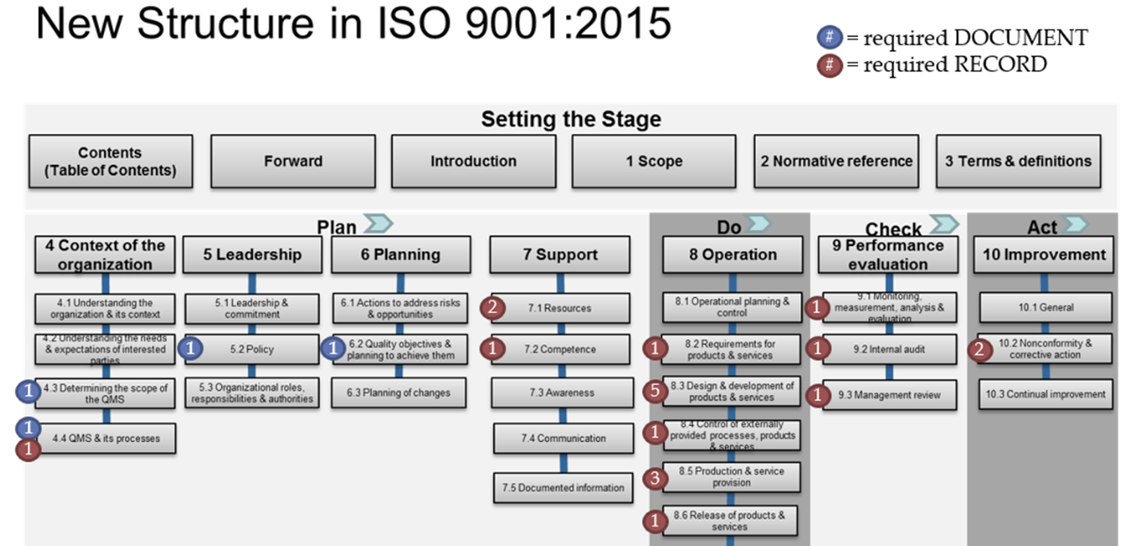
Context of the organization
For a business – how is it organized? What is their QMS (quality management system?)
For a school – how is the school system organized? It usually looks something like this:
City or town school committee -> Superintendent -> School district teams and Principals -> Each individual school teacher and staff structure.
What kind of QMS do we find in schools?
Each school collects data on grades, attendance, safety, college or trade school or career acceptance, etc. They send this data to the appropriate district teams for discussion and analysis. This information should be made available to the school committee and general public.
Leadership
For a business, what are the leadership levels? They often look like:
President -> Vice president -> Department managers -> Employees within each department.
For a school, what are the leadership levels?
Principal -> assistant principals or deans ->teachers and paraprofessionals -> Students
Planning
For a business, what are the objectives and how does it achieve the objectives?
For a school, what are the objectives and how does it achieve the objectives? They may include:
* Promote a safe environment both for teachers and students
* Promote college and/or career readiness
* Develop young women and men into confident, self-directed, lifelong learners
* Develop young women and men to become productive members of their community
Support
For businesses – Resources, awareness, communication, documented information.
For schools –
Resources: Most classes have rooms with sufficient chairs and desks, bookshelves, supplies, manipulatives, lab equipment, textbooks (whether physical or digital;) computers/Chromebooks; school library, etc. Similarly, we can define what resources should be available for music, art, physical education, vocational education, special education, English Language Learners education, etc.
Awareness – There should be a structure for both teachers and students to have their concerns and needs heard by the administration.
Communication – Teachers communicate in regular department meetings and through email. The school has meetings for department heads for cross-curricular issues. There are whole-school meetings for all faculty/staff.
Documented information – This includes, but is not limited to, textbooks, teacher texts, worksheets, sample essays, quizzes, exams, labs, etc. (physical or digital,) and the district’s official learning standards (which may be local, state, national, or a combination thereof.)
Operations
For a business, we clearly define the production and delivery of products/services.
For a school we clearly define the creation/revision of pacing guides and lesson plans; and the implantation of these in the classroom, music room, art room, gym, etc.
Performance evaluation
For businesses: Is the product being made correctly? Monitoring, measurement, analysis, evaluation, internal audit. Management review.
For schools – Informal discussions, and asking questions, with students throughout the day. School quizzes and tests. State or national mandated standardized exams.
Improvement
For businesses – Identify any nonconformities and then decide what corrective actions would be helpful. A goal is continual improvement.
For schools – The parallel to nonconformities in schools could include –
– a student demonstrating that they didn’t (yet) learn certain facts; haven’t (yet) understood how individual facts were related in a greater whole; or haven’t (yet) mastered certain skills.
– a teacher demonstrating that they didn’t (yet) master how to create/revise pacing guides and lesson plans, or (yet) fully implement classroom management skills.
– an administrator demonstrating that they didn’t (yet) master how to help new or struggling teachers, how to help teachers who may feel targeted by students or parents, how to help students who have learning problems, how to help teachers or students who may be experiencing discrimination, etc.
and then decide what corrective actions would be helpful. The goal is continual improvement.
How to prepare for teaching AP Physics

So you have been assigned to teach a high school AP Physics class, congratulations! Teaching this or any AP high school science can be a fun, rewarding experience. There are ways to make it easier for new AP teachers coming into our schools. But if we don’t take such steps then we may set teachers up for failure. So here’s specific advice for those who have been asked to teach AP Physics for the first time:
* Have your school sign you up for an AP physics summer institute. Every high school should pay for this – and they should pay not only for the class, but also travel expenses, and room & board. The amount of money is peanuts compared to the school annual budget, and they know it. It is a one-time expense to create excellence for a program that impact many students for many years.
* Spend a few weeks talking with teachers who’ve taught AP physics before. They will be happy to share their notes with you. With their help, create a month-by-month pacing guide. As the year progresses try to stick with it so you get through all of the material.
* At the beginning of each unit/month, break your pacing guide down into a day-by-day pacing guide.
* Before the first day of school – get into the physics stockroom. Get into the online file/document storage, the bookshelves, and any storage cabinets that they have in the physics classrooms.
* Work with the teachers and science department head to find all the AP physics labs that AP physics students in your school have previously have been doing.
In theory, all of that should already be there for you, plug and play. But in reality many science department heads are overwhelmed, and have not made sure that this was done. In some schools when I walked in there was almost nothing organized for me. Many files were on somebody else’s hard drive or cloud drive, and those that were available were not always well organized or explained. Lab supplies were not always well organized or labeled.
* Plan ahead: You should try to run a couple of AP labs each month.
* Spend time – ideally, before the school year begins – going through the physics lab supply room. Find all items necessary to do the labs. For those items that you cannot find, work with your department head to write a purchase order to get what you need.
This can be a very doable job if there was good organization in the year before. There’s no reason for any school to not already have, for every new teacher walking in the door:
* A month by month, week by week AP pacing guide
* A good textbook or set of online resources that each lesson connects to
* Appropriate, well-labeled, and well-documented, AP physics labs.
* Clear lab write-ups for the teacher and for the students.
The challenges that we face are:
* Some people were disorganized. Their files may be in disarray.
* Some people create a detailed curriculum but take it with them and leave nothing for the new teacher. That shouldn’t be happening, we’re supposed to be a community where we all support and value each other.
* Some people lose parts/ lab supplies, don’t tell anyone, and don’t order replacement parts. That sets the next teacher up for frustration.
How we grow: One of the things I worked on over the years is showing my materials to teachers and students, and improving my process from their reactions. Sometimes what I wrote seems clear to me, yet someone will point out something ambiguous. This gives me an opportunity to rewrite and make things clearer.
Most problems for the next incoming AP science teachers go away as long as, in the previous year, the department head sits down with the science teachers and works things out ahead of time. Good intentions and a recognition that we are all part of a community leads to good organization and improvement of pedagogy. This benefits the entire community.

How do we plan a science class for topics left out by the NGSS?

What do we do when try to align a physics unit with NGSS – and NGSS doesn’t have anything on the topic?! For instance, NGSS seems to leave out: kinematics, vectors, parabolic motion, fluids, buoyancy, electrical circuits, rotational motion, geometric optics, and simple machines.
The official explanation is that NGSS standards are more about skills than content. That would be fair – except they do list specific content for so many other things. So what can we do?
We tie the physics topics that we teach into the NGSS in three ways:
(A) We teach students how to do problem solving in this unit. We address the NGSS problem solving and critical thinking skills.
(B ) Look into the NGSS Evidence statements. These offer many examples. Many of these evidence statements do specifically cover what we are looking for.
(C) We teach students how to do problem solving in this unit and cite the relevant, related Common Core Math standards that are addressed by this.
___________________________________
Thanks for visiting my website. We also have resources here for teachers of Astronomy, Biology, Chemistry, Earth Science, Physics, Diversity and Inclusion in STEM, and connections with reading, books, TV, and film. At this next link you can find all of my products at Teachers Pay Teachers, including free downloads – KaiserScience TpT resources

Which pedagogical strategy is best?

Anurag Katyal offers a great answer to this question!
Lectures work great, except when they don’t. Active Learning works great, except when it doesn’t. Just In Time teaching works great, except when it doesn’t. There’s no silver bullet. Context always matters.
Lectures work better for PhD students because they already have well defined boxes of knowledge in their head that they can file new information in. Younger students don’t have this and that’s why it doesn’t work nearly as well for them, yet it’s wrong to say it doesn’t work at all.
Active learning is fantastic for extroverted self-assured students who are up for the challenge. It doesn’t work as well for those who are painfully shy.
Just in time teaching works well for those who have some background already but need a reminder. You can’t do just in time remediation for factoring when a group of students does not know how to add signed numbers.
Context from day to day matters just as much – are you teaching at an independent school where a chipped nail is a crisis or at an underfunded public school in the inner city where kids don’t know where they will sleep that night.
Some techniques might work well in one school but not the other. You certainly can’t flip a classroom and have students watch YouTube videos ahead of class if they don’t have running water at home, let alone an internet connection. Well, you can try but it won’t go too well.
In my own classes, I find myself starting with inquiry as the highest ideal – and then going down the active learning scale based on the mood in the room on any given day. Sometimes, I have to go all the way to the bottom and lecture.
Sometimes, students pull me aside and say thanks for lecturing that day because xyz happened and they just would not have been a good group member. Other days, those students might be the first at the board.
Forget all the snazzy names and acronyms. Don’t let a pedagogy become your identity. Read the room. Adapt. Teach in a manner that will be best received that day. Remain flexible. Every 5 years, some new acronym comes out that’s the latest and greatest thing since sliced bread when all the students really wanted that day was a PBJ…
A master list of pedagodies/startegies:
Pedagogical strategies
Pedagogical theory
Bloom’s Taxonomy: Use and misuse
Bloom’s Taxonomy: Thinking well requires knowing facts (content and skills)
Levels – Levels of high school science classes
Honors – Why schools should offer Honors classes
Learning new information relies on having already existing knowledge.
Maslow’s hierarchy of needs – claims and reality
Students need to engage in internal mental reflection
Thinking well requires knowing facts
Tier I, II and III vocabulary
Learning styles and multiple intelligences
Reframing the Mind. Howard Gardner and the theory of multiple intelligences, By Daniel T. Willingham
Self esteem and students
Articles by cognitive scientist Daniel Willingham
Writing skills
One page notes/posters
Note taking skills
Good writing and avoiding plagiarism
How to write a physics lab report
Developing writing skills: Verb wheel
___________________
Thanks for visiting my website. We also have resources here for teachers of Astronomy, Biology, Chemistry, Earth Science, Physics, Diversity and Inclusion in STEM, and connections with reading, books, TV, and film. At this next link you can find all of my products at Teachers Pay Teachers, including free downloads – KaiserScience TpT resources
Sci-fi & fantasy cons

If you’re in New England I highly recommend going to Arisia or Boskone – they’re huge, fun, fan-run, science fiction and fantasy conventions (people who go to these sorts of things call them cons.)
Don’t confuse authentic sci-fi/fantasy cons with Comic Cons! The large Comic Cons are run for profit. The commercial ones center around long, expensive autograph lines and a large dealers room, where people browse, buy, and trade comic books and related memorabilia. To be sure, that is perfectly cool. These became popular because they invite many guests from television shows and movies. However, their main function is selling at autograph tables. They’re run by for profit organizations.

Fan-run, non-profit cons have much more to do than buy things. They center around community. Some examples are Arisia and Boskone (in Boston) and Albacon (upstate New York.) By design they have fewer media guests. Rather, their emphasis is on every form of science fiction and fantasy: They invite guest authors and creators of books, short stories, art, music, game creation & playing, and even cosplay.
You don’t have a moment to be bored: Cons usually have several different panels going on simultaneously. Depending on the con size, in any time block there could be between 2 to 10 different events to choose from! Panels usually have several speakers, with an audience between 10 to 200 people, depending on the topic.

Audience questions are always invited – and the interplay between the audience and the panel can be one of the con highlights 🙂 In a con you’re not a customer – you’re part of a community. Sure, you can be quiet and just observe things, but even the shyest folks usually end up asking questions and getting in discussions.

Fan-run cons feature:
* Panels – authors, writers, dreamers, and poets speak to an audience and invite questions
* Dealers room with a wide array or merchants and artisans.
* Video gaming, Role Play Games (RPGs,) sometimes even LARPING (live action RPGs)
* Art shows
* A dance, ball or masquerade
* theatrical and musical events
* hands-on art (“maker”) events
* Viewings of movies and TV shows
Some people go in elaborate costumes, re-creating characters from favorite shows. Some get together for informal photo shoots. (“Cosplay”)


Spiral curriculum
Allan House writes
A spiral curriculum better matches with current understanding of how language is learned. Language can’t be broken down into discrete blocks which are independently masterable, revision is key to mastering items and skills and new vocabulary, learners will not truly learn a grammar point they are not ready for. They will only master a grammar form [or any topic] when they are at the right point in their learning. The repetition inherent in a spiral curriculum better allows for the above.
Learners come in with differing levels of language mastery, and jagged learning profiles. With a linear curriculum they may have missed some points which won’t be covered again. A spiral curriculum allows for revision of previously covered points, which also allows those with gaps to catch up in areas they are weaker in.
Robert Kaiser writes
Here is a visualization of linear learning. Each month, each year, we cover certain topics. In this lineal model we don’t come back to those topics again as time passes by. Rather, as time goes by we cover only new topics. The implicit assumptions here are:
* that everyone really learns – and learns well – the material the first time that they are exposed to it
* When learned encounter new material, they remember and understand the older material that this newer material depends on.
Yet good teachers understand that both of these assumptions are wrong.

For any topic in science (and also history, and ELA) students should instead cover content and skills in a spiraling fashion: They would start by being introduced to basic ideas in elementary school, at a level appropriate to their comprehension levels at the time.
Students must then be reintroduced to most of the same ideas in middle school, yet now at a deeper level. This time with more nuance, more facts. For some topics, with more mathematics. More sophisticated examples and more discussions. During this time we now include new topics that weren’t covered previously.
For those students taking high school classes, such as physics, chemistry, mathematics, they again should cover the same topics, but this time with more math, a richer set of examples, and of course newer material. Here is a visualization of how a spiral curriculum works:

Here is another such visualization.

As science teachers in high school we often have no control over elementary and middle school education, and often even little or no say in the overall curriculum of our own high schools. But if people would just listen to us teachers then they’d know we have a better way to teach science over time, this kind of teaching.
Thanks for visiting my website. We also have resources here for teachers of Astronomy, Biology, Chemistry, Earth Science, Physics, Diversity and Inclusion in STEM, and connections with reading, books, TV, and film. At this next link you can find all of my products at Teachers Pay Teachers, including free downloads – KaiserScience TpT resources
 KaiserScience