
Home » Physics (Page 5)
Category Archives: Physics

Maxwell’s Equations
Introduction
On Quora, Mark Eichenlaub writes –
The history of electromagnetism is one of unification. Over and over, different ideas about how things work were subsumed into the same theoretical framework…. Electromagnetism is an example of a field theory, the central object of study in theoretical physics.
A “field” means that at any point in space and time, there’s an electric and magnetic vector there. These fields pervade all of space – they are in the room around you right now, and in outer space, even within you…
We don’t have a mechanical picture of what the field is, or why it is a certain way. It’s not like waves in the water or anything like that. It just exists, but we do have mathematical rules that describe how it works….
Michael Faraday investigated things like the way a wire carrying electric current deflects a compass needle. His crowning achievement was to discover that changing magnetic fields create electric fields, a phenomenon called induction.
James Clerk Maxwell looked at all that, sat down with pen and papers, and mathematically described Faraday’s results in a complicated set of differential equations, importantly including the idea that changing electric fields would create magnetic fields, completing the symmetry between the two.

When Maxwell finished his theory, he discovered that it allowed waves of electromagnetism to fly off at high speed – when he calculated the speed, it turned out to be the speed of light.
Experiments with radio waves soon verified that light was nothing more than a special form of electricity and magnetism.
You can think of it as if we had been studying the way hot air balloons and airplanes and things work, and so were thinking about the dynamics of air. In the process, we develop equations for air, and figure out that sound is just waves moving through the air.
The theory of sound and the theory of airplanes are actually the same theory, even though they don’t seem very similar. That’s roughly what happened for light, except that unlike for sound, no one expected it. (Or at least it wasn’t obvious beforehand.)
Maxwell’s equations describe how electric and magnetic fields work, but those fields need to interact with matter – that happens via electric charge. Charge is an innate property of matter…

Fields
We keep talking about the electromagnetic field. What exactly is a “field” anyways? See What are fields?
Our articles
Maxwell’s equations (our main article, for now)
Backup: Get to know Maxwell’s Equations
External articles
Get to Know Maxwell’s Equations—You’re Using Them Right Now, Wired
Thanks for reading. While you’re here see our other articles on astronomy, biology, chemistry, Earth science, mathematics, physics, the scientific method, and making science connections through books, TV and movies.

Universal Design for Learning (UDL)
UDL is a design framework for providing increased access and reduced barriers to learning.
UDL encourages us to be intentional in our design without adding excessive demands on faculty. Many of us are already implementing good teaching practices that are the basis of universal design.
UDL can involve high-tech, low-tech and no-tech strategies.

Image by Gerd Altmann, Pixabay, Free for commercial use
Engagement – motivating students
Offer both group and individual work
Engage in-class and online
Allow students to select topics within a given assignment that is based on their interest and relevancy
Presenting information
Offer visual and auditory (text, video, visuals, infographics) works
Provide clear, detailed directions and instructions with rubrics and examples
Record lectures for review after class
Ways to demonstrate learning
Offer flexibility and choice in ways in which students demonstrate learning outcomes (e.g. presentation, essay, show step-by-step problem solving on a whiteboard, etc.)
Provide opportunities for feedback and revision of work
Increase amount of “low stakes” assignments

How teachers transform these ideas into action
Scaffolding: Making the standard curriculum and assignments more accessible.
* study guides
* tapping into student’s prior knowledge
* many opportunities to ask questions
* frontloading selected vocabulary
* relating ideas with analogies and visualizations
* Clear instructions and expectations.
* Frequent checks for understanding
* Have students use interactive apps
* Guided notes
* Graphic organizers
* Showing students how to color code notes, diagrams, etc.
* Historical, cross-curricular connections
* Recording lectures so students can review it later.
Differentiation: Providing a different level of curriculum and assignments. We adapt the topics covered to suit a student’s processing speed and ability.
* Text-to-speech (computer reads aloud documents to students)
* Speech-to-text (student dictates words and the computer writes them in a document.)
* Material from alternative textbooks. Offer a reduced wordcount and embedded vocabulary support for reluctant or struggling readers.
* Use a teacher-developed website: Utilize step-by-step explanations, color graphics, and interactive apps from a variety of sources.
* Shorter homework assignments.
* extra time for assignments
* Mastery grading
* Offer option for units to be self-paced.
* Replace traditional written lab directions with less text and more step-by-step diagrams/drawings.
Provide multiple ways for a student to show what they have learned
Draw – create a comic strip to show a process.
Create a PowerPoint (or Google Slide presentation)
Record a podcast or video (easy with iPads or Chrome extensions like Screencastify)
Create a commercial or skit
Create a concept map
For mathematics and physics problem-solving, it is essential for students to understand and use mathematical equations, and to use and create carefully labelled diagrams. Traditionally students use a pencil, paper, and calculator to do such work, fully writing out solutions on a sheet of paper. This process can be adapted for special education. I will write up a section on how this can be done in a physics class.

Thanks for visiting my website. We have resources for teachers of Astronomy, Biology, Chemistry, Earth Science, Physics, Diversity and Inclusion in STEM, and connections with reading, books, TV, and film. At this next link are some great resources at Teachers Pay Teachers, including free downloads – KaiserScience TpT resources

Fun books to inspire science teachers as well as students
Fun books to inspire science teachers as well as students
________________________________________________________________
Gonzo Gizmos: Projects and Devices to Channel Your Inner Geek, by Simon Quellen Field

Step-by-step instructions to building more than 30 fascinating devices …e.g. how to construct a simple radio with a soldering iron, a few basic circuits, and three shiny pennies. Instructions are included for a rotary steam engine that requires a candle, a soda can, a length of copper tubing, and just 15 minutes. To use optics to roast a hot dog, no electricity or stove is required, just a flexible plastic mirror, a wooden box, a little algebra, and a sunny day. Also included are experiments most science teachers probably never demonstrated, such as magnets that levitate in midair, metals that melt in hot water, a Van de Graaff generator made from a pair of empty soda cans, and lasers that transmit radio signals.
________________________________________________________________
Physics, Fun, and Beyond: Electrifying Projects and Inventions from Recycled and Low-Cost Materials, by Eduardo de Campos Valadares

Build more than 110 projects that uncover the physics beneath everyday life! Most o are amazingly easy to build: all you’ll need are your everyday household tools and cheap (sometimes free) materials.
________________________________________________________________
Why Toast Lands Jelly-Side Down: Zen and the Art of Physics Demonstrations, by Robert Ehrlich

A collection of physics demonstrations that prove that physics can, in fact, be “made simple.” Intentionally using low tech and inexpensive materials from everyday life, Why Toast Lands Jelly-Side Down makes key principles of physics surprisingly easy to understand. After laying out the basic principles of what constitutes a successful demonstration, Ehrlich provides more than 100 examples.
________________________________________________________________
The Prism and the Pendulum: The Ten Most Beautiful Experiments in Science, by Robert Crease

We see the first measurement of the earth’s circumference, accomplished in the third century B.C. by Eratosthenes using sticks, shadows, and simple geometry. We visit Foucault’s mesmerizing pendulum, a cannonball suspended from the dome of the Panthéon in Paris that allows us to see the rotation of the earth on its axis. We meet Galileo – the only scientist with two experiments in the top ten – brilliantly drawing on his musical training to measure the speed of falling bodies. And we travel to the quantum world, in the most beautiful experiment of all.
________________________________________________________________
How Things Work: The Physics of Everyday Life, by Louis A. Bloomfield
Uses familiar objects to introduce basic physics concepts with real-life examples. For example, discussions of skating, falling balls, and bumper cars are included to explain the laws of motion. Air conditioners and automobiles are used to explore thermodynamics.
________________________________________________________________
The Way Things Work Now, by David Macaulay
Explainer-in-Chief David Macaulay updates the worldwide bestseller The New Way Things Work to capture the latest developments in the technology that most impacts our lives. Famously packed with information on the inner workings of everything from windmills to Wi-Fi, this extraordinary and humorous book both guides readers through the fundamental principles of machines, and shows how the developments of the past are building the world of tomorrow.
This sweepingly revised edition embraces all of the latest developments, from touchscreens to 3D printer…. What possible link could there be between zippers and plows, dentist drills and windmills? Parking meters and meat grinders, jumbo jets and jackhammers, remote control and rockets, electric guitars and egg beaters? Macaulay explains them all.
________________________________________________________________
Building Big, by David Macaulay
Why this shape and not that? Why steel instead of concrete or stone? Why put it here and not over there? These are the kinds of questions that David Macaulay asks himself when he observes an architectural wonder. These questions take him back to the basic process of design from which all structures begin, from the realization of a need for the structure to the struggles of the engineers and designers to map out and create the final construction. Macaulay engages readers’ imaginations and gets them thinking about structures they see and use every day — bridges, tunnels, skyscrapers, domes, and dams.
________________________________________________________________
Insultingly Stupid Movie Physics: Hollywood’s Best Mistakes, Goofs and Flat-Out Destructions of the Basic Laws of the Universe, b y Tom Rogers
Would the bus in Speed really have made that jump? -Could a Star Wars ship actually explode in space? -What really would have happened if you said “Honey, I shrunk the kids”? The companion book to the hit website (www.intui tor.c om/moviephy sics), which boasts more than 1 million visitors per year, Insultingly Stupid Movie Physics is a hilarious guide to the biggest mistakes, most outrageous assumptions, and the outright lunacy at work in Hollywood films that play with the rules of science.
________________________________________________________________
Don’t Try This At Home!: The Physics of Hollywood Movies, by Adam Weiner
A fresh look at the basics of physics through the filmmaker’s lens. It will deconstruct, demystify, and debunk popular Hollywood films through the scientific explanations of the action genre’s most dynamic and unforgettable scenes.
________________________________________________________________
The Cosmic Code: Quantum Physics as the Language of Nature, Heinz R. Pagels
One of the best books on quantum mechanics for general readers. Heinz Pagels, an eminent physicist and science writer, discusses the core concepts without resorting to complicated mathematics. He covers the development of quantum physics. And although this is an intellectually challenging topics, he is one of the few popular physics writers to discuss the development and meaning of Bell’s theorem. Anecdotes from the personal documents of Einstein, Oppenheimer, Bohr, and Planck offer intimate glimpses of the scientists whose work forever changed the world.
A reviewer on Goodreads notes – “Pagels assumes a lay audience, but one prepared, after single paragraphs of description, to thereafter carry the technical terms across the finish line. Unlike other popsci, he also favors technical description–albeit written in smooth, clear prose over metaphor… The commitment to not talking down to his audience is rather commendable…
[His] intellectual project [is] reconciling the impossibility of visualizing quantum processes with a remit to communicate the science to non-scientists who, lacking the requisite mathematical literacy, necessarily require metaphor, universal human logics, and everyday comparisons to grasp most science in the first place.”
________________________________________________________________
Quantum Reality: Beyond the New Physics, Nick Herbert
Herbert brings us from the “we’ve almost solved all of physics!” era of the early 1900s through the unexpected experiments which forced us to develop a new and bizarre model of the universe, quantum mechanics. He starts with unexpected results, such as the “ultraviolet catastrophe,” and then brings us on a tour of the various ways that modern physicists developed quantum mechanics.
And note that there isn’t just one QM theory – there are several! Werner Heisenberg initially developed QM using a type of math called matrix mechanics, while Erwin Schrödinger created an entirely different way of explaining things using wave mechanics. Yet despite their totally different math languages – we soon discovered that both ways of looking at the world were logically equivalent, and made the same predictions. Herbert discussed the ways that Paul Dirac and Richard Feynman saw QM, and he describes eight very different interpretations of quantum mechanics, all of which nonetheless are consistent with observation…
________________________________________________________________
In Search of Schrödinger’s Cat: Quantum Physics and Reality, John Gribbon
“John Gribbin takes us step by step into an ever more bizarre and fascinating place, requiring only that we approach it with an open mind. He introduces the scientists who developed quantum theory. He investigates the atom, radiation, time travel, the birth of the universe, superconductors and life itself. And in a world full of its own delights, mysteries and surprises, he searches for Schrodinger’s Cat – a search for quantum reality – as he brings every reader to a clear understanding of the most important area of scientific study today – quantum physics.”
________________________________________________________________
The Elegant Universe: Superstrings, Hidden Dimensions, and the Quest for the Ultimate Theory, Brian Greene
“Brian Greene, one of the world’s leading string theorists, peels away the layers of mystery surrounding string theory to reveal a universe that consists of eleven dimensions, where the fabric of space tears and repairs itself, and all matter—from the smallest quarks to the most gargantuan supernovas—is generated by the vibrations of microscopically tiny loops of energy….
Today physicists and mathematicians throughout the world are feverishly working on one of the most ambitious theories ever proposed: superstring theory. String theory, as it is often called, is the key to the Unified Field Theory that eluded Einstein for more than thirty years.
Finally, the century-old antagonism between the large and the small-General Relativity and Quantum Theory-is resolved. String theory proclaims that all of the wondrous happenings in the universe, from the frantic dancing of subatomic quarks to the majestic swirling of heavenly galaxies, are reflections of one grand physical principle and manifestations of one single entity: microscopically tiny vibrating loops of energy, a billionth of a billionth the size of an atom.”
________________________________________________________________
Thanks for visiting my website. We have resources for teachers of Astronomy, Biology, Chemistry, Earth Science, Physics, Diversity and Inclusion in STEM, and connections with reading, books, TV, and film. At this next link are some great resources at Teachers Pay Teachers, including free downloads – KaiserScience TpT resources

How can we see photos taken in UV, Infrared or Radio?
How is it possible that we can see photos taken in UV, Infrared or Radio?

Humans can only see visible wavelengths of light. Visible light has 𝜆 (wavelengths) of about 380 to 700 nm (nanometers.)
Yet in science class we often see infrared photos, like this!


Or we see photos taken in ultraviolet light. Bees see UV light, and so see flowers differently than we do. On the left is a primrose in visible light, but on the right we see it in UV light.

We see radar images of the Earth from an orbiting satellite, or radio telescope images of the galaxy. And those wavelengths of light just aren’t visible to humans.

UV light 𝜆 = 100 to 400 nm.
Infrared light 𝜆 = 700 nm to 1 mm
Radio waves 𝜆 = 1 millimeter to 100 kilometers.
Okay, the easy part is the technology: we can build equipment that detect such wavelengths. But what is the resulting image that we are looking at? Something visible to the human eye – which is in the visible spectrum.
So what does it even mean to translate something invisible to something visible?
Think about transposing music on a piano. We can play a melody in the middle of a piano keyboard. Then we can play the exact same melody one octave higher just by moving our hands to the right. We can do this again, and again. Each time the same melody is preserved, just an octave higher.

We can keep doing this until the notes are so high pitched that human ears can’t detect them (although maybe dogs and bats could hear this.) The resulting melody would be the same as the original melody, yet undetectable to us.
We can compare this to “seeing” higher frequencies of light – they get higher and higher until they become ultraviolet or X-rays.
Now, we can do the same thing again, but in reverse. Play a melody in the middle of a piano keyboard. Then we can play the exact same melody one octave lower just by moving our hands to the left. We can do this again, and again. Each time the same melody is preserved, just an octave lower.

We can keep doing this until the notes have such a low pitch that human ears can’t detect them (although whales, elephants, and hippopotamuses could hear this.) The resulting melody would be the same as the original melody, yet undetectable to us.

This is pretty much what is happening when we print out images of data capturing UV, Infrared or Radio!
For high frequency images (like UV light) we are dropping the image by many octaves (so to speak) until we reach the visible spectrum.
For low frequency images (like radio or infrared) we are increasing the image by many octaves (so to speak) until we reach the visible spectrum.
Avoiding misunderstandings
Electromagnetic waves (light, UV, radio) are transverse waves. The direction of particle displacement is perpendicular to the direction of movement.


Sound waves are longitudinal waves.

Thanks for visiting my website. We have resources for teachers of Astronomy, Biology, Chemistry, Earth Science, Physics, Diversity and Inclusion in STEM, and connections with reading, books, TV, and film. At this next link are some great resources at Teachers Pay Teachers, including free downloads – KaiserScience TpT resources
.

How do we know how atoms are arranged in a crystal?
How do we know how atoms are arranged in a protein, an enzyme, or a fat molecule?
Each individual atom is only a few nanometers (1 x 10⁻¹⁰ m) wide, way too small to photograph directly.
Yet we often see images of how atoms how are arranged, like this.
Just look it this image: We see individual atoms (yellow, red, blue) connected in a precise pattern. How in the world did we see this?
Well, there’s no way to see this, in one step. Too difficult.
But there is a way to accurately visualize this, if we go through a very careful process.

The process is called X-ray crystallography.
We start with a tiny sample of whatever it is we’d like to learn about. For example, a protein or an enzyme.
First, a biochemist needs to purify cells, and extract just the one molecule that we’re interested in.
That, in of itself, is a procedure that needs to be done carefully.

Once we have a pure form of that molecule, we then crystallize it.
Of course, in order for the rest of this lesson to make sense, we need to know what a “crystal” really is. So if you haven’t already learned about this, first check out our lesson on What is a crystal?
Short version: A crystal is solid material, in which the atoms, molecules, or ions are arranged in an orderly repeating pattern.
For instance, on the left is the atom-by-atom structure of a halite crystal.
(Purple is sodium ion, green is chlorine ion.)
This crystal is so tiny, that it would take 10,000 of them to make one tiny grain of salt!
On the right is a visible salt crystal. This contains millions of such crystal units.

Well, if we have a pure chemical from a cell (protein, enzyme, fatty acid, etc.) we can slowly cool and dry this chemical until it crystallizes!
Each different kind of molecule would create a differently shaped and colored crystal.

Please understand that these crystals look tiny – maybe just 1/10 of an inch across.
Yet each crystal contains millions of repeating atomic units.
Figure 22.3. Examples of protein crystals. From left to right: β-secretase inhibitor complex; human farnesyl pyrophosphatase in complex with zoledronic acid; abl kinase domain in complex with imatinib; cdk2 inhibitor complex.
Source – Jean-Michel Rondeau, Herman Schreuder, in The Practice of Medicinal Chemistry (Fourth Edition), 2015
This crystal is then placed in front of an X-ray source.

The X-rays scatter off the atoms in a crystal.
Those X-rays fly onto either a piece of film, or a digital X-ray detector plate.
Either way, we end up with a beautiful array of dots called a diffraction pattern.
This pattern is beautiful – but doesn’t seem to look like anything?
Ah, but there’s a relationship between the placement of the atoms, and where the X-rays deflect off of them – just like there’s a relationship between a pool ball bouncing off of other pool balls.
Think about it: If you know how a pool table is set up, what balls are made of, and see how the balls move after being it, then you could use math to work backwards.
Just by seeing the results of where the balls are scattering to, you could work backwards to figure out where the balls originally where.

from Banks and Kicks in Pool and Billiards, Dr. Dave Alciatore, Billiards and Pool Principles, Techniques, Resources
The same is true here: We can use math to figure out where each individual atom in the molecule is!
Let’s follow the steps below:
On the left, we see X-rays leave a source. Some of these x-rays hit a lead screen. All those X-rays are stopped.
Only a thin, focused beam of X-rays makes it thru the slit.
Those X-rays hit our crystal sample.
The X-rays bounce off the atoms, like pool balls bouncing off of each other.
(This GIF created by Abhijit Poddar, ‘E-learning’ of select topics in solid state physics and quantum mechanics)

Some of the x-rays bounce onto a film plate. This makes an image.
We end up with a diffraction pattern on film.

Figure 11.4, Purves’s Life: The Science of Biology, 7th Edition
Once we have a diffraction pattern, we use math to work backwards:
We figure out where the atoms must have been.
The result is an electron density map.
This traces out the shape of the atoms in the molecule.

Left image: X-ray diffraction pattern, Wikimedia. Right upper image: electron density map. Right lower image: model fitting atoms to the density map.
Appearance of a zone of the electron density map of a protein crystal, before it is interpreted

The same electron density map after its interpretation in terms of a peptidic fragment.

These last two images come from CSIC Crystallography
_______________________________
Thanks for visiting my website. We have resources for teachers of Astronomy, Biology, Chemistry, Earth Science, Physics, Diversity and Inclusion in STEM, and connections with reading, books, TV, and film. At this next link are some great resources at Teachers Pay Teachers, including free downloads – KaiserScience TpT resources
External resources
Welcome to the world of Crystallography: The Spanish National Research Council
Cryo Electron Microscopy
Cryo-EM is an electron microscopy (EM) technique applied on samples cooled to cryogenic temperatures and embedded in an environment of vitreous water.
An aqueous sample solution is applied to a grid-mesh and plunge-frozen in liquid ethane or a mixture of liquid ethane and propane.
While development of the technique began in the 1970s, recent advances in detector technology and software algorithms have allowed for the determination of biomolecular structures at near-atomic resolution.
This has attracted wide attention to the approach as an alternative to X-ray crystallography or NMR spectroscopy for macromolecular structure determination without the need for crystallization.
Cryo-electron microscopy wins chemistry Nobel, Nature
Thanks for reading. While you’re here see our other articles on astronomy, biology, chemistry, Earth science, mathematics, physics, the scientific method, and making science connections through books, TV and movies.

What does “law” mean in “laws of nature?” ELA and Science

What does the word “law” mean in the phrase “laws of nature?” We won’t be able to understand the science until we understand the English.
In our English language arts classes we have learned about homographs – words spelled the same but have different meanings.

For instance, what is a “bow?” With the same spelling it used for 4 entirely different words.
bow – noun, the front of a boat
bow – verb, to bend at the waist.
bow – noun, a type of ribbon we used to decorate a present.
bow – noun, sporting equipment used to shoot arrows.
The same is true for the word “law.” It can refer to three different things:
Laws made up by people
City, state, or national “laws” aren’t real in any scientific sense. They aren’t part of the universe. They don’t even stay the same. They change all the time.
How old does one have to be in order to vote? How fast can you drive a car on the road? How much property tax does a homeowner have to pay on a house?
None of those rules are part of the universe. These “laws” are just things that people agree on. Nothing more. People get together in communities, clubs, or governments, and decide upon rules so that (hopefully) their society runs safely and smoothly.

Natural law
The idea of natural law is a somewhat controversial idea in philosophy, ethics, and religion. The idea is that there are universal moral laws in nature that mankind is capable of learning, and obligated to follow.
This idea is held by some religious groups and some schools of philosophy.
It isn’t necessarily related to religion; there are many non-religious people who believe in the necessary existence of natural law.

image from commons.wikimedia.org
Laws of nature
In physics, a law of nature is something scientists have learned about how things in our physical world actually work.
A law of nature is a precise relationship between physical quantities, and is expressed as an equation.
Laws of nature are relationships universally agreed upon – but not agree upon because we want this relationship to exist. Rather, the law is only accepted because repeated experiments show us that this relationship exists.
People don’t decide what nature’s laws are. People can only investigate and discover what they are.
Here’s an example: Electrical charge is conserved. The total electric charge in an isolated system never changes. People can’t pass a law that says “positive charges can now be created.” That won’t work. Nothing humans say changes the way that the universe works,

Laws of nature are true for every time and every place. They are just as true in Michigan, Moscow, or Miami, just as true on the Moon or on Mars. They are just as true 10,000 years ago as today, and as next year.
We explore the concept of laws of nature in more detail here – What are laws of nature? What are theories?
_______________________
Thanks for reading. While you’re here see our other articles on astronomy, biology, chemistry, Earth science, mathematics, physics, the scientific method, and making science connections through books, TV and movies.

Rotating space stations in fact and science fiction
This resource – rotating space stations in fact and science fiction – may be used with our resource on Artificial gravity in a space station.
Some people prefer to start here, learning the ideas and designs first, and then look at the physics in more detail. Others prefer the reverse order. Both ways are fine.
Big idea: Building a rotating space station with artificial gravity isn’t a far-out sci-fi idea. The idea has its roots in firm, realistic engineering & science. Most of the designs based on this idea are quite realistic (at least until we get to the world-sized megastructures at the end of this unit.)
NASA 1950s concept
From Dan Beaumont Space Museum
In a 1952 series of articles written in Collier’s, Dr. Wernher von Braun, then Technical Director of the Army Ordnance Guided Missiles Development Group at Redstone Arsenal, wrote of a large wheel-like space station in a 1,075-mile orbit.
This station, made of flexible nylon, would be carried into space by a fully reusable three-stage launch vehicle. Once in space, the station’s collapsible nylon body would be inflated much like an automobile tire.
The 250-foot-wide wheel would rotate to provide artificial gravity, an important consideration at the time because little was known about the effects of prolonged zero-gravity on humans.
Von Braun’s wheel was slated for a number of important missions: a way station for space exploration, a meteorological observatory and a navigation aid. This concept was illustrated by artist Chesley Bonestell.
Graphic – NASA/MSFC Negative Number: 9132079. Reference Number MSFC-75-SA-4105-2C

2001 A Space Odyssey
Perhaps the most classic design of a rotating space ship comes from 2001: A Space Odyssey. This was a 1968 epic science fiction film by Stanley Kubrick, and the concurrently written novel by Arthur C. Clarke. The story was inspired by Clarke’s 1951 short story “The Sentinel.”
The film is noted for its scientifically accurate depiction of space flight. The space station was based on a 1950s conceptual design by NASA scientist Wernher Von Braun.

Classic rotating spacestation designs
The High Frontier: Human Colonies in Space is a 1976 book by Gerard K. O’Neill, a road map for what the United States might do in outer space after the Apollo program, the drive to place a man on the Moon and beyond.
It envisions large manned habitats in the Earth-Moon system, especially near stable Lagrangian points. Three designs are proposed:
Island one (a modified Bernal sphere)
Island two (a Stanford torus)
Island 3, two O’Neill cylinders. See below.
These would be constructed using raw materials from the lunar surface launched into space using a mass driver and from near-Earth asteroids. The habitats spin for simulated gravity. They would be illuminated and powered by the Sun.
O’Neill cylinder
Consists of two counter-rotating cylinders. The cylinders would rotate in opposite directions in order to cancel out any gyroscopic effects that would otherwise make it difficult to keep them aimed toward the Sun.
Each could be 5 miles (8.0 km) in diameter and 20 miles (32 km) long, connected at each end by a rod via a bearing system. They would rotate so as to provide artificial gravity via centrifugal force on their inner surfaces.
The space station in the TV series Babylon 5 is modeled after this kind of design.
(This section adapted from Wikipedia.)

A pair of O’Neill cylinders. NASA ID number AC75-1085
–

Rick Guidice, NASA Ames Research Center; color-corrector unknown
Inhabitants on the inside of the outer edge experience 1 g. When at halfway between the axis and the outer edge they would experience only 0.5 g. At the axis itself they would experience 0 g.
https://www.youtube.com/watch?v=qD3GMwg4qZo
Visions Of The High Frontier Space Colonies of 1970
Rama
In his 1973 science fiction novel Rendezvous with Rama, Arthur C. Clarke provides a vivid description of a rotating cylindrical spaceship, built by unknown minds for an unknown purpose.
http://www.nss.org/settlement/space/rama.htm
Rama video – artist’s homepage and resources

Babylon 5
Babylon 5 was an American hard sci-fi, space-opera, TV series created by J. Michael Straczynski, that aired in the 1990’s. It was conceived of as a novel for television, each episode would be a single chapter. A coherent story unfolds over five 22-episode seasons. The station is modeled after the O’Neil design (above.)
It is an O’Neill cylinder 5 miles (8.0 km) long and 0.5–1.0 mile (0.80–1.61 km) in diameter.

Ringworld
Ringworld is a 1970 science fiction novel by Larry Niven, a classic of science fiction literature. It tells the story of Louis Wu and his companions on a mission to the Ringworld, a rotating wheel space station, an alien construct in space 186 million miles in diameter – approximately the diameter of Earth’s orbit. It encircles a sun-like star.
It rotates to provide artificial gravity and has a habitable, flat inner surface – equivalent in area to approximately three million Earths. It has a breathable atmosphere and a temperature optimal for humans.
Night is provided by an inner ring of shadow squares. These are far from the surface of the ringworld, orbiting closer to the star. These squares are connected to each other by thin, ultra-strong wire.

Halo
Halo is a science fiction media franchise centered on a series of video games. The focus of the franchise builds off the experiences of Master Chief. The term “Halo” refers to the Halo Array: a group of immense, habitable, ring-shaped superweapons.
They are similar to the Orbitals in Iain M. Banks’ Culture novels, and to a lesser degree to author Larry Niven’s Ringworld concept.

ELA/Literary connections
Short Story – “Spirals” by Larry Niven and Jerry Pournelle. First appeared in Jim Baen’s Destinies, April-June 1979. Story summary – Cornelius Riggs, Metallurgist, answers an ad claiming “high pay, long hours, high risk. Guaranteed wealthy in ten years if you live through it.”
The position turns out to be an engineering post aboard humanity’s orbiting habitat. The founders of “the Shack” dream of a livable biosphere beyond Earth’s gravity, a permanent settlement in space. However, Earth’s the economic conditions are getting worse, and the supply ships become more and more infrequent.
See the short story Spirals by Larry Niven and Jerry Pournelle.
Computer & math connections
The O’Neill Cylinder Simulator, by David Kann, Australia.
“In our discussion we came across the thought of what it might look like to throw a ball in the air in a zero-gravity rotating space station. I was stumped so I brought the question to my colleagues. They were stumped. Eventually I was able to make a pair of parametric equations for position in time to model the motion of the ball but it didn’t tell me much unless I could visualize the graph of the equations. The next logical step was to simulate the equations in software. Enter the O’Neill Cylinder Simulator:”

“When I saw the parametric equation animated (like above) it blew my mind a little. Here we see someone throwing a ball up and to the left, it circles above their head, and returns to them from the right. Throwing a ball in an O’Neill Cylinder apparently is nothing like on Earth. You can do some really sweet patterns:”


Also see Rotating space stations with counter rotating segments
Thanks for reading. While you’re here see our other articles on astronomy, biology, chemistry, Earth science, mathematics, physics, the scientific method, and making science connections through books, TV and movies.
Learning Standards
SAT Subject Test in Physics
Circular motion, such as uniform circular motion and centripetal force
2016 Massachusetts Science and Technology/Engineering Curriculum Framework
HS-PS2-1. Analyze data to support the claim that Newton’s second law of motion is a
mathematical model describing change in motion (the acceleration) of objects when
acted on by a net force.
HS-PS2-10(MA). Use free-body force diagrams, algebraic expressions, and Newton’s laws of motion to predict changes to velocity and acceleration for an object moving in one dimension in various situations
Massachusetts Science and Technology/Engineering Curriculum Framework (2006)
1. Motion and Forces. Central Concept: Newton’s laws of motion and gravitation describe and predict the motion of most objects.
1.8 Describe conceptually the forces involved in circular motion.
Great physics discussion questions!
Great physics discussion questions! These were written by Physicist Dr. Matt Caplan, who used to run the QuarksAndCoffee blog.
That blog no longer exists, links to archived copies exist.
If everyone was Kung fu fighting, and their kicks really were fast as lightning, what would happen?
How many calories do superheroes burn using their powers?
What would happen if a 10 meter plasma sphere was transported from the Sun to Earth?
Dyson Sphere: Is there enough material in the solar system to build a shell to enclose the sun?
If it was cold enough for the atmosphere to condense, how deep would the ‘liquid air’ be?
Does my phone weigh more when the battery is charged?
How loud would a literal ‘shot heard round the world’ be?
Why are there seven colors in the rainbow?
Math
What are the odds of solving a Rubik’s cube by making random moves?

Why are some moons spherical while others are shaped like potatoes?
Why are some moons spherical while others are shaped like potatoes?
This blog post was written by Physicist Dr. Matt Caplan, who used to run the QuarksAndCoffee blog. That blog no longer exists, but I’m showing this archived copy of one of his posts for my students.
____________________________________
Short answer: Gravity likes to pull things together, which makes spheres. If the body is small enough gravity isn’t strong enough to deform it, which makes potatoes.
Long answer: Put a ball on top of a hill. What happens? It rolls down to the bottom. Why? Because gravity said so. This isn’t just how it works on the earth, but everywhere in the universe. Clearly, gravity is trying to make spheres. If you tried to dig a super deep hole stuff would fall in from the edges to fill it up. And what happen if we start to pile up rocks? Eventually, the pile of rocks reaches the point where it will all crumble down under its own weight. A sphere is the only shape that has no holes to fill or hills to crush. This is why every planet and star in the universe is round.
Of course, the earth and moon and planets aren’t perfect spheres. They’re lumpy. They’ve got hills and valleys and although none of them are that big compared to the planet, they’re still there. This is because gravity is strong enough to destroy (or prevent the formation) of a really big mountain, but not a small mountain. A small mountain’s own rigidness is enough to support its weight against gravity [1].

This image shows two failure modes for mountains. The mountain on the left experiences shear failure, with the stress from the weight above the diagonal line exceeding the breaking point of the material. The mountain on the right fails due to compression of the base material.
Because materials have some intrinsic rigidity there must be bodies whose gravity isn’t strong enough to pull them into a sphere. Rather, the material is stiff enough to keep an oblong shape. After all, satellites and astronauts and cows don’t collapse into spheres in space.
The limit where gravity is strong enough to overcome the material properties of a body and pull it into a sphere is called the Potato Radius, and it effectively marks the transition from asteroid to dwarf planet [2]. It’s about 200-300 km, with rocky bodies having a slightly larger Potato Radius than icy bodies.
You can use some complicated math with material elasticity, density, and gravity to calculate the Potato Radius from scratch, or you could just look at Mt Everest. It turns out that the same physics determining the maximum height of mountains can be used to determine the Potato Radius – after all, they’re both just the behavior of rocks under gravity.
Check this out. The heights of the tallest mountains on Earth and Mars obey an interesting relation:

If you know the height of Everest and that Mars surface gravity is 2/5ths of Earth, then you know that Olympus Mons (tallest mountain on Mars) is about 5/2× taller than Everest! This relation also works with Maxwell Montes, the tallest mountain on Venus, but not for Mercury. Planetary science is a lot like medicine in this sense- there are always exceptions because everything is completely dependent on the body you’re looking at.
This is more than a curiosity. It tells us something important. The height of the tallest mountain a planet can support, multiplied by that planet’s surface gravity, is a constant.
For this sake of this piece I’ll call it the Rock Constant because that sounds cool. So why am I spending so long on a tangent about mountains in a piece about potato moons? It’s because the Potato Radius and Rock Constant are determined by the same things – gravity and the elasticity of rock! We can use the Rock Constant to estimate the Potato Radius!
Consider an oblong asteroid. Let’s pretend this asteroid is actually a sphere with a large mountain whose height is equal to the radius of that sphere.

As the radius of a body increases the maximum height of a mountain decreases. If the radius was any bigger the mountain would have to be shorter and our asteroid would be entering ‘sphere’ territory.
Let’s check if the radius of this imaginary asteroid is close to the Potato Radius using our relation for the Rock Constant:


And now we have everything we need:

This works out to about 240 km [1], right in the middle of the 200-300 km range of the more rigorous calculation!
(1) How High Can A Mountain Be? P. A. G. Scheuer, Journal of Astrophysics and Astronomy, vol. 2, June 1981, p. 165-169.
Web.archive.org copy
__________________________________
This website is educational. Materials within it are being used in accord with the Fair Use doctrine, as defined by United States law.
§107. Limitations on Exclusive Rights: Fair Use. Notwithstanding the provisions of section 106, the fair use of a copyrighted work, including such use by reproduction in copies or phone records or by any other means specified by that section, for purposes such as criticism, comment, news reporting, teaching (including multiple copies for classroom use), scholarship, or research, is not an infringement of copyright. In determining whether the use made of a work in any particular case is a fair use, the factors to be considered shall include: the purpose and character of the use, including whether such use is of a commercial nature or is for nonprofit educational purposes; the nature of the copyrighted work; the amount and substantiality of the portion used in relation to the copyrighted work as a whole; and the effect of the use upon the potential market for or value of the copyrighted work. (added pub. l 94-553, Title I, 101, Oct 19, 1976, 90 Stat 2546)
How high can a mountain grow?
There is some kind of process that builds mountains, but there also must be something limiting that process. After all, we don’t see mountains 20 or 30 miles tall, right? So we must ask, how high can a mountain grow?
We start by asking, what are the highest mountains on Earth?
Which then brings up the next question, what do we mean by “highest”? The answer isn’t obvious because there are three different ways to think about “highest” – see this diagram.

Given this, we next notice that most mountains on Earth are nowhere near this height. For instance, the highest mountain in New England is Mount Washington New Hampshire 1,900 m (6,300 ft.). The highest mountain in the Rocky Mountains in Mount Elbert in Colorado 4400 m (14,000 ft.)
In general, almost everywhere on our planet, the highest that a mountain can be is about half the height of Everest. This is as tall as a mountain can grow on a lithospheric tectonic plate.
So our next question is, “why is there one set of rules for the highest that a mountain can be almost everywhere on Earth, and why do some locations have exceptions?”
What factors control the height of a mountain?
There is a balance of the forces:
Tectonic plate forces pushes the Earth’s crust upward.
Gravity pulls the mountain downward.
And, when the mountain is high & big enough, the weight of the mountain can crack and shatter the rock inside of it. This causes the mountain to crumble, and settle down to a lower height.
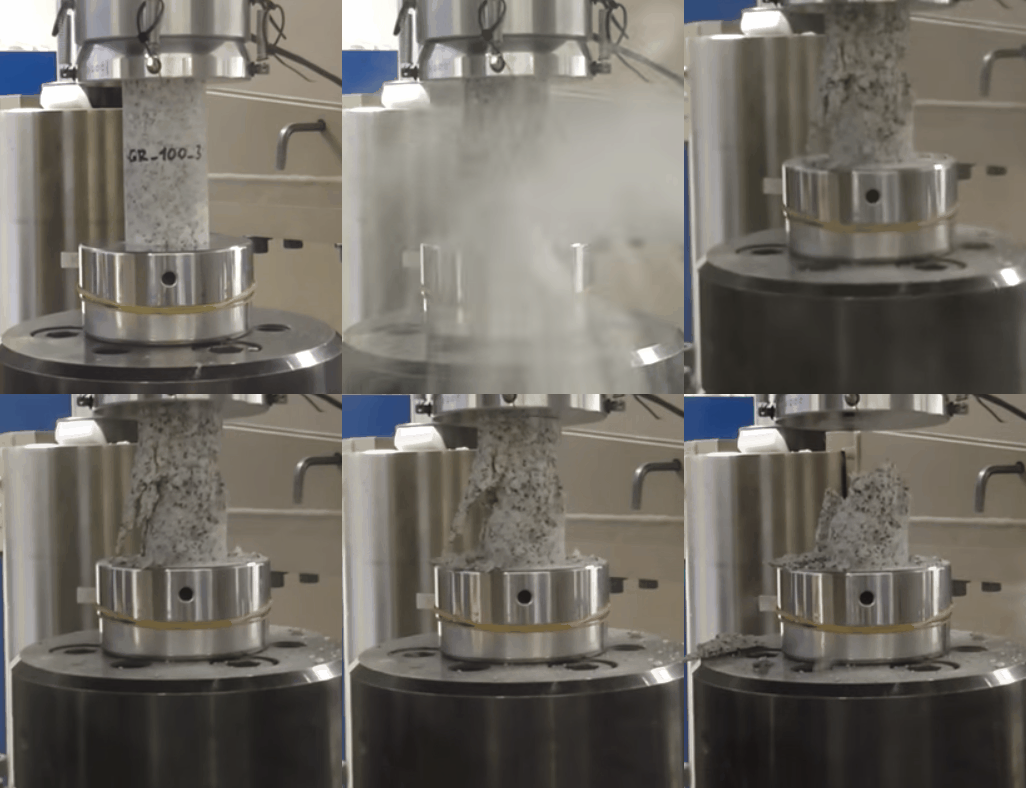
Don’t believe me? Even rock has a maximum amount of strength. Here is a GIF of what happens to solid rock when you put enough pressure on it! 🙂
Source: Unconfined compressive strength test of rock
Thus, if the weight of mountain > yield strength of the base rock then the mountain’s base will crumble.
Then he mountain will compress down to the maximum allowable height.
Of course, when this happens depends on what the mountain is made of. SiO2 is the most common molecule. But there are many minerals that are lighter, or stronger, or both, that can also be found in a mountain.
By the way, this gives us a neat relation – the surface gravity X maximum height of a mountain should be a constant.
Formula lets us relate height of Mt Everest on earth and Olympus Mons on Mars. Or find max deformation of asteroid before gravity pulls it into a sphere.
All the other downward forces on a mountain
Erosion wears the mountain down
How well does the mountain resist weathering/erosion? This depends on what kind of chemicals it is made out of.
Does being in the ocean affect how high a mountain can be?
Consider Mauna Kea, in Hawaii.
Much of Mauna Kea is underwater. It’s base can support more pressure since it’s underwater. Underwater, there is a buoyant force on the object that counteracts the force of gravity. Since nothing counteracts the gravity on Mount Everest, the mountain’s base can only support so much pressure.
What else makes mountains rise or grow?
Even while a mountain is eroding, the underlying plate activity may be forcing the mountain to grow higher.
A tectonic plate pushing more directly against another plate will create higher mountains than a plate moving less directly (say, at an angle) against another plate.
How strong are the crustal roots of the mountain?
As a mountain range grows in height, this root grows in depth, and thus the pressure and temperature experienced by the bottom of this root increases.
At a certain point, rocks in the base of this crustal root metamorphose into a rock called eclogite. At that point this rock will be denser than the material supporting the crustal root.
This causes delamination to occur. Depending on the amount of material removed, the rate of new material added, and erosion, scenarios with net increases or decreases in elevation are possible after a delamination event. This sets another limit on how thick a crustal root can get (and thus how high a mountain range grow on the long term).
Why are there some special spots on Earth where mountains can grow twice as high?
George W Hatcher writes
Mauna Kea rests on oceanic crust, which is denser than continental crust and able to support more weight without displacement. Being mostly inundated with seawater precludes some of the erosional processes to which mountains exposed to the upper atmosphere are subjected.
In addition, the very material of which Mauna Kea is composed (basaltic igneous rocks) is stronger than the variety of rocks that make up the continental crust and uplifted limestone seafloor that can be found atop Everest.
The actual lithospheric limit to mountain height averages about half the height of Everest, which is why Fourteeners are so famous in Colorado. Mountains that exceed this limit have local geologic circumstances that make their height possible, e.g. stronger or denser rocks.
In the case of Everest and the Himalayas, you have a geologic situation that is very rare in Earth history. The Indian plate is ramming into the Eurasian plate with such force that instead of just wrinkling the crust on either side into mountain ranges it has actually succeeded in lifting the Eurasian plate up on top.
So the Himalayas have double the thickness of the average continental plate, thus double the mountain height that would be considered “normal”.
George W Hatcher, Planetary Scientist, Aerospace Engineer
References
How high can a mountain possibly get? Earth Science StackExchange
How High can a mountain get? 2 Earth Science Stack Exchange
How tall can a mountain become on Earth? Quora
What is the theoretical limit to how tall mountains can get on Earth? Reddit
Glacial Buzz Saw Hypothesis: New Scientist article
Examples with math details
Why are some moons spherical while others are shaped like potatoes? Quarks & Coffee
How High Can Mountains Be? Talking Physics
How High Could A Mountain Be? Physics World hk-phy.org
How tall can I make a column of stone? Rhett Allain, Wired magazine columnist
Related lab ideas
Play Doh Modeling Folds: Block Diagrams and Structure Contours
Play-Doh Modeling Folds: Block Diagrams and Structure Contours
 KaiserScience