
Home » Physics (Page 7)
Category Archives: Physics

Two and three dimensional motion
Most high school physics courses don’t include algebraic analysis of two or three dimensional kinematics and momentum. But these clearly are of great importance.
In a regular, college prep physics high school setting, I can’t imagine skipping 2D physics! Even if we don’t do 2D kinematic equations, we need to cover 2D vectors, and show examples of parabolic motion, and vector components.
What is a vector, and what are vector components?
and
What are projectiles?
Even if we are not doing the math, I want them to see examples of conservation of momentum in two dimensions, like this:
Cars in two dimensional collisions

image from physicsclassroom
These seem like great apps for teaching 2D kinematics without all of the detailed calculations.
vectors and projectiles
We won’t be able to do three dimensional collision or momentum problem solving, but we can at least introduce the idea of it, and show them why almost every collision and conservation of momentum in the real world is 3D:
First students need to be introduced to the idea that there are more than just two axes (X and Y,) there is a third dimension, Z!

Then we see how we can plot points in three dimensions. This is the GeoGebra app
Now we realize that the size and motion of any object can be plotted in three dimensions.
The physics of dogs and cats colliding GIF

Two galaxies colliding, and the resulting amazing display
Galaxies colliding GIF
Galaxies colliding GIF
A practical use of 2D kinematics and conservation of momentum: forensic accident reconstruction.

Boyle’s law (gas laws)
A general relationship between pressure and volume: Boyle’s Law
As the pressure on a gas increases, the volume of the gas decreases because the gas particles are forced closer together.
Conversely, as the pressure on a gas decreases, the gas volume increases because the gas particles can now move farther apart.
Example: Weather balloons get larger as they rise through the atmosphere to regions of lower pressure because the volume of the gas has increased; that is, the atmospheric gas exerts less pressure on the surface of the balloon, so the interior gas expands until the internal and external pressures are equal.
from Libretexts, Chemistry, 5.3: The Simple Gas Laws: Boyle’s Law, Charles’s Law and Avogadro’s Law, CC BY-NC-SA 3.0.
This means that, at constant temperature, the pressure (P) of a gas is inversely proportional to the volume (V).
PV = c
Important! This is not a law of physics! Rather, this is a generally useful rule, which is only valid when gas temperature and pressure is low enough for the atoms to usually be far apart from each other. As we begin to deal with more extreme cases, this rule doesn’t hold up.
Let’s see the relationship in action, here:

from http://www.grc.nasa.gov/WWW/K-12/airplane/boyle.html
How was this general rule discovered?
Early scientists explored the relationships among the pressure of a gas (P) and its temperature (T), volume (V), and amount (n) by holding two of the four variables constant (amount and temperature, for example), varying a third (such as pressure), and measuring the effect of the change on the fourth (in this case, volume).
The history of their discoveries provides several excellent examples of the scientific method.
The Irish chemist Robert Boyle (1627–1691) carried out some of the earliest experiments that determined the quantitative relationship between the pressure and the volume of a gas. Boyle used a J-shaped tube partially filled with mercury.
In these experiments, a small amount of a gas or air is trapped above the mercury column, and its volume is measured at atmospheric pressure and constant temperature. More mercury is then poured into the open arm to increase the pressure on the gas sample.
The pressure on the gas is atmospheric pressure plus the difference in the heights of the mercury columns, and the resulting volume is measured. This process is repeated until either there is no more room in the open arm or the volume of the gas is too small to be measured accurately.

Details: Boyle’s Experiment Using a J-Shaped Tube to Determine the Relationship between Gas Pressure and Volume.
(a) Initially the gas is at a pressure of 1 atm = 760 mmHg (the mercury is at the same height in both the arm containing the sample and the arm open to the atmosphere); its volume is V.
(b) If enough mercury is added to the right side to give a difference in height of 760 mmHg between the two arms, the pressure of the gas is 760 mmHg (atmospheric pressure) + 760 mmHg = 1520 mmHg and the volume is V/2.
(c) If an additional 760 mmHg is added to the column on the right, the total pressure on the gas increases to 2280 mmHg, and the volume of the gas decreases to V/3
(This section from from Libretexts, Chemistry, 5.3: The Simple Gas Laws: Boyle’s Law, Charles’s Law and Avogadro’s Law, CC BY-NC-SA 3.0)
Learning standards
Massachusetts Science and Technology/Engineering Curriculum Framework
8.MS-PS1-4. Develop a model that describes and predicts changes in particle motion, relative spatial arrangement, temperature, and state of a pure substance when thermal energy is added or removed.
Next Generation Science Standards
MS-PS1-4. Develop a model that predicts and describes changes in particle motion, temperature, and state of a pure substance when thermal energy is added or removed.
College Board Standards
Objective C.1.5 States of Matter
C-PE.1.5.2 Explain why gases expand to fill a container of any size, while liquids flow and spread out to fill the bottom of a container and solids hold their own shape. Justification includes a discussion of particle motion and the attractions between the particles.
C-PE.1.5.3 Investigate the behavior of gases. Investigation is performed in terms of volume (V ), pressure (P ), temperature (T ) and amount of gas (n) by using the ideal gas law both conceptually and mathematically.
Common Core Math
Analyze proportional relationships and use them to solve real-world and mathematical problems.
CCSS.MATH.CONTENT.7.RP.A.2
Recognize and represent proportional relationships between quantities.
CCSS.MATH.CONTENT.7.RP.A.2.A
Decide whether two quantities are in a proportional relationship, e.g., by testing for equivalent ratios in a table or graphing on a coordinate plane and observing whether the graph is a straight line through the origin.
CCSS.MATH.CONTENT.7.RP.A.2.B
Identify the constant of proportionality (unit rate) in tables, graphs, equations, diagrams, and verbal descriptions of proportional relationships.

Buoyancy of balloons in Up
Up is a 2009 American computer-animated comedy-drama film produced by Pixar Animation Studios and released by Walt Disney Pictures.
In this movie, the hero releases many, many helium filled balloons out of the house. Could that actually be enough to make a house float?

In Physics and the movie UP – floating a house, 6/3/2009, Wired Magazine, Rhett Allain writes:
…The first time I saw this trailer I thought the balloons were stored in his house. After re-watching in slow motion, it seems the balloons were maybe in the back yard held down by some large tarps. … [but] what if he had the balloons in his house and then released them? Would that make the house float more? Here is a diagram:
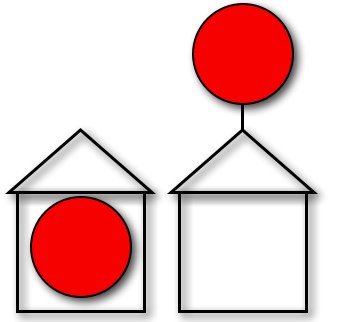
There is a buoyancy force when objects displace air or a fluid. This buoyancy force can be calculated with Archimedes’ principle which states: The buoyancy force is equal to the weight of the fluid displaced.
The easiest way to make sense of this is to think of some water floating in water. Of course water floats in water. For floating water, it’s weight has to be equal to it’s buoyant force. Now replace the floating water with a brick or something. The water outside the brick will have the exact same interactions that they did with the floating water. So the brick will have a buoyancy force equal to the weight of the water displaced. For a normal brick, this will not be enough to make it float, but there will still be a buoyant force on it.
What is being displaced? What is the mass of the object. It really is not as clear in this case. What is clear is the thing that is providing the buoyancy is the air. So, the buoyancy force is equal to the weight of the air displaced.
What is displacing air? In this case, it is mostly the house, all the stuff in the house, the balloons and the helium in the balloons.
In the two cases above, the volume of the air displaced does not change. This is because the balloons are in the air in the house. (Remember, I already said that I see that this NOT how it was shown in the movie).
So, if you (somehow) had enough balloons to make your house fly and you put them IN your house, your house would float before you let them outside.
Why doesn’t the balloon house keep rising? The reason the balloon reaches a certain height is that the buoyant force is not constant with altitude.
As the balloon rises, the density of the air decreases. This has the effect of a lower buoyant force.
At some point, the buoyant force and the weight are equal and the balloon no longer changes in altitude.
http://scienceblogs.com/dotphysics/2009/06/03/physics-and-the-movie-up-floating-a-house/
1
https://en.wikipedia.org/wiki/Larry_Walters
1
1
1
1
Mythbusters : Lets talk buoyancy – Pirates of the Carribean
Adam and Jamie explore the possibility of raising a ship with ping-pong balls, originally conceived in the 1949 Donald Duck story The Sunken Yacht by Carl Barks.
MythBusters S02E13 Pingpong Rescue, 2004
Doing the math of MythBusters – Warning: Science content
More on the movie Up! (or Upper)
Rhett Allain on June 9, 2009
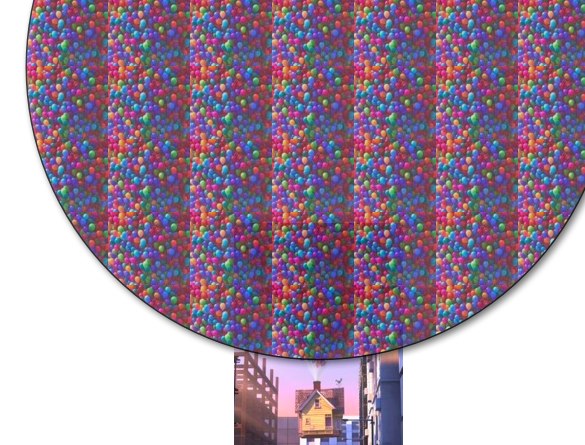
If the house were lifted by standard party balloons, what would it look like? The thing with party balloons is that they are not packed tightly, there is space between them. This makes it look like it takes up much more space. Let me just use Slate’s calculation of 9.4 million party balloons….
Pixar said they used 20,600 balloons in the lift off sequence. From that and the picture I used above and the same pixel size trick, the volume of balloons is about the same as a sphere of radius 14 meters. This would make a volume of 12,000 m3…
And then this would lead to an apparent volume of the giant cluster of 9.4 million balloons:
If this were a spherical cluster, the radius would be 110 meters. Here is what that would look like:
How long would it take this guy to blow up this many balloons? You can see that there is no point stopping now. I have gone this far, why would I stop? That would be silly.
The first thing to answer this question is, how long does it take to fill one balloon. I am no expert, I will estimate low. 10 seconds seems to be WAY too quick.
But look, the guy is filling 9.4 million balloons, you might learn a few tricks to speed up the process. If that were the case, it would take 94 million seconds or 3 years….
What if it was just 20,600 balloons like Pixar used in the animation? At 10 seconds a balloon, that would be 2.3 days (and I think that is a pretty fast time for a balloon fill). Remember that MythBusters episode where they filled balloons to lift a small boy? Took a while, didn’t it?
How many tanks of helium would he need? According this site, a large helium cylinder can fill 520 of the 11″ party balloons and costs about $190. If he had to fill 9.4 million balloons, this would take (9.4 million balloons)(1 tank)/(520 balloons)= 18,000 tanks at a cost of 3.4 million dollars.
http://scienceblogs.com/dotphysics/2009/06/09/more-on-the-movie-up-or-upper/
Backup The Particle Physics of You
This is a class backup of the article, The particle physics of you, 11/03/15 By Ali Sundermier. Symmetry Magazine.
Not only are we made of fundamental particles, we also produce them and are constantly bombarded by them throughout the day.
https://www.symmetrymagazine.org/article/the-particle-physics-of-you
Fourteen billion years ago, when the hot, dense speck that was our universe quickly expanded, all of the matter and antimatter that existed should have annihilated and left us nothing but energy. And yet, a small amount of matter survived.
We ended up with a world filled with particles. And not just any particles—particles whose masses and charges were just precise enough to allow human life. Here are a few facts about the particle physics of you that will get your electrons jumping.

The particles we’re made of
About 99 percent of your body is made up of atoms of hydrogen, carbon, nitrogen and oxygen. You also contain much smaller amounts of the other elements that are essential for life.
While most of the cells in your body regenerate every seven to 15 years, many of the particles that make up those cells have actually existed for millions of millennia. The hydrogen atoms in you were produced in the big bang, and the carbon, nitrogen and oxygen atoms were made in burning stars. The very heavy elements in you were made in exploding stars.
The size of an atom is governed by the average location of its electrons. Nuclei are around 100,000 times smaller than the atoms they’re housed in. If the nucleus were the size of a peanut, the atom would be about the size of a baseball stadium. If we lost all the dead space inside our atoms, we would each be able to fit into a particle of lead dust, and the entire human race would fit into the volume of a sugar cube.
As you might guess, these spaced-out particles make up only a tiny portion of your mass. The protons and neutrons inside of an atom’s nucleus are each made up of three quarks. The mass of the quarks, which comes from their interaction with the Higgs field, accounts for just a few percent of the mass of a proton or neutron. Gluons, carriers of the strong nuclear force that holds these quarks together, are completely massless.
If your mass doesn’t come from the masses of these particles, where does it come from? Energy. Scientists believe that almost all of your body’s mass comes from the kinetic energy of the quarks and the binding energy of the gluons.

The particles we make
Your body is a small-scale mine of radioactive particles. You receive an annual 40-millirem dose from the natural radioactivity originating inside of you. That’s the same amount of radiation you’d be exposed to from having four chest X-rays.
Your radiation dose level can go up by one or two millirem for every eight hours you spend sleeping next to your similarly radioactive loved one.
You emit radiation because many of the foods you eat, the beverages you drink and even the air you breathe contain radionuclides such as Potassium-40 and Carbon-14. They are incorporated into your molecules and eventually decay and produce radiation in your body.
When Potassium-40 decays, it releases a positron, the electron’s antimatter twin, so you also contain a small amount of antimatter.
The average human produces more than 4000 positrons per day, about 180 per hour. But it’s not long before these positrons bump into your electrons and annihilate into radiation in the form of gamma rays.

The particles we meet
The radioactivity born inside your body is only a fraction of the radiation you naturally (and harmlessly) come in contact with on an everyday basis. The average American receives a radiation dose of about 620 millirem every year. The food you eat, the house you live in and the rocks and soil you walk on all expose you to low levels of radioactivity. Just eating a Brazil nut or going to the dentist can up your radiation dose level by a few millirem. Smoking cigarettes can increase it up to 16,000 millirem.
Cosmic rays, high-energy radiation from outer space, constantly smack into our atmosphere. There, they collide with other nuclei and produce mesons, many of which decay into particles such as muons and neutrinos. All of these shower down on the surface of the Earth and pass through you at a rate of about 10 per second. They add about 27 millirem to your yearly dose of radiation. These cosmic particles can sometimes disrupt our genetics, causing subtle mutations, and may be a contributing factor in evolution.
In addition to bombarding us with photons that dictate the way we see the world around us, our sun also releases an onslaught of particles called neutrinos. Neutrinos are constant visitors in your body, zipping through at a rate of nearly 100 trillion every second. Aside from the sun, neutrinos stream out from other sources, including nuclear reactions in other stars and on our own planet.
Many neutrinos have been around since the first few seconds of the early universe, outdating even your own atoms. But these particles are so weakly interacting that they pass right through you, leaving no sign of their visit.
You are also likely facing a constant shower of particles of dark matter. Dark matter doesn’t emit, reflect or absorb light, making it quite hard to detect, yet scientists think it makes up about 80 percent of the matter in the universe.
Looking at the density of dark matter throughout the universe, scientists calculate that hundreds of thousands of these particles might be passing through you every second, colliding with your atoms about once a minute. But dark matter doesn’t interact very strongly with the matter you’re made of, so they are unlikely to have any noticeable effects on your body.
The next time you’re wondering how particle physics applies to your life, just take a look inside yourself.
Artwork by Sandbox Studio, Chicago with Ana Kova.
_________________________
This website is educational. Materials within it are being used in accord with the Fair Use doctrine, as defined by United States law.
§107. Limitations on Exclusive Rights: Fair Use. Notwithstanding the provisions of section 106, the fair use of a copyrighted work, including such use by reproduction in copies or phone records or by any other means specified by that section, for purposes such as criticism, comment, news reporting, teaching (including multiple copies for classroom use), scholarship, or research, is not an infringement of copyright. In determining whether the use made of a work in any particular case is a fair use, the factors to be considered shall include: the purpose and character of the use, including whether such use is of a commercial nature or is for nonprofit educational purposes; the nature of the copyrighted work; the amount and substantiality of the portion used in relation to the copyrighted work as a whole; and the effect of the use upon the potential market for or value of the copyrighted work. (added pub. l 94-553, Title I, 101, Oct 19, 1976, 90 Stat 2546)
Backup: Get to know Maxwell’s Equations
This is a backup of an article on Wired,’Get to know Maxwell’s Equations – You’re Using Them Right Now,” by Rhett Allain , 8/6/19
Maxwell’s equations are sort of a big deal in physics. They’re how we can model an electromagnetic wave—also known as light. Oh, it’s also how most electric generators work and even electric motors. Essentially, you are using Maxwell’s equations right now, even if you don’t know it. Why are they called “Maxwell’s equations”? That’s after James Clark Maxwell. He was the 19th-century scientist who sort of put them together, even though many others contributed.
There are four of these equations, and I’ll go over each one and give a conceptual explanation. Don’t worry, you won’t need to refresh your calculus skills. If you do want to follow the math, let me point out that there are two different ways to write these equations, either as integrals or as spatial derivatives. I’ll give both versions—but again, if the math looks uninviting, just ignore it.

The short version is that Gauss’ law describes the electric field pattern due to electric charges. What is a field? I like this description – “It’s an energy field created by all living things. It surrounds us, penetrates us, and binds the galaxy together.”
Oh wait. That was Obi Wan’s description of the Force in Star Wars Episode IV. But it’s not a terrible description of an electric field. Here is another definition (by me):
If you take two electric charges, there is an interaction force between them. The electric field is the force per unit charge on one of those charges. So, it’s sort of like a region that describes how an electric charge would feel a force. But is it even real? Well, a field can have both energy and momentum—so it’s at least as real as those things.
Don’t worry about the actual equation. It’s sort of complicated, and I just want to get to the idea behind it. (If you have seen this physics equation before, you might think I am going to go into electric flux, but let’s see if I can do this with “no flux given.”) So let’s just say that Gauss’ law says that electric fields point away from positive charges and towards negative charges. We can call this a Coulomb field (named after Charles-Augustin de Coulomb).

Everyone knows that positive charges are red and negative charges are blue. Actually, I don’t know why I always make the positive red—you can’t see them anyway.
Also, you might notice that the electric field due to the negative charges looks shorter. That’s because those arrows start farther away from the charge. One of the key ideas of a Coulomb field is that the strength of the field decreases with distance from a single point charge.
But wait! Not all electric fields look like this. The electric field also follows the superposition principle. This means that the total electric field at any location is the vector sum of the electric field due to whatever point charges are nearby. This means you can make cool fields like the one below, which are the result of two equal and opposite charges (called a dipole).
And here’s the Python code I used to create it. https://trinket.io/glowscript/18196b0cf1

This dipole field is going to be important for the next equation.

Yes, this looks very similar to the other Gauss’ law. But why isn’t the previous equation called “Gauss’ law for electricism”? First, that’s because “electricism” isn’t a real word (yet). Second, the other Gauss’ law came first, so it gets the simple name. It’s like that time in third grade when a class had a student named John. Then another John joined the class and everyone called him John 2. It’s not fair—but that’s just how things go sometimes.
OK, the first thing about this equation is the B. We use this to represent the magnetic field. But you will notice that the other side of the equation is zero. The reason for this is the lack of magnetic monopoles. Take a look at this picture of iron filings around a bar magnet (surely you have seen something like this before).
This looks very similar to the electric field due to a dipole (except for the clumps of filings because I can’t spread them out). It looks similar because it is mathematically the same. The magnetic field due to a bar magnet looks like the electric field due to a dipole. But can I get a single magnetic “charge” by itself and get something that looks like the electric field due to a point charge? Nope.

Here’s what happens when you break a magnet in half. Yes, I cheated. The picture above shows two bar magnets. But trust me—if you break a magnet into two pieces, it will look like this.

It’s still a dipole. You can’t get a magnetic field to look like the electric field due to a point charge because there are no individual magnetic charges (called a magnetic monopole). That’s basically what Gauss’ law for magnetism says—that there’s no such thing as a magnetic monopole. OK, I should be clear here. We have never seen a magnetic monopole. They might exist.
Faraday’s law

The super-short version of this equation is that there is another way to make an electric field. It’s not just electric charges that make electric fields. In fact, you can also make an electric field with a changing magnetic field. This is a HUGE idea as it makes a connection between electric and magnetic fields.
Let me start with a classic demonstration. Here is a magnet, a coil of wire, and a galvanometer (it basically measures tiny electric currents). When I move the magnet in or out of the coil, I get a current.
If you just hold the magnet in the coil, there is no current. It has to be a changing magnetic field. Oh, but where is the electric field? Well, the way to make an electric current is to have an electric field in the direction of the wire. This electric field inside the wire pushes electric charges to create the current.
But there is something different about this electric field. Instead of pointing away from positive charges and pointing towards negative charges, the field pattern just makes circles. I will use the name “curly electric field” for a case like this (I adopted the term from my favorite physics textbook authors). With that, we can call the electric field made from charges a “Coulomb field” (because of Coulomb’s law).
Here is a rough diagram showing the relationship between the changing magnetic field and an induced curly electric field.

Note that I am showing the direction of the magnetic field inside of that circle, but it’s really the direction of the change in magnetic field that matters.
AMPERE-MAXWELL LAW

Do you see the similarity? This equation sort of looks like Faraday’s law, right? Well, it replaces E with B and it adds in an extra term. The basic idea here is that this equation tells us the two ways to make a magnetic field. The first way is with an electric current.
Here is a super-quick demo. I have a magnetic compass with a wire over it. When an electric current flows, it creates a magnetic field that moves the compass needle.
It’s difficult to see from this demo, but the shape of this magnetic field is a curly field. You can sort of see this if I put some iron filings on paper with an electric current running through it.

Maybe you can see the shape of this field a little better with this output from a numerical calculation. This shows a small part of a wire with electric current and the resulting magnetic field.

Actually, that image might seem complicated to create but it’s really not too terribly difficult. Here is a tutorial on using Python to calculate the magnetic field. There is another way to create a curly magnetic field—with a changing electric field. Yes, it’s the same way a changing magnetic field creates a curly electric field. Here’s what it would look like.

Notice that I even changed the vector colors to match the previous curly field picture—that’s because I care about the details. But let me just summarize the coolest part. Changing electric fields make curly magnetic fields. Changing magnetic fields make curly electric fields. AWESOME.
What About Light?
The most common topic linked to Maxwell’s Equations is that of an electromagnetic wave. How does that work? Suppose you have a region of space with nothing but an electric field and magnetic field. There are no electric charges and there isn’t an electric current. Let’s say it looks like this.

Let me explain what’s going on here. There is an electric field pointing INTO your computer screen (yes, it’s tough dealing with three dimensions with a 2D screen) and a magnetic field pointing down. This region with a field is moving to the right with some velocity v.
What about that box? That’s just an outline of some region. But here’s the deal. As the electric field moves into that box, there is a changing field that can make a magnetic field. If you draw another box perpendicular to that, you can see that there will be a changing magnetic field that can make a magnetic field. In fact, if this region of space moves at the speed of light (3 x 10⁸ m/s), then the changing magnetic field can make a changing electric field. These fields can support each other without any charges or currents. This is an electromagnetic pulse.
An electromagnetic wave is an oscillating electric field that creates an oscillating magnetic field that creates an oscillating electric field. Most waves need some type of medium to move through. A sound wave needs air (or some other material), a wave in the ocean needs water. An EM wave does not need this. It is its own medium. It can travel through empty space—which is nice, so that we can get light from the sun here on Earth.
_________________________
This website is educational. Materials within it are being used in accord with the Fair Use doctrine, as defined by United States law.
§107. Limitations on Exclusive Rights: Fair Use. Notwithstanding the provisions of section 106, the fair use of a copyrighted work, including such use by reproduction in copies or phone records or by any other means specified by that section, for purposes such as criticism, comment, news reporting, teaching (including multiple copies for classroom use), scholarship, or research, is not an infringement of copyright. In determining whether the use made of a work in any particular case is a fair use, the factors to be considered shall include: the purpose and character of the use, including whether such use is of a commercial nature or is for nonprofit educational purposes; the nature of the copyrighted work; the amount and substantiality of the portion used in relation to the copyrighted work as a whole; and the effect of the use upon the potential market for or value of the copyrighted work. (added pub. l 94-553, Title I, 101, Oct 19, 1976, 90 Stat 2546)

Tidal power
Content objective:
What are we learning? Why are we learning this?
content, procedures, skills
Vocabulary objective
Tier II: High frequency words used across content areas. Key to understanding directions, understanding relationships, and for making inferences.
Tier III: Low frequency, domain specific terms
Building on what we already know
What vocabulary & concepts were learned in earlier grades?
Make connections to prior lessons.
Ocean tides are caused by tidal forces.
What are “tides”?
Types of tidal power
Tidal barrages may be the most efficient way to capture energy from the tides.
Here, a dam utilizes the potential energy generated by the change in height between high and low tides.
In this example, the motion of the water spins a propeller.

image from technologystudent.com/images5/tidal1.gif
The spinning propeller spins an axle, which transmits the motion up to the generator.
Inside the generator, this motion is used to rotate wires inside a magnet (or vice-versa)

The wire feels the magnetic field changing;
this produces an electrical current inside the wires.

Thus we have converted the energy of moving water into electrical energy.
Tidal fences
Turbines that operate like giant turnstiles.
The spinning turnstiles spins an axle, which transmits the motion up to the generator.
Inside the generator, this motion is used to rotate wires inside a magnet (or vice-versa) as shown above.

Tidal turbines
Similar to wind turbines but these are underwater.
The mechanical energy of tidal currents is used to turn turbines.
These are connected to a generator that produces electricity

Other possible designs
Many other designs are possible, for instance:
Fluid Pumping Apparatuses Powered By Waves Or Flowing Currents
Great animations
Many types of tidal energy convertors (European Marine Energy Centre)
Advantages of tidal power
Environmentally friendly
Relatively small amount of space
Ocean currents generate relatively more energy than air currents. Why? Because ocean water is 832 times more dense than air. It therefore applies greater force on the turbines.
Disadvantages of tidal power
High construction costs
The amount of energy produced is not constant per hour, or even per week.
It requires a suitable site, where tidal streams are consistently strong.
The equipment must be capable of withstanding strong tides and storms.
It can be expensive to maintain and repair.
Related topics
Why Is There a Tidal Bulge Opposite the Moon?
The Discovery of Global Warming
The idea that manmade caused global warming could occur isn’t new. Most people don’t know this, but this was first understood as far back as the late 1800s! This is because it is basic physics: adding more greenhouses gases into an atmosphere increases the amount of heat that it will hold.

Dr. Spencer Weart is a historian specializing in the history of modern physics and geophysics. Until his retirement in 2009 he was Director of the Center for History of Physics of the American Institute of Physics (AIP) in College Park, Maryland, USA, and he continues to be affiliated with the Center.
Spencer Weart writes in the summary overview to his book:
In 1896 the Swedish scientist Svante Arrhenius published a new idea. By burning fossil fuels such as coal, thus adding CO2 to Earth’s atmosphere, humanity would raise the planet’s average temperature. This “greenhouse effect,” as it later came to be called, was only one of many speculations about climate change, and not the most plausible.
The few scientists who paid attention to Arrhenius used clumsy experiments and rough approximations to argue that our emissions could not change the planet. Most people thought it was already obvious that puny humanity could never affect the vast global climate cycles, which were governed by a benign “balance of nature.”
In the 1930s, measurements showed that the United States and North Atlantic region had warmed significantly during the previous half-century. Scientists supposed this was just a phase of some mild natural cycle, probably regional, with unknown causes. Only one lone voice, the English steam engineer and amateur scientist Guy Stewart Callendar, published arguments that greenhouse warming was underway. If so, he and most others thought it would be beneficial.
In the 1950s, Callendar’s claims provoked a few scientists to look into the question with far better techniques and calculations than earlier generations could have deployed. This research was made possible by a sharp increase of government funding, especially from military agencies that wanted to know more about the weather and geophysics in general.
Not only might such knowledge be crucial in future battles, but scientific progress could bring a nation prestige in the Cold War competition. The new studies showed that, contrary to earlier crude assumptions, CO2 might indeed build up in the atmosphere and bring warming. In 1960 painstaking measurements of the level of the gas in the atmosphere by Charles Keeling, a young scientist with an obsession for accuracy, drove home the point. The level was in fact rising year by year.
(This essay covers only developments relating directly to carbon dioxide, with a separate essay for Other Greenhouse Gases. Theories are discussed in the essay on Simple Models of Climate.)
The Discovery of Global Warming: A hypertext history of how scientists came to (partly) understand what people are doing to cause climate change.
Books
The Discovery of Global Warming: Revised and Expanded Edition, by Spencer R. Weart, Harvard University Press, 2008
________________________________________
This website is educational. Materials within it are being used in accord with the Fair Use doctrine, as defined by United States law.
§107. Limitations on Exclusive Rights: Fair Use. Notwithstanding the provisions of section 106, the fair use of a copyrighted work, including such use by reproduction in copies or phone records or by any other means specified by that section, for purposes such as criticism, comment, news reporting, teaching (including multiple copies for classroom use), scholarship, or research, is not an infringement of copyright. In determining whether the use made of a work in any particular case is a fair use, the factors to be considered shall include: the purpose and character of the use, including whether such use is of a commercial nature or is for nonprofit educational purposes; the nature of the copyrighted work; the amount and substantiality of the portion used in relation to the copyrighted work as a whole; and the effect of the use upon the potential market for or value of the copyrighted work. (added pub. l 94-553, Title I, 101, Oct 19, 1976, 90 Stat 2546)

Astronomical engineering: a strategy for modifying planetary orbits
In a world of high-stakes testing and test-driven curriculums, we teachers need to make time for exploration and inspiration. In the past, did students fall in love with physics due to standardized tests? Of course not. They became interested in becoming a physicist due to great experience, like reading a great science fiction story, or having a science teacher discuss such stories in class, Such conversations about the big ideas can catch one’s imagination.
As such, I encourage physics teachers to go beyond the standards, and do what the classic teachers of past generations did: make room for wonder!
How’s this for an idea for a science-fiction story?
The sun has unexpectedly started to swell into a red giant – which would engulf and destroy the Earth. So, “to save humanity, the world’s governments have banded together and constructed thousands of rocket engines across the Earth’s surface. Once installed, they propel the planet out of its solar system and onto a 2,500 year journey to resettle in Alpha Centauri.” (Grant Watson.)
The Wandering Earth (Chinese: 流浪地球) is a 2019 Chinese science fiction film directed by Frant Gwo, loosely based on the novella of the same name by author Liu Cixin. Here’s an image of one of the many “Earth Engines.”

Our question – Could this be done in real life?
What science in the film did they get wrong?
Helium flash – brief thermal runaway nuclear fusion of large quantities of helium in the core of low mass stars during their red giant phase
Thrusting the Earth out of orbit with rockets: consider, how much reaction mass would we need to do this?
Even if you could build engines large enough, mining the Earth (as these engines do in the film) causes a problem. There would barely be any Earth left by the point you mined enough dirt to thrust the planet to Proxima Centauri, 4.2 light-years away. “It would take about 95 percent of the mass of Earth to do this,” Elliott estimates.
Stopping the rotation of the Earth?
Gravitational slingshot around Jupiter
Surviving the radiation around Jupiter
External links
Could ‘The Wandering Earth’ Actually Happen? Here’s What a NASA Engineer Says
Wandering Earth: Rocket scientist explains how we could move our planet. ARS Technia
Other options
We could eventually move human civilization to Mars, which become habitable.
Could we actually change Earth’s orbit?
G. Korycansky, Gregory Laughlin, and Fred C. Adams write
The Sun’s gradual brightening will seriously compromise the Earth’s biosphere within ~ 1E9 years. If Earth’s orbit migrates outward, however, the biosphere could remain intact over the entire main-sequence lifetime of the Sun.
In this paper, we explore the feasibility of engineering such a migration over a long time period. The basic mechanism uses gravitational assists to (in effect) transfer orbital energy from Jupiter to the Earth, and thereby enlarges the orbital radius of Earth.
This transfer is accomplished by a suitable intermediate body, either a Kuiper Belt object or a main belt asteroid. The object first encounters Earth during an inward pass on its initial highly elliptical orbit of large (~ 300 AU) semimajor axis.
The encounter transfers energy from the object to the Earth in standard gravity-assist fashion by passing close to the leading limb of the planet. The resulting outbound trajectory of the object must cross the orbit of Jupiter; with proper timing, the outbound object encounters Jupiter and picks up the energy it lost to Earth.
With small corrections to the trajectory, or additional planetary encounters (e.g., with Saturn), the object can repeat this process over many encounters. To maintain its present flux of solar energy, the Earth must experience roughly one encounter every 6000 years (for an object mass of 1E22 g). We develop the details of this scheme and discuss its ramifications.
Astrophys.Space Sci.275:349-366, 2001. Astronomical Engineering: A Strategy For Modifying Planetary Orbits
Cite as: arXiv:astro-ph/0102126 (or arXiv:astro-ph/0102126v1 for this version)
Astronomical engineering: a strategy for modifying planetary orbits
D. G. Korycansky, Gregory Laughlin, Fred C. Adams (7 Feb 2001)
Moving our sun and entire solar system
Could a species conceivably move an entire solar system? In principle, physics does seem to allow this as a possibility. Although, we must stress, the engineering required to do this is far beyond anything we can imagine for the near term future, and even if possible it would take huge amounts of time to actually move our solar system.
The Caplan thruster was conceived of by Matthew Caplan from Illinois State University.
These images are from How to Move the Sun: Stellar Engines by Kurzgesagt – In a Nutshell.

and

from Scientist figures out how to move our sun to avoid space collisions, BigThink
Stellar engines: Design considerations for maximizing acceleration, Acta Astronautica, 12/2019
Paul Ratner writes
Caplan envisions two stellar engine designs, with one of them based on the idea of encapsulating the sun in a megastructure that would take advantage of its energy. Another engine would make use of a giant sail to move the solar system by about 50 light years during the course of a million years….
One big reason would be to move the solar system if we’re anticipating running into a mega-explosion from a supernova or some such cataclysmic scenario. Of course, we’d need to be way more ahead technologically for any such endeavor.
If you were to be moving the solar system, the convenient thing is that theoretically everything inside it would move along at the same time. Being pulled by the sun’s gravity would keep the contents of the system in consistent orbit.
One of the stellar engine designs involves a thin mirror-like solar sail, like the “Shkladov thruster”. The reflective material would be thinner than a red blood cell. The sail would be positioned over the poles of the sun and would not be orbiting.
It would be important to install it in such a way that it won’t interfere with the Earth’s temperature. This would also affect the direction in which we’d be steering the solar system.
Thrust for the sail design would be created by solar radiation reflecting onto the mega-mirror. This is definitely not the fastest way to travel, with the sun being pushed along at the rate of 100 light-year in 230 million years. That’s actually not fast enough to get out of the way of a supernova explosion, admits Caplan.
What would work better is a speedier “active” thruster, called the “Caplan thruster” by Kurzgesagt, which initially approached Caplan to design such engines. It would be propelled by thermonuclear blasts of photon particles. This thruster is a modified version of the “Bussard ramjet,” conceptualized in the 1960s, which works on fusion energy.
The engine would need millions of tons of fuel per second to function, creating fusion from matter it collects in the solar wind by utilizing a giant electromagnetic field. More energy would also be gathered by a Dyson sphere megastructure, built around the sun.
Caplan imagines the engine having two jets, with one using hydrogen pointed at the sun, to prevent colliding with it, and another, employing helium, directed away from the star. This would cause net momentum, like from a tug boat, and move the thruster forward.
The astrophysicist calculates this type of thruster would be fast enough to escape a supernova. It could also redirect the galactic orbit of our solar system in as little as 10 million years.
The Shkadov Thruster was conceived of by Leonid M. Shkadov (1927–2003) scientist, engineer from the Central Aerohydrodynamic Institute in Russia.

Excerpted from a painting by Neil Blevans
Painting above from here.
Related articles
Gregory Benford and Larry Niven solved the problems with Shkavdov thrusters for a propulsion system for moving stars
“On the Possibility of Detecting Class A Stellar Engines Using Exoplanet Transit Curves,” Journal of the British Interplanetary Society
See this video
Learning Standards
2016 Massachusetts Science and Technology/Engineering Curriculum Framework
8.MS-ESS1-2. Explain the role of gravity in ocean tides, the orbital motions of planets, their moons, and asteroids in the solar system.
HS-PS2-4. Use mathematical representations of Newton’s law of gravitation and Coulomb’s law to both qualitatively and quantitatively describe and predict the effects of gravitational and electrostatic forces between objects.
Next Generation Science Standards
HS-PS2.B.1 ( High School Physical Sciences ): Newton’s law of universal gravitation and Coulomb’s law provide the mathematical models to describe and predict the effects of gravitational and electrostatic forces between distant objects.
Next Generation Science Standards Appendix F: Science and Engineering Practices
Ask questions that arise from careful observation of phenomena, or unexpected results, to clarify and/or seek additional information.
Ask questions that arise from examining models or a theory, to clarify and/or seek additional information and relationships.
Ask and/or evaluate questions that challenge the premise(s) of an argument, the interpretation of a data set, or the suitability of a design.
A Framework for K-12 Science Education: Practices, Crosscutting Concepts, and Core Ideas (2012)
PS2.B: TYPES OF INTERACTIONS: Gravitational, electric, and magnetic forces between a pair of objects do not require that they be in contact. These forces are explained by force fields that contain energy and can transfer energy through space. These fields can be mapped by their effect on a test object (mass, charge, or magnet, respectively). Objects with mass are sources of gravitational fields and are affected by the gravitational fields of all other objects with mass. Gravitational forces are always attractive. For two human-scale objects, these forces are too small to observe without sensitive instrumentation. Gravitational interactions are non-negligible, however, when very massive objects are involved. Thus the gravitational force due to Earth, acting on an object near Earth’s surface, pulls that object toward the planet’s center. Newton’s law of universal gravitation provides the mathematical model to describe and predict the effects of gravitational forces between distant objects.
Science teaching methods
“Pedagogy is the study of teaching methods, including the aims of education and the ways in which such goals may be achieved. The field relies heavily on educational psychology, which encompasses scientific theories of learning, and to some extent on the philosophy of education, which considers the aims and value of education from a philosophical perspective.”
~ Encyclopædia Britannica
What type of teaching works with NGSS?
No one model of pedagogy is best for every topic or every teacher. Different teachers are enthusiastic about different approaches. Experienced science teachers change the mode of instruction to match the phenomenon which they are presenting.
Philip Bell and Andrew Shouse write
People often assume that a particular instructional model is best for engaging students in the NGSS practices. In fact, there are multiple models that can be used effectively.
NGSS and the underlying NRC Framework do not say anywhere that there is only one instructional approach for engaging students in the practices. But specific curricula, instructional resources, and PD can reinforce this view by focusing on only one model at a time. There are actually multiple instructional models that can be productively used to implement the learning goals of NGSS.
Explore the practice-focused instructional models listed in the table and select one(s) that fit your situation and personal preferences.
Selecting an instructional model that fits a particular classroom should be based on local circumstances. This can involve supporting instruction that fits a teacher’s personal history, goals, or commitments. Or it can be based on what instructional model is in use in the local curriculum. The district’s or school’s instructional strategy or a professional learning community may also shape teachers’ orientation to an instructional model.
From Are there multiple instructional models that fit with the science and engineering practices in NGSS?, STEM Teaching Tools

Image by Gerd Altmann, Pixabay, Free for commercial use
Flipped classroom
The flipped classroom intentionally shifts instruction to a learner-centered model. Students take responsibility to learn the content at home, usually through video lessons prepared by the teacher or third parties, and readings from textbooks. In-class lessons include activity learning, homework problems, using manipulatives, doing labs, presentations, project-based learning, skill development, etc.
An early example of this was called Peer Instruction by Harvard Professor Eric Mazur, in the early 1990s.
Just-in-Time Teaching
There is no hard line between approaches Just-In-Time teaching may be considered halfway between traditional teaching methods and the flipped classroom.
JiTT relies on pre-class assignments completed by students before class meetings. These assignments are usually completed online. The pre-class assignments cover the material that will be introduced in the subsequent class, and should be answered based on students’ reading or other preparation. The idea is to create incentive for students to complete the assigned reading before class. At college level, teachers make the pre-class assignment due at least 1 hour before class. This allows the faculty member to review the students’ answers before class.
Apps/interactive simulations
Science apps are sometimes called Physlets, Chemlets, etc. In the past many ran on Flash or JAVA. Today they are increasingly being written to run on any browser with HTML5 standards.
Apps help make the visual and conceptual models of expert scientists accessible to students.
Example: PhET Interactive Simulations
Classroom response systems (“clickers”)
A classroom response system (sometimes called a personal response system, student response system, or audience response system) is a set of hardware and software that facilitates teaching activities such as the following.
-
A teacher poses a multiple-choice question via an overhead or computer projector.
-
Each student submits an answer to the question using a clicker.
-
Software collects the answers and produces a bar chart showing how many students chose each of the answer choices.
-
The teacher makes “on the fly” choices in response to the bar chart.
Ranking Task Exercises
Conceptual physics exercises that challenges readers to make comparative judgments about a set of variations on a particular physical situation. Exercises encourage readers to formulate their own ideas about the behavior of a physical system, correct any misconceptions they may have, and build a better conceptual foundation of physics.
Interactive Lecture Demonstrations
See Interactive Lecture Demonstrations, Active Learning in Introductory Physics, by David Sokoloff and Ronald Thornton.
Start with a scripted activity in a traditional lecture format. Because the activity causes students to confront their prior understanding of a core concept, students are ready to learn in a follow-up lecture.
Interactive Lecture Demonstrations use three steps in which students:
Predict the outcome of the demonstration. Individually, and then with a partner, students explain to each other which of a set of possible outcomes is most likely to occur.
Experience the demonstration. Working in small groups, students conduct an experiment, take a survey, or work with data to determine whether their initial beliefs were confirmed (or not).
Reflect on the outcome. Students think about why they held their initial belief and in what ways the demonstration confirmed or contradicted this belief. After comparing these thoughts with other students, students individually prepare a written product on what was learned.
https://serc.carleton.edu/introgeo/demonstrations/index.html
GIFs as step-by-step animations
Textbooks and lectures use static diagrams. For many students it is hard to visualize the scientific process being taught. GIFs help students visualize a complex process.
GIFs add to our toolbook. For instance, one can model an electric series circuit with two resistors in many ways. We can model this circuit with math, with a circuit diagram, or with a GIF. With the GIF we can see how the battery adds potential energy to the electrons in a circuit, while the electrons lose this potential energy as they go through any circuit element with resistance.
https://www.stem.org.uk/news-and-views/opinions/using-gifs-classroom
http://blog.cdnsciencepub.com/science-communicators-get-your-gif-on/
http://blogs.nottingham.ac.uk/makingsciencepublic/2014/01/24/how-to-do-things-with-gifs/
Cooperative group problem solving
Cooperative Group Problem-solving – Students work in groups using structured problem-solving strategy. In this way they can solve complex, context-rich problems which could be difficult for them to solve individually.
Students in introductory physics courses typically begin to solve a problem by plunging into the algebraic and numerical solution — they search for and manipulate equations, plugging numbers into the equations until they find a combination that yields an answer (e.g. the plug-and-chug strategy).
They seldom use their conceptual knowledge of physics to qualitatively analyze the problem situation, nor do they systematically plan a solution before they begin numerical and algebraic manipulations of equations. When they arrive at an answer, they are usually satisfied — they rarely check to see if the answer makes sense.
To help students integrate the conceptual and procedural aspects of problem solving so they could become better problem solvers, we introduced a structured, five-step problem solving strategy.
5E Model (a modelling method)
The 5E model is a constructivist science learning method created in the late 1980s by the Biological Sciences Curriculum Study (BSCS Science Learning) team. The method usually has 5 steps –
Engage, student’s interest is captured,
Explore, student constructs knowledge through facilitated questioning and observation
Explain, students are asked to explain what they have discovered. Instructor leads discussion of topic to refine the students’ understanding.
Extend (Elaborate), students asked to apply what they have learned to different situations,
Evaluate.
Tutorials in Introductory Physics
Guided-inquiry worksheets for small groups in recitation section of intro calculus-based physics. Instructors engage groups in Socratic dialogue.
RealTime Physics
A series of introductory laboratory modules that use computer data acquisition tools to help students develop physics concepts and acquire lab skills.
Modeling Instruction
Instruction organized around active student construction of conceptual and mathematical models in an interactive learning community. Students engage with simple scenarios to build, test and apply the handful of scientific models that represent the content core of physics.
Force Concept Inventory
“The FCI is a test of conceputal understanding of Newtonian mechanics, developed from the late 1980s. It consists of 30 MCQ questions with 5 answer choices for each question and tests student understanding of conceptual understanding of velocity, acceleration and force. Many distracters in the test items embody commonsense beliefs about the nature of force and its effect on motion. ”
Developed by Hestenes, Halloun, Wells, and Swackhamer (1985.) Sample question:

Problem with relying solely on modeling methods
The major issues with relying solely on modeling methods, such as 5E, is that if we really followed this methodology for all topics then it would take many years to get a student through one year of a high school science class.
After all, it took some of the world’s smartest people 2,000 years of intellectual exploration to notice and understand the scientific phenomenon that make up just a one year high school science course.
There is no hope of having most high school students do all the steps in 5E for more than a small percent of physics, chemistry, or biology phenomenon in just one year.
When in science teacher discussion communities I haven’t found many people who advocated for year-long modeling as the sole or primary way to teach. The push for these methods seems to come from massive, for-profit, textbook publishing companies. They sell various 5E and NGSS labeled curricula. Older teachers have noticed that these companies always dump their own curricula and replace it with a new one every 15 years or so.
To be clear – I am not critiquing anyone who uses modeling teaching. I just am saying that there is not enough time for students to discover every phenomenon. We also need some traditional instruction: assigning reading and lecturing.
Different types of learners?
Daniel T. Willingham writes:
Question: What does cognitive science tell us about the existence of visual, auditory, and kinesthetic learners and the best way to teach them?
The idea that people may differ in their ability to learn new material depending on its modality—that is, whether the child hears it, sees it, or touches it—has been tested for over 100 years. And the idea that these differences might prove useful in the classroom has been around for at least 40 years.
What cognitive science has taught us is that children do differ in their abilities with different modalities, but teaching the child in his best modality doesn’t affect his educational achievement. What does matter is whether the child is taught in the content’s best modality.
See more at Do Visual, Auditory, and Kinesthetic Learners Need Visual, Auditory, and Kinesthetic Instruction?
External resources
www.physport.org Teaching Methods
How to teach AP Physics
ASU Modeling Instruction modeling.asu.edu/R&E/Research.html
Stars are powered by nuclear fusion
Stars are powered by nuclear fusion
Before reading this section, you will first need to know
-
Atoms are the smallest stable building blocks of matter in the universe
-
Atoms are not solid. They are made of protons, neutrons, and electrons.
-
All solids, liquids, gases and plasma in our universe are made of these particles.
-
All matter is attracted to other matter through gravity. If you have enough mass floating around in space, over time, large amounts of matter will be attracted together to form giant gas clouds – nebulas.
-
Nebulas themselves can contract, due to gravity. This leads to the development of stars
-
Generally speaking, all matter in our universe is conserved (conservation of matter)
-
Generally speaking, all energy in our universe is conserved (conservation of energy)
-
Here’s the wacky bit: scientists discovered fascinating and unexpected violations of those supposedly inviolable laws, but instead of that being magic, it pointed towards an even greater discovery: the law of conservation of matter and energy. This was discovered by Albert Einstein, and is known as mass–energy equivalence.
As such, first read our lesson on the discovery of nuclear physics and radioactivity.
At this point you now have the background for what comes next.
Inside a star, gravity pulls billions of tons of matter towards the center. Atoms are pushed very close together. So close that sometimes two atoms will fuse into one, heavier atom. The mass of this new atom is slightly less than the mass of the pieces that it was made of in the first place? Where the did missing go? It effectively becomes energy – which we see as photons, or as the heat/motion energy of other particles.
As an example, here we see deuterium fusing with tritium. The resulting product has less mass than the parts going in to the collision. That missing mass we see becomes 3.5 mega electron-volts of energy,

Here we some typical nuclear fusion reactions that go on inside yellow dwarf stars like our sun.

Here is a step-by-step cascade showing how hydrogen atoms can fuse to create Helium, giving off gamma rays and neutrinos in the process.

In a different form we see the same process here.

(More text TBA)
 KaiserScience