
Home » Teaching (Page 3)
Category Archives: Teaching

Why schools should offer Honors classes
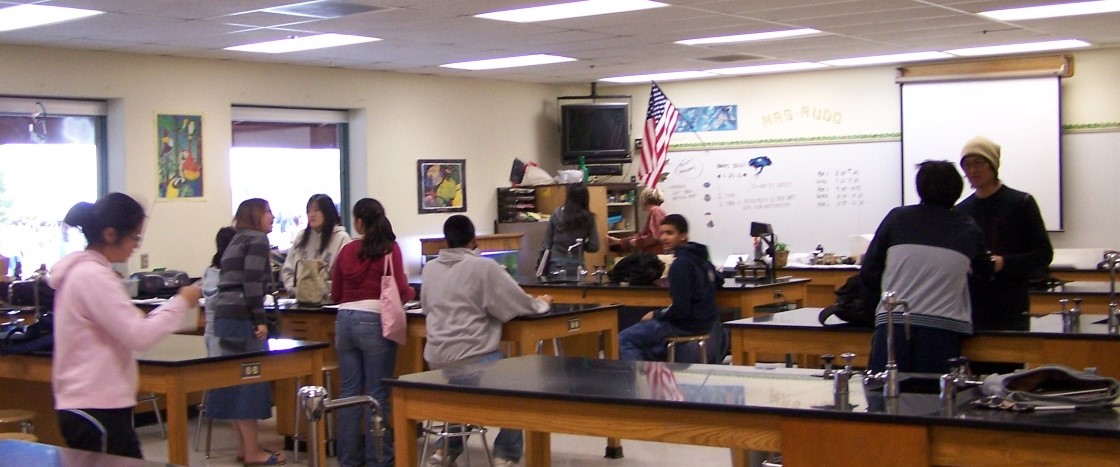
A view of a class in the science wing of Brea Olinda High School in Brea, California. Wikipedia
Why do high schools need to offer honors classes? An important part of being a good teacher is listening to voices. Make space to learn from the lived experiences of our students and their families. As such, here are some voices –
________________________________________________________
Since I had a hard time relating to other kids my age, I came to deeply believe that I must be *horribly* ugly. It was only when I started taking honors & AP classes in high school that I really felt normal & ok for the first time in my life. Any school system that doesn’t allow separate classes for very smart (‘gifted & talented’) kids either doesn’t understand very smart kids at all, or it sadistically wants them to be suffer through boredom, frustration, alienation, & bullying.
Then I worked with inner-city high school kids in DC schools in the mid 90s. Those were all black and brown SUPER smart kids and boy did they need those classes & opportunities to be around other smart kids. Those kids *need* these programs.
And you don’t achieve equality when you lump all the students together. You end up with a system where the bigger, stronger, handsomer, or prettier, kids dominate & the nerdy kids who *could be* happy, creative, & productive very often hide who they are.
Geoffrey Miller writes
https://twitter.com/primalpoly/status/1446485504468398085
________________________________________________________
Monica Osborne @DrMonicaOsborne Oct 8, 2021
This was my experience also. I felt like there was something wrong with me until I was put into programs with kids like me. It’s the same for my son. It’s painful for him when he isn’t being given the intellectual stimulation he needs and around kids whose brains work like his.
________________________________________________________
I was afraid to raise my hand in class because you’d be tormented by kids asking “What are you, a brain?” It was the worst insult from their perspective.
Ronna McNamara
________________________________________________________
We don’t tell kids who have musical, artistic or sports talents that they should stay in the same class as the kid with no rhythm or the one who can’t catch a ball. We train them with experts so that they excel. Why can’t we view intelligence as a similar gift that needs support?
Dr. Rachel S. Harris
________________________________________________________
Not grouping students by mental ability is like not grouping athletes by physical ability. Banning gifted & talented education is therefore like banning varsity teams, making JV running backs play against Varsity linebackers.
Alastair
https://twitter.com/_AlastairX_/status/1446587344640004099
________________________________________________________
As a former teacher I can tell you that it is nearly impossible to teach and challenge gifted students while at the same time making the lessons and material suitable for students who are grade levels behind.
Selma Guzman
Studies on the importance of having leveled classes
“The composition of peer groups is thought to impact productivity and academic achievement. Researchers evaluated the impact of creating peer groups optimized to improve the academic achievement of lower-ability first-year students at the United States Air Force Academy. Placing lower-ability students in the optimized groups, which mixed them with a relatively large number of peers with high scores on the verbal portion of the SAT, caused the lower-ability students to perform worse, and actually led them to interact more with other lower-ability students.”
Peer Group Assignment and Student Achievement in the United States, Bruce Sacerdote Scott Carrell James West
https://www.povertyactionlab.org/es/node/2019
Also, this study is from outside of the US:
“grouping children based on learning levels rather than age or grade” … “ consistently improves learning outcomes when implemented well and has led to some of the largest learning gains among rigorously evaluated education programs”
Teaching at the Right Level to improve learning
https://www.povertyactionlab.org/case-study/teaching-right-level-improve-learning
Another randomized study on effects of ability grouping on students at a lower learning level: “all students may benefit if tracking allows teachers to better tailor their instruction level”
Peer Effects, Teacher Incentives, and the Impact of Tracking: Evidence from a Randomized Evaluation in Kenya. Esther Duflo, Pascaline Dupas, and Michael Kremer
aeaweb.org
See also W Thomas Boyce’s work on “orchids and dandelions.” Those kids are orchids: they can bloom brilliantly, but if we don’t cultivate that talent, they crash and burn particularly badly.
Jessie Mannisto, A Place for Orchids, October 30, 2020
_________________________________
Thanks for visiting my website. We also have resources here for teachers of Astronomy, Biology, Chemistry, Earth Science, Physics, Diversity and Inclusion in STEM, and connections with reading, books, TV, and film. At this next link you can find all of my products at Teachers Pay Teachers, including free downloads – KaiserScience TpT resources

Hands-on immune system simulation
Learning goals
How does our skin protect us from pathogens?
What are the different jobs of white blood cells?
How does our body recognize pathogens?
How can we train our immune system to recognize potential threats?
We start by using our resource on learning about our immune system. Then we print out some of our images on heavy cardstock, and cut them out. They can be used as manipulatives.

KaiserScience
We talk about how the immune system works, and go through several scenarios. We work them all out by hand on a large table top.

KaiserScience
I printed out a background showing epithelial cells. The choice of background is important: I want students to understand that what we are showing is happening not within a single cell, but within a tissue.
I want the background images to be detailed enough so that they interpret them as realistic – yet not so detailed that they concentrate on the background. The manipulatives in the foreground are the most important part here.

Photo by RK
Learning Standards
Next Generation Science Standards (NGSS)
HS-LS1-2 Develop and use a model to illustrate the hierarchical organization of interacting systems that provide specific functions within multicellular organisms.
DCI – LS1.A: Structure and Function – Feedback mechanisms maintain a living system’s internal conditions within certain limits and mediate behaviors, allowing it to remain alive and functional even as external conditions change within some range.
Evidence statements: In the model, students describe the relationships between components, including:
* A system’s function and how that relates both to the system’s parts and to the overall function of the organism.
* Students use the model to illustrate how the interaction between systems provides specific functions in multicellular organisms
Benchmarks for Science Literacy, AAAS
The immune system functions to protect against microscopic organisms and foreign substances that enter from outside the body and against some cancer cells that arise within. 6C/H1*
Thanks for visiting my website. We also have resources here for teachers of Astronomy, Biology, Chemistry, Earth Science, Physics, Diversity and Inclusion in STEM, and connections with reading, books, TV, and film. At this next link you can find all of my products at Teachers Pay Teachers, including free downloads – KaiserScience TpT resources

Meiosis and crossing over licorice lab
During meiosis, in the cell, a spindle apparatus forms. One tetrad attaches to the spindle on one side. Other tetrad attaches to spindle on the other side.
Here we don’t want exact copies of the parent – we want all daughter cells to be different! So the chromosomes start crossing over – like shuffling a deck of cards. Here’s a simplified physical representation:

Bits of one chromosome break off and stick on another chromosome, and vice-versa. This process is more or less random – the results are slightly different every time.
After this happens, the mixed up chromosomes are then pulled by the spindle apparatus to opposite sides of the cell (once done, it then divides into two new cells.) We see this here:

From Meiosis video by Raghavendra Rao
Students better understand this when they model this physically! We can use Twizzlers or any other colored licorice.
Here we see chromosome forming a tetrad, before pieces break off and rearrange:

KaiserScience
Here a student shows what happens during the time when pieces of one chromosome break off, and move onto a nearby one.
(For ease of use, the licorice pieces aren’t in a tetrad shape at the moment.)

KaiserScience
and

Learning Standards
2016 Massachusetts Science and Technology/Engineering Curriculum Framework
HS-LS3-1. Develop and use a model to show how DNA in the form of chromosomes is passed from parents to offspring through the processes of meiosis and fertilization in sexual reproduction.
HS-LS3-2. Make and defend a claim based on evidence that genetic variations (alleles) may result from (a) new genetic combinations via the processes of crossing over and random segregation of chromosomes during meiosis, (b) mutations that occur during replication, and/or (c) mutations caused by environmental factors. Recognize that mutations that occur in gametes can be passed to offspring.
Disciplinary Core Idea Progression Matrix – “Nearly every cell in an organism contains an identical set of genetic information on DNA but the genes expressed by cells can differ. In sexual reproduction, genetic material in chromosomes of DNA is passed from parents to offspring during meiosis and fertilization.“
Thanks for visiting my website. We also have resources here for teachers of Astronomy, Biology, Chemistry, Earth Science, Physics, Diversity and Inclusion in STEM, and connections with reading, books, TV, and film. At this next link you can find all of my products at Teachers Pay Teachers, including free downloads – KaiserScience TpT resources

Build an anatomically correct candy neuron
Intro & Goals: Students need to understand anatomy, including the structure of neurons, nerves, how nerves connect to each other, or to muscles, etc. We can show and tell the students this anatomy at any level.

We can use images, PowerPoints, and amazing three dimensional computer graphics. Many students will be able to understand much from varied presentations.

Image from commons.wikimedia.org/wiki/File:Neuron.svg
But if time is available we find that many students greatly benefit from creating physical models. Here we give our students various candy as building manipulatives. Ask them to then create a neuron.

from the class of DeAnne Martin
Let’s take a closer look

from the class of DeAnne Martin
Items: Sour punch rainbow straws, Colored marshmallows, Twizzlers licorice, Toothpicks

from the class of DeAnne Martin
Learning Standards
NGSS
High School -Science and Engineering Practices
Developing and Using Models: Modeling in 9–12 builds on K–8 experiences and progresses to using, synthesizing, and developing models to predict and show relationships among variables between systems and their components in the natural and designed world(s).
Develop and use a model based on evidence to illustrate the relationships between systems or between components of a system. (HS-LS1-2)
High School DCIs
Systems of specialized cells within organisms help them perform the essential functions of life. (HS-LS1-1)
Multicellular organisms have a hierarchical structural organization, in which any one system is made up of numerous parts and is itself a component of the next level. (HS-LS1-2)
Feedback mechanisms maintain a living system’s internal conditions within certain limits and mediate behaviors, allowing it to remain alive and functional even as external conditions change within some range. Feedback mechanisms can encourage (through positive feedback) or discourage (negative feedback) what is going on inside the living system. (HS-LS1-3)
High School Cross Cutting Concepts
Stability and Change: Feedback (negative or positive) can stabilize or destabilize a system. (HS-LS1-3)
2016 Massachusetts Science and Technology/Engineering Curriculum Framework
HS-LS1-2. Develop and use a model to illustrate the key functions of animal body systems: Emphasis is on the primary function of the following body systems (and structures): digestive (mouth, stomach, small intestine [villi], large intestine, pancreas), respiratory (lungs, alveoli, diaphragm), circulatory (heart, veins, arteries, capillaries), excretory (kidneys, liver, skin), and nervous (neurons, brain, spinal cord)
Thanks for visiting my website. We also have resources here for teachers of Astronomy, Biology, Chemistry, Earth Science, Physics, Diversity and Inclusion in STEM, and connections with reading, books, TV, and film. At this next link you can find all of my products at Teachers Pay Teachers, including free downloads – KaiserScience TpT resources

3 stage rockets – human powered in the gym or hall
When we went to the Moon in the 1960s and 1970s we used the Saturn 5 rocket, a rocket with three stages.

Lunar libration with phase
Why didn’t we use a single stage rocket? The Earliest ideas about manned space travel once envisioned building a powerful rocket that could take off from Earth, fly into orbit, then to the moon, and finally back again. Here is a classic painting
The Conquest of Space is a 1949 speculative science book written by Willy Ley and illustrated by Chesley Bonestell. The book contains a portfolio of paintings by Bonestell depicting the possible future exploration of the Solar System, with explanatory text by Ley.
This book is now considered a both classic of early science writing and American mid-20th century painting.

But even by 1949 most engineers and scientists had come to realize that this would be almost impossible to build. They came to understand that any practical rocket would have to be built in multiple stages. Why? Here we discuss theory, and then we turn to a fun classroom activity!
Theory
This explanation is from a discussion at physics.stackexchange.com
The easiest way to think of it is this, imagine all the mass left over when a rocket has burned 85% of it’s fuel. The mass of most of the tank and structure is now overkill and waste. It would be nice to be able to jettison that extra mass so that the fuel left can accelerate only the payload.
That’s what a multi-stage rocket does. It jettisons the mass of initial stages so that the remaining fuel and thrust can accelerate much smaller mass to a much higher velocity than it would have been able to if there was only one stage.
Remember acceleration is proportional to mass, so if you can get rid of say 80% of the mass then you can accelerate the payload 5 times more for the same remaining fuel.
Another benefit is that you can use rocket motors that are tuned for different velocities. In the initial stage you need maximum thrust and the rocket is not moving as fast. In the later stages you want high efficiency motors, not necessarily high thrust.
To get very high velocities it requires less overall fuel and mass with multiple stages. This comes at the cost of greater complexity and cost.
from Why do rockets have multiple stages?
This is the design of the spaceship that once sent men to the moon.

Saturn 5 rocket staging
This next explanation is from Staging, David Darling
Serial staging of the Saturn V. At the start of the flight the large, lower stage is used; here it accounts for 83.3% of the propellant but accelerates the rocket to only 33% of its final velocity.
When it has used up its fuel, it drops away and the second stage takes over.
Only the third stage goes into orbit.
Here is an actual video – Amazing Saturn V Launch and Staging in 1080p HD
Equipment
Large, smooth floor like a hallway or gym floor.
Scooters, such as Spectrum 16″ Scooter

Here is the lab in action from Tiffany Taylor and her physics class!
Learning Standards
NGSS HS-PS2-2
DCI – PS2.A: Forces and Motion
Momentum is defined for a particular frame of reference; it is the mass times the velocity of the object.
If a system interacts with objects outside itself, the total momentum of the system can change; however, any such change is balanced by changes in the momentum of objects outside the system.
2016 Massachusetts Science and Technology/Engineering Curriculum Framework
HS-PS2-1. Analyze data to support the claim that Newton’s second law of motion is a mathematical model describing change in motion (the acceleration) of objects when acted on by a net force.
HS-PS2-10(MA). Use free-body force diagrams, algebraic expressions, and Newton’s laws of motion to predict changes to velocity and acceleration for an object moving in one dimension in various situations
A FRAMEWORK FOR K-12 SCIENCE EDUCATION: Practices, Crosscutting Concepts, and Core Ideas
PS2.A: FORCES AND MOTION
How can one predict an object’s continued motion, changes in motion, or stability?
Interactions of an object with another object can be explained and predicted using the concept of forces, which can cause a change in motion of one or both of the interacting objects… At the macroscale, the motion of an object subject to forces is governed by Newton’s second law of motion… An understanding of the forces between objects is important for describing how their motions change, as well as for predicting stability or instability in systems at any scale.

______________________________
Thanks for visiting my website. We also have resources here for teachers of Astronomy, Biology, Chemistry, Earth Science, Physics, Diversity and Inclusion in STEM, and connections with reading, books, TV, and film. At this next link you can find all of my products at Teachers Pay Teachers, including free downloads – KaiserScience TpT resources
Levels of high school science classes
Most high schools offer several levels of many of their science classes.
A view of a class in the science wing of Brea Olinda High School in Brea, California. Wikipedia
Honors – More rigorous, aimed at students with interests in STEM careers or top tier colleges. They provide an intellectual challenge and opportunity. Some honors classes go at a faster pace, covering more topics over the course of a year. Others follow the same pace as regular classes but in more depth.
College Prep – Aimed at most students in the school. These are meant to challenge and grow students intellectually.
Foundations – For students on a lower academic level or for those doing well in other subjects yet who have issues with mathematics. This level focuses on applications and big ideas.
Foundations classes shouldn’t be confused with SPED. That being said, they could be a great opportunity for SPED inclusion. This level is variously known as (for example)
* Foundations of {physics} * Conceptual {physics} * Applied {physics}
* Fundamental {physics} * {Physics} in the community * Introductory {physics}
Advanced Placement – Many schools offer a higher level science class in the following year, Advanced Placement or IB (International Baccalaureate.)
Some caution – one shouldn’t replace Honors classes with AP. I would hate to throw a student with no physics background straight into an AP Physics class. I would want them to have a year of honors or college prep physics first.
Integrated science classes – Many schools offer integrated subjects, such as:
Physical Science – combining elements of chemistry and physics, with examples of applications to biology, for instance.
General Science- combining elements of many different science topics.
________________________
Thanks for visiting my website. We also have resources here for teachers of Astronomy, Biology, Chemistry, Earth Science, Physics, Diversity and Inclusion in STEM, and connections with reading, books, TV, and film. At this next link you can find all of my products at Teachers Pay Teachers, including free downloads – KaiserScience TpT resources

Golf balls, moon phases, and geometry oh my
You know about the phases of the moon, right? They are how the moon appears – which parts are light and which are dark. They are seen from the perspective of someone looking up from Earth, into space, at the moon.

Don Hass, from the Paleontological Research Institution and its Museum of the Earth, has this special treat for us!
If you hold a ball and line it up with the moon when it’s out during daylight, the ball will be in the same phase as the moon!
That’s because the geometry of the moon-Earth-sun system is the same as the geometry of the ball-eye-sun system.

By Don Hass
Don writes
When’s the next ‘full’ Titleist? It’s complicated! The next full moon is November 19, but as we go into these days of fewer daylight hours, you won’t see a full moon during daylight, so this trick won’t work with a full moon, I think, until spring.
Here’s the set up. I laid down next to the table to get the shot.

By Don Hass
On a related note, we have this from https://flatearth.ws/

Some related articles
Earth-Moon system
Moons – What exactly is a moon?
Why are some moons spherical while others are shaped like potatoes?
How many moons does Earth have?
Lunar motions (Libration, axial precession, apsidal precession, nodal precession
Yes, geometry can be useful in real life and in careers!
Thanks for visiting my website. We also have resources here for teachers of Astronomy, Biology, Chemistry, Earth Science, Physics, Diversity and Inclusion in STEM, and connections with reading, books, TV, and film. At this next link you can find all of my products at Teachers Pay Teachers, including free downloads – KaiserScience TpT resources

Iberian, Spanish, Latino, Hispanic – Terminology
During National Hispanic American Heritage Month questions may arise from students and teachers – who is included as Hispanic?
The question of what term to use is found in many articles. Vanessa Romo on NPR writes
As the headline unambiguously states, here at NPR we’ve kicked off Hispanic Heritage Month. Not Latino Heritage Month. Not Latinx Heritage Month. Not even a compromise or a combination of the three: Hispanic/Latino/ Latinx Heritage Month… it’s not too late to pose the following thorny questions: What’s the harm in lumping together roughly 62 million people with complex identities under a single umbrella? Is a blanket pan-ethnic term necessary to unite and reflect a shared culture that is still largely (infuriatingly) excluded from mainstream popular culture? Or the more basic question: ¿Por que Hispanic?
Yes, We’re Calling It Hispanic Heritage Month And We Know It Makes Some Of You Cringe by Vanessa Romo on NPR, 9/17/2021
Here we discuss these different terms and how they are used.
Iberian – The origin of Hispanic, Latin, etc.
The Spanish and Portuguese peoples originate from the Iberian peninsula. This is a peninsula in the southwest corner of Europe.
People from Spain refer to themselves as Spanish.
People from Portugal refer to themselves as Lusitanians or Portuguese.
Both Spanish and Portuguese people can be referred to as Iberians; Spanish and Portuguese who have moved to the United States may refer to themselves as Iberian-Americans.

Sure, this peninsula is mostly divided between Spain and Portugal. But small amount of this peninsula includes
• a small area of Southern France
• Andorra (a sovereign landlocked microstate)
• Gibraltar (a tiny, self-governing British overseas territory. Technically part of the United Kingdom.)
Americans often see the Iberian peninsula as being synonymous with Spain, but there is a diversity of ethnic and linguistic groups. This next image is from Iberia’s children: A short history of why Portuguese and Spanish are different.

present day languages of the Iberian Peninsula
Debate on names and identities
Let’s look at Latinos or Hispanics? A Debate About Identity, by Darryl Fears, Washington Post, August 25, 2003
That declaration — “I’m a Latina” — is resounding more and more through the vast and diverse Spanish-speaking population that dethroned African Americans as the nation’s largest ethnic group a few months ago.
It is also deepening a somewhat hidden but contentious debate over how the group should identify itself — as Hispanics or Latinos. The debate is increasingly popping up wherever Spanish speakers gather.
It was raised last month at the National Council of La Raza’s convention in Austin. The Internet is littered with articles and position papers on the issue. Civic organizations with Hispanic in their titles have withstood revolts by activist members seeking to replace it with the word Latino.
Cisneros refused to appear on the cover of Hispanic magazine earlier this year because of its name. She relented only after editors allowed her to wear a huge faux tattoo on her biceps that read “Pura Latina,” or Pure Latina.
Another Mexican American writer, Luis J. Rodriguez, only reluctantly accepted an award from a Hispanic organization “because I’m not Hispanic,” he said.
…. Although the terms Latino and Hispanic have been used interchangeably for decades, experts who have studied their meanings say the words trace the original bloodlines of Spanish speakers to different populations in opposite parts of the world.
Hispanics derive from the mostly white Iberian peninsula that includes Spain and Portugal, while Latinos are descended from the brown indigenous Indians of the Americas south of the United States and in the Caribbean, conquered by Spain centuries ago.
Latino-Hispanic is an ethnic category in which people can be of any race. They are white, like the Mexican American boxer Oscar de la Hoya, and black, like the Dominican baseball slugger Sammy Sosa.
… Duard Bradshaw has a different opinion. “I’ll tell you why I like the word Hispanic,” said the Panamanian president of the Hispanic National Bar Association. “If we use the word Latino, it excludes the Iberian peninsula and the Spaniards. The Iberian peninsula is where we came from. We all have that little thread that’s from Spain.”
A survey of the community conducted last year by the Pew Hispanic Center of Washington found that nearly all people from Spanish-speaking backgrounds identify themselves primarily by their place of national origin.
When asked to describe the wider community, more than half, 53 percent, said both Hispanic and Latino define them. A substantial but smaller group, 34 percent, favored the term Hispanic. The smallest group, 13 percent, said they preferred Latino. A survey by Hispanic Trends magazine produced a similar finding.
…Mexican American activists in California and Puerto Rican activists in New York were not pleased. They favored a term that included the brown indigenous Indians who they believe are the source of their bloodline.
“Hispanic doesn’t work for me because it’s about people from Spain,” said Rodriguez, author of the book “The Republic of East L.A.” “I’m Mexican, and we were conquered by people from Spain, so it’s kind of an insult.” Rodriguez’s views are typical of Mexican Americans in Los Angeles, the epicenter of immigrants from that country, and the Chicano rights movement.
Some tentative definitions: Hispanic, Latino, Spanish
Spanish – someone from Spain.
Portuguese – someone from Portugal.
Hispanic – people from or with ancestors from, Spanish speaking countries, e.g. Spain, Mexico, Central America and South America.
Brazilians are not considered Hispanic because they speak Portuguese.
Latino – People from, or who have ancestors from, Latin America which includes Mexico, Central America and South America.
In this case, Brazilians are considered Latino, but people from Spain are not.
Chicano – Mexican Americans.
From the Rice & Frijoles social media page we have this suggestion.

This next infographic is similar, but we immediately see a different: This group believes that the term Hispanic should include people from Spain, and does not suggest “Spanish” as an independent, alternate name.
This image is from Clarifying Terms for Hispanic Heritage Month.

Hispanic, Latino, Latin(x), Spanish: Clarifying Terms, Ketchum
Chicano
Neither of these infographics mention “Chicano.” Chicano or Chicana is a chosen identity for many Mexican Americans in the United States. It is often used interchangeably with Mexican American.
While Mexican-American identity emerged to encourage assimilation into White American society and separate the community from African-American political struggle, Chicano identity emerged among anti-assimilationist youth, some of whom belonged to the Pachuco subculture, who claimed the term (which had previously been a classist and racist slur.)
Chicano was widely reclaimed in the 1960s and 1970s to express political empowerment, ethnic solidarity, and pride in being of Indigenous descent (with many using the Nahuatl language as a symbol), diverging from the more assimilationist Mexican American identity.
Chicano youth in barrios rejected cultural assimilation into whiteness and embraced their identity and worldview as a form of empowerment and resistance.
In the Boston area
The following is from the Norman B. Leventhal Map & Education Center at the Boston Public Library.

While Hispanic Heritage Month is widely construed as a time to celebrate individuals of Latin American heritage in the U.S, the term “Hispanic” actually has a more specific definition.
Hispanic refers to any individual who speaks Spanish. This definition includes a significant portion of Hispanic Americans who don’t share Latin American (and/or Latino, Latinx, Latine) identity, such as individuals from Spain or the Republic of Equatorial Guinea.
Conversely, the phrasing of Hispanic Heritage excludes those with Latin American heritage who do not speak Spanish, including individuals with ancestry in Brazil, Haiti, and Belize.
While the most widely spoken non-English language in the greater Boston area is Spanish, much of Boston’s language diversity is found in non-Spanish speaking Latine communities. As you can observe when comparing these two maps, some of Boston’s most diverse neighborhoods in terms of languages spoken are areas where Spanish speaking communities border and coexist with French Creole and Portuguese speaking communities.
Map 1: Boston neighborhoods colored differently to indicate different non-English languages spoken by 10% or greater of the population. Boston Planning and Development Agency, “Boston’s top 5 foreign languages spoken at home, 2015” (2017)
Map 2: Boston neighborhoods colored in to show percentages of language diversity. Boston Planning and Development Agency, “Boston’s diversity index, 2010: measures of diversity: language other then English spoken at home” (2014)

Articles
Latinx, Latine, Hispanic, Latino/a: What Do We Call Ourselves? Laysha Macedo, HipLatina, 10/13/2021
“Terminology is tricky to denounce or uphold. For example, “Hispanic” is an outdated, colonizer label but that doesn’t stop older generations from using them to identify themselves and others. Latinx, in particular, is a term that means something different depending on the person. As we’ve seen on social media and even in discourse held in our own kitchen tables, there is a strong distaste for it so much so that “Hispanic” is still preferred despite the ties to colonization…
“Hispanic” versus “Latino” versus “Latin”, Hispanic Economics
Is it Hispanic, Chicano/Chicana, Latino/Latina, or Latinx?, GENIAL: Latinas
Generating Engagement and New Initiatives for All Latinos
___________________
Thanks for visiting my website. We also have resources here for teachers of Astronomy, Biology, Chemistry, Earth Science, Physics, Diversity and Inclusion in STEM, and connections with reading, books, TV, and film. At this next link you can find all of my products at Teachers Pay Teachers, including free downloads – KaiserScience TpT resources

Gender is both binary and bimodal
Gender, in mammals, is binary. That’s always been taught and understood as a fact. Yet in modern social discourse, we are hearing from people who hold that gender is not binary.
Not only does disagreement exist, but now it has become socially acceptable, among some, to demand that everyone agree with “our” views. Some even demonize those who have a different point of view.
This is an area where scientists can role-model the best public discourse: It doesn’t matter whether we are talking about forces in aerodynamics; chromosomal mutations such as Edwards Syndrome, Down syndrome; or about gender and identity.
The key is to be clear and consistent in terminology. Without clearly agreed-upon definitions we talk past each other.

image from Between the (Gender) Lines: the Science of Transgender Identity, Science In The News, Harvard U.
Science, logic, and philosophy, can sharpen our own thinking about such issues. In fact, we scientists and philosophers live by this ideal “The aim of an argument or discussion should not be victory, but progress.” – Joseph Joubert
So what can clear communication do to help us understand this issue? View gender as bimodal – and view sex as binary. Scott Barry Kaufman writes about this topic.
He notes that it is critical to distinguish between: gender identity, biological sex, and evolutionary sex.
The first, gender identity, is fluid but tends to be bimodal.
The second, biological sex, isn’t strictly binary even though it’s best thought of as a bimodal distribution.
That is to say, almost all people are male or female; that’s binary, and a scientific observation. It is not a social construct. But there are some people with differences in chromosomes and genes that are not totally male or female. (The existence of the former population does not negate the existence of the latter population)
Such variations are scientifically observable; see Other genetic and chromosomal genders.
Evolutionary sex is about the implications of biological sex. It is mostly binary in mammals or else we wouldn’t exist.
In T: The Story of Testosterone, the Hormone that Dominates and Divides Us, Carole Hooven writes

Carole Hooven
How common is it to be intersex?
There is no agreed-upon definition of intersex, so there is no one, agreed upon number. But there are constellation of DSDs that, when added together, can give answers. But please note – the answer that one gets depends on which conditions one wants to include.
Anne Fausto-Sterling, professor of biology and gender studies at Brown University, has made an expansive definition of intersex in her book “Sexing The Body: Gender Politics And The Construction Of Sexuality” and in a paper, “How Sexually Dimorphic Are We?” American Journal of Human Biology.
She adds together all of the following conditions, and concludes that almost 1.7% of people could be considered intersex; her definition includes people who have some mix of male and female sexual anatomy but it also includes women and men who have incomplete development of their anatomy, but no mixing of gender.
What if we don’t include conditions such as vaginal agenesis and late-onset adrenal hyperplasia (LOCAH)? Then the percent of people who are intersex would be lower.
In “How Common is Intersex? A Response to Anne Fausto-Sterling” Leonard Sax uses a more restrictive definition of intersex and comes up with a figure of 0.018%. ( Sex Res. 2002 Aug;39(3) )

The data is clear – biological sex (which, yes, is fair to call gender) is generally binary, yes. But not absolutely so. There is some minor percent of variation.
My hope is that people will study this issue in the same way that they approach all scientific questions:
* make hypotheses with testable predictions.
* read papers from peer-reviewed scientific journals.
* do not accept or force acceptance of claims based on social or political pressure.
Learning Standards
2016 Massachusetts Science and Technology/Engineering Standards
Students will be able to:
* apply scientific reasoning, theory, and/or models to link evidence to the claims and assess the extent to which the reasoning and data support the explanation or conclusion;
* respectfully provide and/or receive critiques on scientific arguments by probing reasoning and evidence and challenging ideas and conclusions, and determining what additional information is required to solve contradictions
* evaluate the validity and reliability of and/or synthesize multiple claims, methods, and/or designs that appear in scientific and technical texts or media, verifying the data when possible.
A Framework for K-12 Science Education: Practices, Crosscutting Concepts, and Core Ideas (2012)
Implementation: Curriculum, Instruction, Teacher Development, and Assessment
“Through discussion and reflection, students can come to realize that scientific inquiry embodies a set of values. These values include respect for the importance of logical thinking, precision, open-mindedness, objectivity, skepticism, and a requirement for transparent research procedures and honest reporting of findings.”
Next Generation Science Standards: Science & Engineering Practices
● Ask questions that arise from careful observation of phenomena, or unexpected results, to clarify and/or seek additional information.
● Ask questions that arise from examining models or a theory, to clarify and/or seek additional information and relationships.
● Ask questions to determine relationships, including quantitative relationships, between independent and dependent variables.
● Ask questions to clarify and refine a model, an explanation, or an engineering problem.
● Evaluate a question to determine if it is testable and relevant.
● Ask questions that can be investigated within the scope of the school laboratory, research facilities, or field (e.g., outdoor environment) with available resources and, when appropriate, frame a hypothesis based on a model or theory.
● Ask and/or evaluate questions that challenge the premise(s) of an argument, the interpretation of a data set, or the suitability of the design.
Thanks for visiting my website. We also have resources here for teachers of Astronomy, Biology, Chemistry, Earth Science, Physics, Diversity and Inclusion in STEM, and connections with reading, books, TV, and film. At this next link you can find all of my products at Teachers Pay Teachers, including free downloads – KaiserScience TpT resources

The Next Dust Bowl? Lake Powell and Lake Mead
The Dust Bowl was a period of severe dust storms that greatly damaged the ecology and agriculture of the American and Canadian prairies during the 1930s.
Could something like this happen again here in the USA?
In this unit we’ll take a look at places here in the United States, Lake Powell and Lake Mead.

Let’s start by using this map to put us in geographical perspective.

from gcdamp.com
 KaiserScience