

What colors of light do plants use?
What colors of light do plants use?
Plants mostly use red and blue wavelengths of light.
When you see a leaf, green is the color that the leaf doesn’t absorb. (Green is reflected.)

How much of each color is reflected, absorbed, or transmitted?

What does this look like, within the leaf itself?

Shine sunlight on a plant.
That sunlight really is made of many different colors, as a prism reveals:

The plant absorbs some of these colors/wavelengths of light, and reflects others.
From the graph below, tell us
-
which colors/wavelengths are mostly absorbed?
-
which colors/wavelengths are mostly reflected?

from pinklightaeroponics.net, science-of-futuristic-aeroponic-indoor-gardening.
According to this diagram, do plants use IR (infrared) light?

Why is chlorophyll green?
Why did the chlorophyll pigment evolve to be green? That only absorbs some wavelengths of light. Why not evolve into a black pigment, which would absorb all visible colors of light?
The answer has to do with quantum mechanics!
Why did chlorophyll evolve to be green – as opposed to black – which would absorb more energy?
___________________________
Thanks for visiting my website. We also have resources here for teachers of Astronomy, Biology, Chemistry, Earth Science, Physics, Diversity and Inclusion in STEM, and connections with reading, books, TV, and film. At this next link you can find all of my products at Teachers Pay Teachers, including free downloads – KaiserScience TpT resources

Evolution of dogs
What are we learning?
The diversity and unity of life on Earth can be explained by the process of evolution.
Over time, the process of natural selection leads to the evolution of new species.
Why are we learning this?
from Teaching About Evolution and the Nature of Science (1998) National Academy of Sciences
Evolution accounts for the most fundamental features of the world around us: the similarities among living things, the diversity of life, and many features of the physical world we inhabit.
Explanations of these phenomena in terms of evolution draw on results from physics, chemistry, geology, many areas of biology, and other sciences. Thus, evolution is the central organizing principle that biologists use to understand the world.
To teach biology without explaining evolution deprives students of a powerful concept that brings great order and coherence to our understanding of life.
Discussion
Remove domestication from the human species, and there’s probably a couple of million of us on the planet, max. Instead, what do we have? Seven billion people, climate change, travel, innovation and everything. Domestication has influenced the entire earth. And dogs were the first. For most of human history, we’re not dissimilar to any other wild primate. We’re manipulating our environments, but not on a scale bigger than, say, a herd of African elephants. And then, we go into partnership with this group of wolves. They altered our relationship with the natural world. …
— Greger Larson

and

Dual origin hypothesis:
In Genomic and archaeological evidence suggest a dual origin of domestic dogs, we read:
“The history of how wolves became our pampered pooches of today has remained controversial. Frantz et al. describe high-coverage sequencing of the genome of an Irish dog from the Bronze Age as well as ancient dog mitochondrial DNA sequences. Comparing ancient dogs to a modern worldwide panel of dogs shows an old, deep split between East Asian and Western Eurasian dogs. Thus, dogs were domesticated from two separate wolf populations on either side of the Old World.”

Genomic and archaeological evidence suggest a dual origin of domestic dogs
Articles
How Wolf Became Dog
Scientists are racing to solve the enduring mystery of how a large, dangerous carnivore evolved into our best friend
By Virginia Morell on July 1, 2015
=============================================
Observations | Evolution: The Curious Case of Dogs
By Christie Wilcox on November 13, 2011
=============================================
Dog Domestication Much Older than Previously Known
Genetic information from a 35,000-year-old wolf bone found below a frozen cliff in Siberia is shedding new light on humankind’s long relationship with dogs. May 21, 2015
=============================================
Domestication Made Dogs’ Facial Anatomy More Fetching to Humans
Wolves lack the muscles that allow dogs to raise their eyebrows and make puppy dog eyes
By Jim Daley on June 17, 2019
=============================================
From Wolf to Woof Twice, Christopher Intagliata, June 2, 2016
=============================================
Humans May Have Befriended Wolves with Meat
Christopher Intagliata on January 7, 2021
=============================================
The Domestic Dog Is the Book We’ve Been Waiting for Since 1995
Featuring two decades of new evidence on dog evolution, behavior, training and human interaction
Julie Hecht, October 5, 2017
=============================================
Dog Genetics Spur Scientific Spat: Researchers disagree over the whens and wheres of canine domestication
By Ewen Callaway, Nature magazine on June 18, 2013, Scientific American
=============================================
Dog Domestication May Have Begun because Paleo Humans Couldn’t Stomach the Original Paleo Diet
Unable to digest large amounts of protein, hunters likely left scraps that could have led to the taming of wolves
By Rachel Nuwer on January 7, 2021
=============================================
How did dogs get to the Americas? An ancient bone fragment holds clues
February 23, 2021
https://www.sciencedaily.com/releases/2021/02/210223192442.htm
=============================================
Genomic and archaeological evidence suggest a dual origin of domestic dogs
Laurent A. F. Frantz et al.
Science 03 Jun 2016, Vol. 352, Issue 6290, pp. 1228-1231
DOI: 10.1126/science.aaf3161
The history of how wolves became our pampered pooches of today has remained controversial. Frantz et al. describe high-coverage sequencing of the genome of an Irish dog from the Bronze Age as well as ancient dog mitochondrial DNA sequences. Comparing ancient dogs to a modern worldwide panel of dogs shows an old, deep split between East Asian and Western Eurasian dogs. Thus, dogs were domesticated from two separate wolf populations on either side of the Old World.
=============================================
To fill in some of the blanks, two big names in dog and human genetics teamed up: Greger Larson, an evolutionary biologist at the University of Oxford, and Pontus Skoglund, a paleogenomicist at the Francis Crick Institute. Larsen, Skoglund, and colleagues sifted through more than 2000 sets of ancient dog remains dating back nearly 11,000 years from Europe, Siberia, and the Near East. In the process, they added 27 ancient dog genomes to the five already on record. They then compared those with the genomes of 17 humans living in the same places and times as the dogs.
The dog DNA alone revealed some surprises. As early as 11,000 years ago, there were already five distinct dog lineages; these gave rise to canines in the Near East, northern Europe, Siberia, New Guinea, and the Americas, the team reports today in Science. Because dogs had already diversified so much by that time, “domestication had to occur long before then,” Skoglund says. That fits with archaeological evidence: The oldest definitive dog remains come from Germany about 15,000 to 16,000 years ago.
How dogs tracked their humans across the ancient world
David Grimm, Science Mag, AAAS, 10/29/2020
https://www.sciencemag.org/news/2020/10/how-dogs-tracked-their-humans-across-ancient-world
=====================
Five distinct types of dog existed by end of last ice age, study finds
Nicola Davis, 10/29/2020
https://www.theguardian.com/world/2020/oct/29/five-distinct-types-dog-existed-end-last-ice-age-study-finds
=============================================
Dawn of the dog, David Grimm, Science Apr 17, 2015
Vol. 348, Issue 6232, pp. 274-279
DOI: 10.1126/science.348.6232.274
=============================================
America’s first dogs lived with people for thousands of years. Then they vanished
By David Grimm, Science Mag, AAAS, 7/5/2018
https://www.sciencemag.org/news/2018/07/america-s-first-dogs-lived-people-thousands-years-then-they-vanished
=============================================
Origins and genetic legacy of prehistoric dogs
Anders Bergström and Laurent Frantz, Science, 30 Oct 2020:
Vol. 370, Issue 6516, pp. 557-564
DOI: 10.1126/science.aba9572
https://science.sciencemag.org/content/370/6516/557
Dogs were the first domesticated animal, likely originating from human-associated wolves, but their origin remains unclear. Bergstrom et al. sequenced 27 ancient dog genomes from multiple locations near to and corresponding in time to comparable human ancient DNA sites (see the Perspective by Pavlidis and Somel).
By analyzing these genomes, along with other ancient and modern dog genomes, the authors found that dogs likely arose once from a now-extinct wolf population. They also found that at least five different dog populations ∼10,000 years before the present show replacement in Europe at later dates. Furthermore, some dog population genetics are similar to those of humans, whereas others differ, inferring a complex ancestral history for humanity’s best friend.
=============================================
Ancient wolves that played with humans likely evolved into today’s friendly dogs
National Geographic
https://www.nationalgeographic.com/animals/article/ancient-playful-wolves-evolved-domestic-dogs

Why schools should offer Honors classes
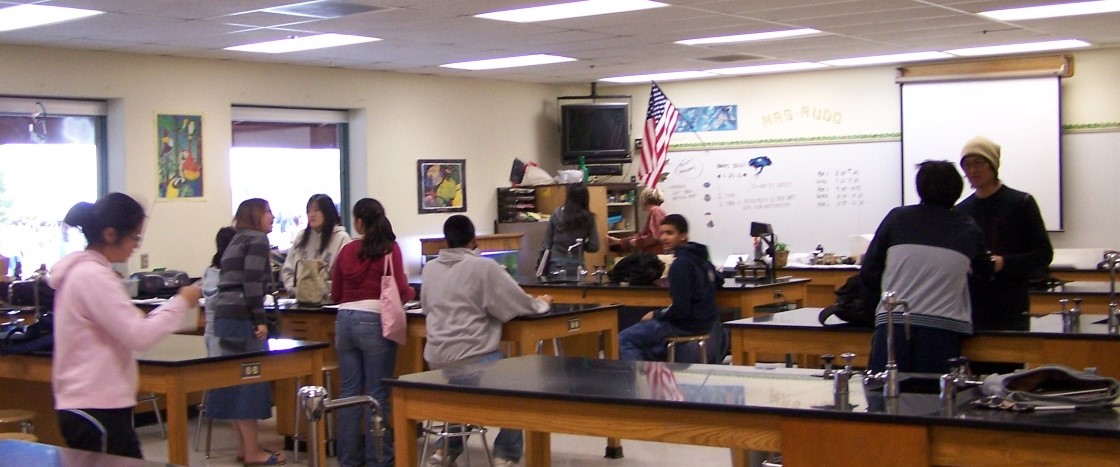
A view of a class in the science wing of Brea Olinda High School in Brea, California. Wikipedia
Why do high schools need to offer honors classes? An important part of being a good teacher is listening to voices. Make space to learn from the lived experiences of our students and their families. As such, here are some voices –
________________________________________________________
Since I had a hard time relating to other kids my age, I came to deeply believe that I must be *horribly* ugly. It was only when I started taking honors & AP classes in high school that I really felt normal & ok for the first time in my life. Any school system that doesn’t allow separate classes for very smart (‘gifted & talented’) kids either doesn’t understand very smart kids at all, or it sadistically wants them to be suffer through boredom, frustration, alienation, & bullying.
Then I worked with inner-city high school kids in DC schools in the mid 90s. Those were all black and brown SUPER smart kids and boy did they need those classes & opportunities to be around other smart kids. Those kids *need* these programs.
And you don’t achieve equality when you lump all the students together. You end up with a system where the bigger, stronger, handsomer, or prettier, kids dominate & the nerdy kids who *could be* happy, creative, & productive very often hide who they are.
Geoffrey Miller writes
https://twitter.com/primalpoly/status/1446485504468398085
________________________________________________________
Monica Osborne @DrMonicaOsborne Oct 8, 2021
This was my experience also. I felt like there was something wrong with me until I was put into programs with kids like me. It’s the same for my son. It’s painful for him when he isn’t being given the intellectual stimulation he needs and around kids whose brains work like his.
________________________________________________________
I was afraid to raise my hand in class because you’d be tormented by kids asking “What are you, a brain?” It was the worst insult from their perspective.
Ronna McNamara
________________________________________________________
We don’t tell kids who have musical, artistic or sports talents that they should stay in the same class as the kid with no rhythm or the one who can’t catch a ball. We train them with experts so that they excel. Why can’t we view intelligence as a similar gift that needs support?
Dr. Rachel S. Harris
________________________________________________________
Not grouping students by mental ability is like not grouping athletes by physical ability. Banning gifted & talented education is therefore like banning varsity teams, making JV running backs play against Varsity linebackers.
Alastair
https://twitter.com/_AlastairX_/status/1446587344640004099
________________________________________________________
As a former teacher I can tell you that it is nearly impossible to teach and challenge gifted students while at the same time making the lessons and material suitable for students who are grade levels behind.
Selma Guzman
Studies on the importance of having leveled classes
“The composition of peer groups is thought to impact productivity and academic achievement. Researchers evaluated the impact of creating peer groups optimized to improve the academic achievement of lower-ability first-year students at the United States Air Force Academy. Placing lower-ability students in the optimized groups, which mixed them with a relatively large number of peers with high scores on the verbal portion of the SAT, caused the lower-ability students to perform worse, and actually led them to interact more with other lower-ability students.”
Peer Group Assignment and Student Achievement in the United States, Bruce Sacerdote Scott Carrell James West
https://www.povertyactionlab.org/es/node/2019
Also, this study is from outside of the US:
“grouping children based on learning levels rather than age or grade” … “ consistently improves learning outcomes when implemented well and has led to some of the largest learning gains among rigorously evaluated education programs”
Teaching at the Right Level to improve learning
https://www.povertyactionlab.org/case-study/teaching-right-level-improve-learning
Another randomized study on effects of ability grouping on students at a lower learning level: “all students may benefit if tracking allows teachers to better tailor their instruction level”
Peer Effects, Teacher Incentives, and the Impact of Tracking: Evidence from a Randomized Evaluation in Kenya. Esther Duflo, Pascaline Dupas, and Michael Kremer
aeaweb.org
See also W Thomas Boyce’s work on “orchids and dandelions.” Those kids are orchids: they can bloom brilliantly, but if we don’t cultivate that talent, they crash and burn particularly badly.
Jessie Mannisto, A Place for Orchids, October 30, 2020
_________________________________
Thanks for visiting my website. We also have resources here for teachers of Astronomy, Biology, Chemistry, Earth Science, Physics, Diversity and Inclusion in STEM, and connections with reading, books, TV, and film. At this next link you can find all of my products at Teachers Pay Teachers, including free downloads – KaiserScience TpT resources

Hands-on immune system simulation
Learning goals
How does our skin protect us from pathogens?
What are the different jobs of white blood cells?
How does our body recognize pathogens?
How can we train our immune system to recognize potential threats?
We start by using our resource on learning about our immune system. Then we print out some of our images on heavy cardstock, and cut them out. They can be used as manipulatives.

KaiserScience
We talk about how the immune system works, and go through several scenarios. We work them all out by hand on a large table top.

KaiserScience
I printed out a background showing epithelial cells. The choice of background is important: I want students to understand that what we are showing is happening not within a single cell, but within a tissue.
I want the background images to be detailed enough so that they interpret them as realistic – yet not so detailed that they concentrate on the background. The manipulatives in the foreground are the most important part here.

Photo by RK
Learning Standards
Next Generation Science Standards (NGSS)
HS-LS1-2 Develop and use a model to illustrate the hierarchical organization of interacting systems that provide specific functions within multicellular organisms.
DCI – LS1.A: Structure and Function – Feedback mechanisms maintain a living system’s internal conditions within certain limits and mediate behaviors, allowing it to remain alive and functional even as external conditions change within some range.
Evidence statements: In the model, students describe the relationships between components, including:
* A system’s function and how that relates both to the system’s parts and to the overall function of the organism.
* Students use the model to illustrate how the interaction between systems provides specific functions in multicellular organisms
Benchmarks for Science Literacy, AAAS
The immune system functions to protect against microscopic organisms and foreign substances that enter from outside the body and against some cancer cells that arise within. 6C/H1*
Thanks for visiting my website. We also have resources here for teachers of Astronomy, Biology, Chemistry, Earth Science, Physics, Diversity and Inclusion in STEM, and connections with reading, books, TV, and film. At this next link you can find all of my products at Teachers Pay Teachers, including free downloads – KaiserScience TpT resources

Meiosis and crossing over licorice lab
During meiosis, in the cell, a spindle apparatus forms. One tetrad attaches to the spindle on one side. Other tetrad attaches to spindle on the other side.
Here we don’t want exact copies of the parent – we want all daughter cells to be different! So the chromosomes start crossing over – like shuffling a deck of cards. Here’s a simplified physical representation:

Bits of one chromosome break off and stick on another chromosome, and vice-versa. This process is more or less random – the results are slightly different every time.
After this happens, the mixed up chromosomes are then pulled by the spindle apparatus to opposite sides of the cell (once done, it then divides into two new cells.) We see this here:

From Meiosis video by Raghavendra Rao
Students better understand this when they model this physically! We can use Twizzlers or any other colored licorice.
Here we see chromosome forming a tetrad, before pieces break off and rearrange:

KaiserScience
Here a student shows what happens during the time when pieces of one chromosome break off, and move onto a nearby one.
(For ease of use, the licorice pieces aren’t in a tetrad shape at the moment.)

KaiserScience
and

Learning Standards
2016 Massachusetts Science and Technology/Engineering Curriculum Framework
HS-LS3-1. Develop and use a model to show how DNA in the form of chromosomes is passed from parents to offspring through the processes of meiosis and fertilization in sexual reproduction.
HS-LS3-2. Make and defend a claim based on evidence that genetic variations (alleles) may result from (a) new genetic combinations via the processes of crossing over and random segregation of chromosomes during meiosis, (b) mutations that occur during replication, and/or (c) mutations caused by environmental factors. Recognize that mutations that occur in gametes can be passed to offspring.
Disciplinary Core Idea Progression Matrix – “Nearly every cell in an organism contains an identical set of genetic information on DNA but the genes expressed by cells can differ. In sexual reproduction, genetic material in chromosomes of DNA is passed from parents to offspring during meiosis and fertilization.“
Thanks for visiting my website. We also have resources here for teachers of Astronomy, Biology, Chemistry, Earth Science, Physics, Diversity and Inclusion in STEM, and connections with reading, books, TV, and film. At this next link you can find all of my products at Teachers Pay Teachers, including free downloads – KaiserScience TpT resources

Build an anatomically correct candy neuron
Intro & Goals: Students need to understand anatomy, including the structure of neurons, nerves, how nerves connect to each other, or to muscles, etc. We can show and tell the students this anatomy at any level.

We can use images, PowerPoints, and amazing three dimensional computer graphics. Many students will be able to understand much from varied presentations.

Image from commons.wikimedia.org/wiki/File:Neuron.svg
But if time is available we find that many students greatly benefit from creating physical models. Here we give our students various candy as building manipulatives. Ask them to then create a neuron.

from the class of DeAnne Martin
Let’s take a closer look

from the class of DeAnne Martin
Items: Sour punch rainbow straws, Colored marshmallows, Twizzlers licorice, Toothpicks

from the class of DeAnne Martin
Learning Standards
NGSS
High School -Science and Engineering Practices
Developing and Using Models: Modeling in 9–12 builds on K–8 experiences and progresses to using, synthesizing, and developing models to predict and show relationships among variables between systems and their components in the natural and designed world(s).
Develop and use a model based on evidence to illustrate the relationships between systems or between components of a system. (HS-LS1-2)
High School DCIs
Systems of specialized cells within organisms help them perform the essential functions of life. (HS-LS1-1)
Multicellular organisms have a hierarchical structural organization, in which any one system is made up of numerous parts and is itself a component of the next level. (HS-LS1-2)
Feedback mechanisms maintain a living system’s internal conditions within certain limits and mediate behaviors, allowing it to remain alive and functional even as external conditions change within some range. Feedback mechanisms can encourage (through positive feedback) or discourage (negative feedback) what is going on inside the living system. (HS-LS1-3)
High School Cross Cutting Concepts
Stability and Change: Feedback (negative or positive) can stabilize or destabilize a system. (HS-LS1-3)
2016 Massachusetts Science and Technology/Engineering Curriculum Framework
HS-LS1-2. Develop and use a model to illustrate the key functions of animal body systems: Emphasis is on the primary function of the following body systems (and structures): digestive (mouth, stomach, small intestine [villi], large intestine, pancreas), respiratory (lungs, alveoli, diaphragm), circulatory (heart, veins, arteries, capillaries), excretory (kidneys, liver, skin), and nervous (neurons, brain, spinal cord)
Thanks for visiting my website. We also have resources here for teachers of Astronomy, Biology, Chemistry, Earth Science, Physics, Diversity and Inclusion in STEM, and connections with reading, books, TV, and film. At this next link you can find all of my products at Teachers Pay Teachers, including free downloads – KaiserScience TpT resources

3 stage rockets – human powered in the gym or hall
When we went to the Moon in the 1960s and 1970s we used the Saturn 5 rocket, a rocket with three stages.

Lunar libration with phase
Why didn’t we use a single stage rocket? The Earliest ideas about manned space travel once envisioned building a powerful rocket that could take off from Earth, fly into orbit, then to the moon, and finally back again. Here is a classic painting
The Conquest of Space is a 1949 speculative science book written by Willy Ley and illustrated by Chesley Bonestell. The book contains a portfolio of paintings by Bonestell depicting the possible future exploration of the Solar System, with explanatory text by Ley.
This book is now considered a both classic of early science writing and American mid-20th century painting.

But even by 1949 most engineers and scientists had come to realize that this would be almost impossible to build. They came to understand that any practical rocket would have to be built in multiple stages. Why? Here we discuss theory, and then we turn to a fun classroom activity!
Theory
This explanation is from a discussion at physics.stackexchange.com
The easiest way to think of it is this, imagine all the mass left over when a rocket has burned 85% of it’s fuel. The mass of most of the tank and structure is now overkill and waste. It would be nice to be able to jettison that extra mass so that the fuel left can accelerate only the payload.
That’s what a multi-stage rocket does. It jettisons the mass of initial stages so that the remaining fuel and thrust can accelerate much smaller mass to a much higher velocity than it would have been able to if there was only one stage.
Remember acceleration is proportional to mass, so if you can get rid of say 80% of the mass then you can accelerate the payload 5 times more for the same remaining fuel.
Another benefit is that you can use rocket motors that are tuned for different velocities. In the initial stage you need maximum thrust and the rocket is not moving as fast. In the later stages you want high efficiency motors, not necessarily high thrust.
To get very high velocities it requires less overall fuel and mass with multiple stages. This comes at the cost of greater complexity and cost.
from Why do rockets have multiple stages?
This is the design of the spaceship that once sent men to the moon.

Saturn 5 rocket staging
This next explanation is from Staging, David Darling
Serial staging of the Saturn V. At the start of the flight the large, lower stage is used; here it accounts for 83.3% of the propellant but accelerates the rocket to only 33% of its final velocity.
When it has used up its fuel, it drops away and the second stage takes over.
Only the third stage goes into orbit.
Here is an actual video – Amazing Saturn V Launch and Staging in 1080p HD
Equipment
Large, smooth floor like a hallway or gym floor.
Scooters, such as Spectrum 16″ Scooter

Here is the lab in action from Tiffany Taylor and her physics class!
Learning Standards
NGSS HS-PS2-2
DCI – PS2.A: Forces and Motion
Momentum is defined for a particular frame of reference; it is the mass times the velocity of the object.
If a system interacts with objects outside itself, the total momentum of the system can change; however, any such change is balanced by changes in the momentum of objects outside the system.
2016 Massachusetts Science and Technology/Engineering Curriculum Framework
HS-PS2-1. Analyze data to support the claim that Newton’s second law of motion is a mathematical model describing change in motion (the acceleration) of objects when acted on by a net force.
HS-PS2-10(MA). Use free-body force diagrams, algebraic expressions, and Newton’s laws of motion to predict changes to velocity and acceleration for an object moving in one dimension in various situations
A FRAMEWORK FOR K-12 SCIENCE EDUCATION: Practices, Crosscutting Concepts, and Core Ideas
PS2.A: FORCES AND MOTION
How can one predict an object’s continued motion, changes in motion, or stability?
Interactions of an object with another object can be explained and predicted using the concept of forces, which can cause a change in motion of one or both of the interacting objects… At the macroscale, the motion of an object subject to forces is governed by Newton’s second law of motion… An understanding of the forces between objects is important for describing how their motions change, as well as for predicting stability or instability in systems at any scale.

______________________________
Thanks for visiting my website. We also have resources here for teachers of Astronomy, Biology, Chemistry, Earth Science, Physics, Diversity and Inclusion in STEM, and connections with reading, books, TV, and film. At this next link you can find all of my products at Teachers Pay Teachers, including free downloads – KaiserScience TpT resources
Levels of high school science classes
Most high schools offer several levels of many of their science classes.
A view of a class in the science wing of Brea Olinda High School in Brea, California. Wikipedia
Honors – More rigorous, aimed at students with interests in STEM careers or top tier colleges. They provide an intellectual challenge and opportunity. Some honors classes go at a faster pace, covering more topics over the course of a year. Others follow the same pace as regular classes but in more depth.
College Prep – Aimed at most students in the school. These are meant to challenge and grow students intellectually.
Foundations – For students on a lower academic level or for those doing well in other subjects yet who have issues with mathematics. This level focuses on applications and big ideas.
Foundations classes shouldn’t be confused with SPED. That being said, they could be a great opportunity for SPED inclusion. This level is variously known as (for example)
* Foundations of {physics} * Conceptual {physics} * Applied {physics}
* Fundamental {physics} * {Physics} in the community * Introductory {physics}
Advanced Placement – Many schools offer a higher level science class in the following year, Advanced Placement or IB (International Baccalaureate.)
Some caution – one shouldn’t replace Honors classes with AP. I would hate to throw a student with no physics background straight into an AP Physics class. I would want them to have a year of honors or college prep physics first.
Integrated science classes – Many schools offer integrated subjects, such as:
Physical Science – combining elements of chemistry and physics, with examples of applications to biology, for instance.
General Science- combining elements of many different science topics.
________________________
Thanks for visiting my website. We also have resources here for teachers of Astronomy, Biology, Chemistry, Earth Science, Physics, Diversity and Inclusion in STEM, and connections with reading, books, TV, and film. At this next link you can find all of my products at Teachers Pay Teachers, including free downloads – KaiserScience TpT resources

Intrusive igneous activity
In this unit we discover geological features created by intrusive igneous activity.
What’s the difference between extrusive and intrusive geological activity?

Wikimedia commons, Intrusive-Extrusive Igneous Features.pdf
Where in a course do we teach this? One idea is to follow the sequence in Earth Science, by Tarbuck, Lutgens, and Tasa.
Volcanoes and other igneous activity
Volcanic eruptions
Lava flows and gases
Anatomy of a volcano
Volcanic hazards
Calderas
Fissure eruptions and basalt plateaus
Volcanic necks and pipes
Intrusive Igneous Activity
Nature of Intrusive Bodies
Tabular Intrusive Bodies: Dikes and Sills
Massive Intrusive Bodies: Batholiths, Stocks, and Laccoliths
Partial melting and the origin of magma
What are intrusive igneous bodies?
A body of hot magma is less dense than the rock surrounding it, so it has a tendency to move very slowly up toward the surface.
It does so in a few different ways, including filling and widening existing cracks, melting the surrounding rock (called country rock, pushing the rock aside (where it is somewhat plastic), and breaking the rock.
Some upward-moving magma reaches the surface, resulting in volcanic eruptions, but most cools within the crust. The resulting body of rock is known as a pluton.
https://opentextbc.ca/geology/chapter/3-5-intrusive-igneous-bodies/ Physical Geology by Steven Earle, BCcampus Open Publishing.
Plutons
A body made when a blob of hot magma started to rise but then cooled within the crust.
“A pluton is a large mass of igneous rock formed originally below ground – basically, an intrusion. They come in various sizes and shapes, and different shapes have different names.
‘Pluton’ is the general term for ‘all large igneous intrusions, of any and all sizes, shapes and compositions’.”
What are plutons and what are the different types of it?
https://www.nps.gov/subjects/geology/intrusive-igneous-landforms.htm
https://www.geologyin.com/2018/03/types-of-intrusive-igneous-rock.html
Why are these called plutons?
The name is supposed to be obvious – these massive bodies developed in the underworld. In classical Greek and Roman mythology the underworld was ruled by Hades (ᾍδης), later known as Pluto.
Hades was the god of the dead and king of the underworld; eventually the underworld itself also became known as Hades. Pluto is the most common name for this deity today.

Pluto en Cerberus, Bernard Picart, 1727 Dutch
Pluto and his brothers, Zeus and Poseidon, defeated their father’s generation of gods, the Titans, and claimed rulership over the cosmos. Pluto/Hades received the underworld, Zeus the sky, and Poseidon the sea, with the solid earth, long the province of Gaia, available to all three concurrently.
Hades is typically portrayed holding a bident and wearing his helm with Cerberus, the three-headed guard dog of the underworld, standing to his side.
In later centuries the Romans refered to Pluto as Dīs Pater.

Batholiths
Large irregular-shaped plutons. They have a surface exposure of at least 100 square kilometres (40 sq mi)
Usually made of granite, quartz monzonite, or diorite.
Definition:
Despite sounding like something out of Harry Potter, a batholith is a type of igneous rock that forms when magma rises into the earth’s crust, but does not erupt onto the surface. The magma cools beneath the earth’s surface, forming a rock structure that extends at least one hundred square kilometers across (40 square miles), and extends to an unknown depth.
Etymology:
Bath– comes from the Greek for “deep,” and -lith, also from Greek, means “rock.” For instance, another name for the Stone Age is the Paleolithic age.
Use/Significance in the Earth Science Community:
Batholiths and other geologic formations are important to geologists and geophysicists, as various rock types have different meanings for natural hazards, mineral resources, and ecology.
USGS Use:
Knowing the origin and type of rock formations is helpful to a variety of USGS scientific projects. Batholiths are often subject to significant internal stress, which affects natural hazards like landslides and earthquakes. In addition, since batholiths are nearly always made of rocks that contain feldspar and quartz, knowing the location of batholiths helps with our mineral studies.
This section from USGS (United States Geological Survey), U.S. Department of the Interior
Batholith example – The heart of California’s Sierra Nevada mountains is carved from a granitic batholith
Stocks – Large irregular-shaped plutons, smaller than batholiths. Has a surface exposure of less than 100 square kilometres (40 sq mi)
Tabular intrusive bodies: dikes and sills
Sill – a tabular concordant igneous intrusion
Tabular – broad and flat like the top of a table.
Concordant – runs parallel to other rock strata around it. Sills are sheets parallel to sedimentary beds.
“A sill is a flat, sheet-like igneous rock mass that forms when magma intrudes into and crystallizes between preexisting rock layers. Sills can form from magmas with a range of silica contents. These features can vary from less than one inch up to hundreds of feet thick and can extend for many miles.”
Sills are fed by dikes. Magma is pushed up a dike, and then may flow sideways, when pushing against brittle regions. The force of magma fractures this rock, allowing more magma to flow in.
The Palisades in NJ and NY and sills

from Igneous Intrusions: Sills, Dykes and Plutons, Encyclopedia of Geology (Second Edition)
Example – “The tabular mass of quartz trachyte near the summit of Engineer Mountain near Silverton, Colorado is a well-known example of a sill.”
Dikes (Dykes)
– A sheet of rock (aka tabular structure) formed in a fracture of a pre-existing rock body. They can be made in two ways:
Magmatic dikes form when magma flows into a crack. Then it solidifies. It may cut across layers of rock or through a contiguous mass of rock.
Clastic dikes are formed when sediment fills a pre-existing crack.
Dikes are discordant – not parallel to the other strata around it.
They usually cross through other layers at a steep angle.
https://en.wikipedia.org/wiki/Dike_(geology)
Igneous Rocks and Volcanic Landforms

and
Cross-cutting relationships can be used to determine the relative ages of rock strata and other geological structures.

A – folded rock strata cut by a thrust fault.
B – large intrusion (cutting through A)
C – erosional angular unconformity (cutting off A & B) on which rock strata were deposited.
D – volcanic dike (cutting through A, B & C).
E – even younger rock strata (overlying C & D)
F – normal fault (cutting through A, B, C & possibly E).
Here is a diabase dike at Hance Rapid on the Colorado River. It cross-cuts the Hakatai Shale. Grand Canyon National Park, Arizona.
Next image from Geologic Principles: Cross-cutting Relationships, US NPS

Here is one of the amazing, famous dikes leading to the well known Shiprock formation. Shiprock (Navajo: Tsé Bitʼaʼí, “rock with wings” or “winged rock”.)
Located in Navajo Nation, San Juan County, New Mexico, United States. It is about 10.75 miles (17.30 km) southwest of the town of Shiprock, which is named for the peak.
These wall-like sheets are made of what was once lava.

Photo by Louis J. Maher, Jr., http://geoscience.wisc.edu/~maher/air/air00.htm
Giant Dikes in northeast America
Dike swarms
Ring dikes
Laccoliths
A laccolith is a shallow, typically mushroom-shaped, igneous intrusion that has deformed the overlying host rock.
“A laccolith forms when molten magma forces its way into a rock formation, then cools and hardens. As the surrounding rock erodes away, the hardened former magma remains.” – USGS
“laccolith is a sheet-like intrusion that has been inserted between the two layers of sedimentary rocks. Due to the intense pressure of the magma, the overlying strata are forced upward and folded, giving the laccolith a dome or mushroom-like form (or feasibly conically or wedge shape) with a substantially planar base. As time goes on, erosion can form small mountains or hills around a central peak as magma rock is likely more susceptible to weathering than the host rock.
The laccolith growth can take as little or a few months when related to the injection of a single magma event or up to a hundred or thousands of years by multiple magnetic pulses, assembling sills on top of each other and impairing the host rock steadily. “
https://www.vedantu.com/geography/laccolith

Famous example: Torres del Paine National Park, Chile

From Wikimedia
Where is this? Start by locating South America.
Then look in southern Chile near the border of Argentina. Finally, look at the close up of features.

source mappery.com and TUBS
For more about this see Torres del Paine National Park (NASA Earth Observatory) and Torres del Paine – The Patagonian Diamond
An American example: Devil’s Tower, Black Hills, Wyoming

Grinnell, EYEEM, Getty images
Volcanic pipes
These are subterranean geological structures formed by the violent, supersonic eruption of deep-origin volcanoes.
They may have a circular, elliptical, or even irregular cross-section.
Pipes once served as a conduit for the movement of magma from one location to another.
They are usually vertical. We see a volcanic pipe here labeled as #6.

basic types of intrusions, Motilla, Wikipedia
Basic types of intrusions: 1. Laccolith, 2. Small dike, 3. Batholith, 4. Dike, 5. Sill, 6. Volcanic neck, pipe, 7. Lopolith.
Also see https://en.wikipedia.org/wiki/Volcanic_pipe
Learning Standards
NGSS
HS-ESS2-1 – Develop a model to illustrate how Earth’s internal and surface processes operate at different spatial and temporal scales to form continental and ocean-floor features.
Emphasis is on how the appearance of land features … are a result of both constructive forces (such as volcanism, tectonic uplift, and orogeny) and destructive mechanisms (such as weathering, mass wasting, and coastal erosion).
HS-ESS2 Earth’s Systems – Cross-cutting concepts: Stability and Change
* Much of science deals with constructing explanations of how things change and how they remain stable. (HS-ESS2-7)
* Change and rates of change can be quantified and modeled over very short or very long periods of time. Some system changes are irreversible. (HS-ESS2-1)
AAAS Benchmarks for Science Literacy
Some changes in the earth’s surface are abrupt (such as earthquakes and volcanic eruptions) while other changes happen very slowly (such as uplift and wearing down of mountains). 4C/M2a
Rock bears evidence of the minerals, temperatures, and forces that created it. 4C/M4
Common Core ELA
CCSS.ELA-LITERACY.RST.9-10.1
Cite specific textual evidence to support analysis of science and technical texts, attending to the precise details of explanations or descriptions.
CCSS.ELA-LITERACY.RST.9-10.4
Determine the meaning of symbols, key terms, and other domain-specific words and phrases as they are used in a specific scientific or technical context relevant to grades 9-10 texts and topics.
CCSS.ELA-LITERACY.RST.9-10.5
Analyze the structure of the relationships among concepts in a text, including relationships among key terms
CCSS.ELA-LITERACY.RST.9-10.7
Translate quantitative or technical information expressed in words in a text into visual form (e.g., a table or chart) and translate information expressed visually or mathematically (e.g., in an equation) into words.
CCSS.ELA-LITERACY.RST.9-10.10
By the end of grade 10, read and comprehend science/technical texts in the grades 9-10 text complexity band independently and proficiently.
Thanks for visiting my website. We also have resources here for teachers of Astronomy, Biology, Chemistry, Earth Science, Physics, Diversity and Inclusion in STEM, and connections with reading, books, TV, and film. At this next link you can find all of my products at Teachers Pay Teachers, including free downloads – KaiserScience TpT resources

Super Size Me – science or balderdash

Many students have seen the 2004 documentary “Super Size Me” in a health class. Is this film a fair illustration of the harmful effects of fast food, or is it junk science, misleading, and possibly deceptive?
Super Size Me is directed by and starring Morgan Spurlock. The movie follows a one month period during which he ate only very large portions of McDonald’s food.
“The film documents this lifestyle’s drastic effect on Spurlock’s physical and psychological well-being and explores the fast food industry’s corporate influence, including how it encourages poor nutrition for its own profit.” (Wikipedia)
The most common criticism is that eating fast food doesn’t cause weight gain; in fact several people had demonstrated sustained weight loss while eating a McDonalds-only diet. The weight gain came from deliberate, daily binging.
A deeper criticism is a rejection of his claim that fast food causes liver damage in just one month. In fact, Morgan Spurlock later admitted that he was a lifelong alcoholic, and it is believed that this behavior which caused the liver issues he spoke about at the end of his film.
Ken Hoffman writes
Now comes comedian-writer Tom Naughton with Fat Head, a new documentary that he’s shopping around to distributors. In Fat Head, Naughton plows head first into fast food and doesn’t come up for air for 30 days. It’s similar in premise to Super Size Me and is just as funny but with a very different ending.
Naughton loses 12 pounds (206 to 194) and his cholesterol goes down (231 to 222, which still isn’t good, but better)…
Naughton lost weight stuffing his face with burgers. Basically, he went on a modified Atkins low-carb diet. He ate the burger but tossed most, if not all, of the bun. Unlike Spurlock, Naughton has a page on his Web site that lists every item (including nutritional information) he ate during his fast-food month.
Ordering up some food for thought, Ken Hoffman, Houston Chronicle, 1/15/2008
Soso Whaley showed that if one made reasonable dietary choices then one could eat every day at McDonalds, lose weight, lower one’s cholesterol level, and stay healthy. She writes:
Even without seeing the film I could tell from the clips and the description by Spurlock that this was nothing more than junk science masquerading as legitimate scientific discovery…. Super Size Me should not be allowed to exist without a proper counterpoint to it’s blatant propagandizing and shoddy scientific methodology. Other than that, I wanted to lose ten pounds.”
“…no, McDonald’s isn’t what is considered to be a “politically correct” source of food in our current cultural climate. However, when I was growing up during the 50s and 60s we didn’t have all the tens of thousands of food choices available today. Back then a hamburger or a chicken sandwich was considered a legitimate way to acquire a serving of high-grade protein and grains, add a tomato and some lettuce, maybe a little onion, pour an 8 oz. glass of milk and you have what would be considered a pretty healthy meal, provided you use proper serving sizes.
So from my point of view McDonald’s serves food that is no better or even different than that which I could acquire at the local store or pretty much any other restaurant”
“To be honest this film is not about bucking up McDonald’s, just a close look at what happens when a person engages in a lifestyle which includes common sense and personal responsibility. I understand that these concepts are very scary to those individuals and corporations who rely on our fear and lack of education to make a buck.
It’s time to take a stand against these food cops and health nannies who won’t be happy until we are eating only food approved by a small group of people who claim to have our best interests at heart but whose real agenda seems to be more about scaring people than in truly educating the public. Spurlock is merely an agent of those who would seek to control our lives and limit our choices “for our own good”.”
“Yes, I lost weight and have managed to maintain that loss. The first time I did the diet in April 2004, I lost 10 pounds (going from 175 to 165) and lowered my cholesterol from 237 to 197, a drop of 40 points. I did the diet again in June 2004 and lost another 8 pounds (going from 165 to 157), there was no change in my cholesterol during that time as it remained at around 197. “
Soso, So Good, National Review Interview, 6/3/2005
==========
Bob Carlton writes
Iowa high school science teacher John Cisna weighed 280 pounds and wore a size 51 pants. Then he started eating at McDonalds. Every meal. Every day. For 180 days. By the end of his experiment, Cisna was down to a relatively svelte 220 and could slip into a size 36.
Cisna left it up to his students to plan his daily menus, with the stipulation that he could not eat more than 2,000 calories a day and had to stay within the FDA’s recommended daily allowances for fat, sugar, protein, carbohydrates and other nutrients. A local McDonald’s franchisee agreed to provide the meals.
“Every time we try to throw the fast-food industry under the bus, it enables fat people like me to say, ‘That’s why I’m fat; McDonald’s makes me fat. Burger King makes me fat,'” Cisna said. “But in all those years that I was fat, I hardly ate fast food. I got that way eating from a grocery store, and from restaurants.
“As a science teacher, I would never show ‘Super Size Me’ because when I watched that, I never saw the educational value in that,” Cisna said. “I mean, a guy eats uncontrollable amounts of food, stops exercising, and the whole world is surprised he puts on weight?’
“What I’m not proud about is probably 70 to 80 percent of my colleagues across the United States still show ‘Super Size Me’ in their health class or their biology class. I don’t get it.”
Meet the science teacher who lost 60 pounds eating nothing but McDonald’s three meals a day, Bob Carlton, 8/11/2015, updated 1/13/2019
==========
In the Wall Street Journal, Phelim McAleer writes that some central points of Super Size Me seem to be bogus:
Before the 30-day experiment, he said, he was in a “good spot” healthwise. By the experiment’s end, he reported experiencing fatigue and shakes (trembling, not Shamrock). Most disturbing, and most widely reported, was that he had suffered liver damage.
The New York Times review was headlined “You Want Liver Failure With That?” The doctor examining him during the experiment said the fast food was “pickling his liver” and that it looked like an “alcoholic’s after a binge.”
Fast-forward to December 2017, when Mr. Spurlock issued a #MeToo mea culpa titled “I Am Part of the Problem,” detailing a lifetime of sexual misdeeds. As a result, YouTube dropped its plans to screen his “Super Size Me” sequel, and other broadcasters cut ties. But overlooked in all this was a stunning admission that calls into question the veracity of the original “Super Size Me.”
After blaming his parents for his bad acts, Mr. Spurlock asked: “Is it because I’ve consistently been drinking since the age of 13? I haven’t been sober for more than a week in 30 years.”
Could this be why his liver looked like that of an alcoholic? Were those shakes symptoms of alcohol withdrawal? Mr. Spurlock’s 2017 confession contradicts what he said in his 2004 documentary.
“Any alcohol use?” the doctor asks at the outset. “Now? None,” he replies. In explaining his experiment, he says: “I can only eat things that are for sale over the counter at McDonald’s—water included.”
A Big Mac Attack, or a False Alarm? Phelim McAleer, 5/23/2018, Wall Street Journal
==========
“All Mr. Spurlock demonstrated is that gluttony does not lead to weight loss. We already knew that.”
– Dr. Ruth Kava, ACSH nutrition director
Health Panel: “Supersize Me” Movie Trivializes Obesity, A Serious Problem, American Council on Science and Health, 5/6/2004
==========
Kate Douglas writes
By the end of Spurlock’s McDonald’s binge, the film-maker was a depressed lardball with sagging libido and soaring cholesterol. He had gained 11.1 kilograms, a 13 per cent increase in his body weight, and was on his way to serious liver damage.
In contrast, Karimi had no medical problems. In fact, his cholesterol was lower after a month on the fast food than it had been before he started, and while he had gained 4.6 kilos, half of that was muscle. …
Supersize me’ revisited – under lab conditions, Kate Douglas, New Scientist, 1/2007
Archived versions of that article may be read here:
https://skylertanner.com/2010/04/30/supersize-me-revisted-under-lab-conditions/
https://forum.bodybuilding.com/showthread.php?t=1316711
Learning Standards
2016 Massachusetts Science and Technology/Engineering Standards
Students will be able to:
* apply scientific reasoning, theory, and/or models to link evidence to the claims and assess the extent to which the reasoning and data support the explanation or conclusion;
* respectfully provide and/or receive critiques on scientific arguments by probing reasoning and evidence and challenging ideas and conclusions, and determining what additional information is required to solve contradictions
* evaluate the validity and reliability of and/or synthesize multiple claims, methods, and/or designs that appear in scientific and technical texts or media, verifying the data when possible.
A Framework for K-12 Science Education: Practices, Crosscutting Concepts, and Core Ideas (2012)
Implementation: Curriculum, Instruction, Teacher Development, and Assessment
“Through discussion and reflection, students can come to realize that scientific inquiry embodies a set of values. These values include respect for the importance of logical thinking, precision, open-mindedness, objectivity, skepticism, and a requirement for transparent research procedures and honest reporting of findings.”
Next Generation Science Standards: Science & Engineering Practices
● Ask questions that arise from careful observation of phenomena, or unexpected results, to clarify and/or seek additional information.
● Ask questions that arise from examining models or a theory, to clarify and/or seek additional information and relationships.
● Ask questions to determine relationships, including quantitative relationships, between independent and dependent variables.
● Ask questions to clarify and refine a model, an explanation, or an engineering problem.
● Evaluate a question to determine if it is testable and relevant.
● Ask questions that can be investigated within the scope of the school laboratory, research facilities, or field (e.g., outdoor environment) with available resources and, when appropriate, frame a hypothesis based on a model or theory.
● Ask and/or evaluate questions that challenge the premise(s) of an argument, the interpretation of a data set, or the suitability of the design.
Thanks for visiting my website. We also have resources here for teachers of Astronomy, Biology, Chemistry, Earth Science, Physics, Diversity and Inclusion in STEM, and connections with reading, books, TV, and film. At this next link you can find all of my products at Teachers Pay Teachers, including free downloads – KaiserScience TpT resources
Latest Posts
-

Importance of art education
Why is teaching art intrinsically important to being human? Some would have us believe that we should have art education in our schools because it…
-

What are broken symmetries?
Symmetry is an important concept for understanding how our universe works. Symmetry lets us see what stays the same when certain conditions change. Symmetries are…
-

Native Americans in New England
When did the ancestors of native Americans arrive in what we now call New England? Their earliest confirmed presence in New England is about 12,000–13,000…
-
Why is music education important
Why is music intrinsically important to being human? Every year I read yet another article trying to persuade us that we should have music education…
 KaiserScience