
Home » Physics (Page 12)
Category Archives: Physics
Emergent phenomenon

Thomas T. Thomas writes:
From our perspective at the human scale, a tabletop is a flat plane.

but at the atomic level, the flat surface disappears into a lumpy swarm of molecules.

Aficionados of fractal imagery will understand this perfectly: any natural feature like the slope of a hill or shore of a coast can be broken down into smaller and smaller curves and angles, endlessly subject to refinement. In fractal geometry, which is driven by simple equations, the large curves mirror the small curves ad infinitum.
The emergent property is not an illusion… The flatness of the tabletop is just as real—and more useful for setting out silverware and plates—than the churning atoms that actually compose it. The hill and its slope are just as real—and more useful for climbing—than the myriad tiny angles and curves, the surfaces of the grains of sand and bits of rock, that underlie the slope.
Emergent property works on greater scales, too. From space the Earth presents as a nearly perfect sphere, a blue-white marble decorated with flashes of green and brown, but still quite smooth. That spherical shape only becomes apparent from a great distance. Viewed from the surface, it’s easy enough for the eye to see a flat plane bounded by the horizon and to focus on hills and valleys as objects of great stature which, from a distance of millions of miles, do not even register as wrinkles.
Emergent properties come into play only when the action of thousands, millions, or billions of separate and distinct elements are perceived and treated as a single entity. “Forest” is an emergent property of thousands of individual trees. The concept of emergent properties can be extremely useful to describe some of the situations and events that we wrestle with daily.
The Human Condition: Emergent Properties, Thomas T. Thomas, 8/11/2013
also
NOVA ScienceNow Emergence, PBS
Examples
Conway’s game of life
https://en.wikipedia.org/wiki/Conway%27s_Game_of_Life
http://emergentuniverse.wikia.com/wiki/Conway%27s_Game_of_Life
http://www.scholarpedia.org/article/Game_of_Life
http://www.conwaylife.com/
BOIDS: Birds flocking
Boids Background and Update by Craig Reynolds
http://www.red3d.com/cwr/behave.html
http://www.emergentmind.com/boids
Coding: 3 Simple Rules of Flocking Behaviors: Alignment, Cohesion, and Separation
https://en.wikipedia.org/wiki/Flocking_(behavior)
Classical physics
Classical physics is an emergent property of quantum mechanics
TBA
External links
Online Interactive Science Museum about Emergence
How Complex Wholes Emerge From Simple Parts Quanta magazine
Learning Standards
2016 Massachusetts Science and Technology/Engineering Curriculum Framework
Appendix VIII Value of Crosscutting Concepts and Nature of Science in Curricula
In grades 9–12, students can observe patterns in systems at different scales and cite patterns as empirical evidence for causality in supporting their explanations of phenomena. They recognize that classifications or explanations used at one scale may not be useful or need revision using a different scale, thus requiring improved investigations and experiments. They use mathematical representations to identify certain patterns and analyze patterns of performance in order to re-engineer and improve a designed system.
Next Gen Science Standards HS-PS2 Motion and Stability
Crosscutting Concepts: Different patterns may be observed at each of the scales at which a system is studied and can provide evidence for causality in explanations of phenomena. (HS-PS2-4)
A Framework for K-12 Science Education
Scale, proportion, and quantity. In considering phenomena, it is critical to recognize what is relevant at different measures of size, time, and energy and to recognize how changes in scale, proportion, or quantity affect a system’s structure or performance…. The understanding of relative magnitude is only a starting point. As noted in Benchmarks for Science Literacy, “The large idea is that the way in which things work may change with scale. Different aspects of nature change at different rates with changes in scale, and so the relationships among them change, too.” Appropriate understanding of scale relationships is critical as well to engineering—no structure could be conceived, much less constructed, without the engineer’s precise sense of scale.
Dimension 2, Crosscutting Concepts, A Framework for K-12 Science Education: Practices, Crosscutting Concepts, and Core Ideas (2012)
http://necsi.edu/guide/concepts/emergence.html
Ray Tracing
This lesson is from Rick Matthews, Professor of Physics, Wake Forest University.
Lesson 1, convex lens: The object is far from the lens.

Lesson 2, convex lens: The object is near the lens

The rules for concave lenses, are similar:
A horizontal ray is refracted outward, as if emanating from the near focal point.
A ray that strikes the middle of the lens continues in a straight line.
A ray coming from the object, far from the far focal point, will leave the lens horizontal.
Lesson 3, concave lens.
Note that object placement has little effect on the nature of the image: The rays diverge.

In every case:
…if the rays leaving the lens actually intersect then the image is real.
… if the rays leaving the lens diverge then someone looking back through the lens
would see a virtual image:
Your mind extrapolates where you think the image should be, even though one isn’t really there, as shown below with the dotted lines.

image from Giancoli Physics, 6th edition
http://users.wfu.edu/matthews/courses/tutorials/RayTrace/RayTracing.html
Sonar and ultrasound
Sonar (SOund Navigation And Ranging)
The use of sound to navigate, communicate with, or detect objects – on or under the surface of the water – such as another vessel.

Active sonar uses a sound transmitter and a receiver.
Active sonar creates a pulse of sound, often called a “ping”, and then listens for reflections (echo) of the pulse.

Several animals developed sonar through evolution by natural selection.
Example: whales

Example: dolphins

Example: bats

Aquaman uses sonar! (Superfriends, 1970s, ABC)
How do we know what the ocean floor looks like?
Figure 6.8: A ship sends out sound waves to create a picture of the seafloor below it.
The echo sounder has many beams of sound. It creates a three dimensional map of the seafloor beneath the ship.
Early echo sounders had only a single beam and only created a line of depth measurements.

Boston Harbor

Data from USGS Construction of Digital Bathymetry for the Gulf of Maine
What would it look like if we could use sonar to map out the entire Atlantic ocean?

National Oceanic and Atmospheric Administration (NOAA), ETOPO1 Global Relief Model, http://www.virginiaplaces.org/geology/rocksdui4.html
Ultrasound
Medical ultrasound – a diagnostic imaging technique using ultrasound.
Used to see internal body structures such as tendons, muscles, joints, vessels and internal organs.
The practice of examining pregnant women using ultrasound is called obstetric ultrasound.
Ultrasound is sound waves with frequencies which are higher than those audible to humans (>20,000 Hz).
Ultrasonic images also known as sonograms are made by sending pulses of ultrasound into tissue using a probe.
The sound echoes off the tissue; with different tissues reflecting varying degrees of sound. These echoes are recorded and displayed as an image to the operator.
Medical ultrasound (Wikipedia)

“Amniocentesis is a prenatal test in which a small amount of amniotic fluid is removed from the sac surrounding the fetus for testing. The sample of amniotic fluid (less than one ounce) is removed through a fine needle inserted into the uterus through the abdomen, under ultrasound guidance.”
“The fluid is then sent to a laboratory for analysis. Different tests can be performed on a sample of amniotic fluid, depending on the genetic risk and indication for the test.”

.

Blue sky
This is the outline for a future lesson on Rayleigh Scattering: Why the sky is blue
– Rayleigh scattering occurs when light is scattered off many very small particles.
– Mie scattering occurs when light is scattered off of many larger particles.

text
Addressing misconceptions
Question: Particles in the air cause shorter wavelengths (blue-ish0 to scatter more than the longer wavelengths (reddish.) This causes us to see the sky as being blue. So why does the sunrise (or sunset) and sun look red/orange?
Answer: “When you look at the sky and see blue you’re seeing blue light being scattered towards your eye.”
“When you look at the sun and it looks red or orange that’s because the blue light is being scattered away from your eye – leaving the remaining light to enter your eye.”
“The blue light is being scattered in all directions by Raleigh scattering. The colors you see depend on what direction you’re looking.”
Reference Physicsforums.com How-does-rayleigh-scattering-work
External resources
Why the sky is blue, by Chuck Weidman, Atmo 170A1 Sect. 3 Fall 2013
http://math.ucr.edu/home/baez/physics/General/BlueSky/blue_sky.html
https://www.itp.uni-hannover.de/~zawischa/ITP/scattering.html
http://hyperphysics.phy-astr.gsu.edu/hbase/atmos/blusky.html
http://www.thephysicsmill.com/2014/03/23/sky-blue-lord-rayleigh-sir-raman-scattering/
Brownian motion app galileoandeinstein Brownian motion app
Lesson EarthRef.org Digital Archive ematm.lesson3.scattering.pptx
EM in the Atmosphere: Reflection, Absorption, and Scattering Lesson Plan
Powerpoint for the lesson plan
Learning standards
AP Learning Objectives
IV.A.2.b: Students should understand the inverse-square law, so they can calculate the intensity of waves at a given distance from a source of specified power and compare the intensities at different distances from the source.
IV.B.2.b: Know the names associated with electromagnetic radiation and be able to arrange in order of increasing wavelength the following: visible light of various colors, ultraviolet light, infrared light, radio waves, x-rays, and gamma rays.
L.2: Observe and measure real phenomena: Students should be able to make relevant observations, and be able to take measurements with a variety of instruments (cannot be assessed via paper-and-pencil examinations).
L.3: Analyze data: Students should understand how to analyze data, so they can:
– a) Display data in graphical or tabular form.
– b) Fit lines and curves to data points in graphs.
L.5: Communicate results: Students should understand how to summarize and communicate results, so they can:
– a) Draw inferences and conclusions from experimental data.
– b) Suggest ways to improve experiment.
– c) Propose questions for further study

Rainbows
Rainbows are produced by electromagnetic radiation – visible light – reflecting in marvelous ways from the dispersion of light.
Let’s start with the basics:
A prism separates white light into many colors
How? Each wavelength of light refracts by a different amount
The result is dispersion – each wavelength is bent by a different amount

The physics of rainbow formation
Rainbows: At Atmospheric optics
http://hyperphysics.phy-astr.gsu.edu/hbase/atmos/rbowpri.html
http://www.atmo.arizona.edu/students/courselinks/spring13/atmo170a1s1/1S1P_stuff/atmos_optical_phenomena/optical_phenomena.html
Rebecca McDowell How rainbows form
The shape of a rainbow
A discussion of this comic is here Explain XKCD. 1944: The End of the Rainbow
If one considers the path that light takes to form a rainbow, then it forms a two-cone structure, where the Sun (the vertex of the outer cone) emits light rays that move towards the Earth (forming the faces of the outer cone),
Then the rays reflect off water droplets located at just the right angle (the circular base) to reach our eyes (the vertex of the inner cone).
Thus, such a rainbow structure can be said to have “ends”, represented by the vertices of the two cones: one at the eye of the viewer, and another at the light source (usually the sun).

from the webcomic XKCD.
Do rainbows have reflections?
It certainly seems like rainbows can have reflections. Consider this great photo by Terje O. Nordvik, September ’04 near Sandessjøen, Norway.
http://www.atoptics.co.uk/rainbows/bowim6.htm
But rainbows aren’t real objects – and so they literally can’t have reflections. So what are we seeing here? See Rainbow reflections: Rainbows are not Vampires

Learning Standards
2016 Massachusetts Science and Technology/Engineering Curriculum Framework
HS-PS4-3. Evaluate the claims, evidence, and reasoning behind the idea that electromagnetic radiation can be described by either a wave model or a particle model, and that for some situations involving resonance, interference, diffraction, refraction, or the photoelectric effect, one model is more useful than the other.
SAT subject test in Physics: Waves and optics
• General wave properties, such as wave speed, frequency, wavelength, superposition, standing wave diffraction, and Doppler effect
• Reflection and refraction, such as Snell’s law and changes in wavelength and speed
• Ray optics, such as image formation using pinholes, mirrors, and lenses
• Physical optics, such as single-slit diffraction, double-slit interference, polarization, and color.
Schrödinger’s cat
Schrödinger’s cat is a thought experiment, sometimes described as a paradox, devised by Austrian physicist Erwin Schrödinger in 1935.
It illustrates what he saw as the problem of the Copenhagen interpretation of quantum mechanics when applied to everyday objects.

Here is how the Schrödinger’s cat thought experiment works:
Acat, a flask of poison, and a radioactive source are placed in a sealed box.
If an internal monitor detects radioactivity (i.e., a single atom decaying), the flask is shattered, releasing the poison, which kills the cat.
The Copenhagen interpretation of quantum mechanics implies that after a while, the cat is simultaneously alive and dead.
Yet, when one looks in the box, one sees the cat either alive or dead, not both alive and dead.

This poses the question of when exactly quantum superposition ends and reality collapses into one possibility or the other.
The Copenhagen interpretation implies that the cat remains both alive and dead – until the state is observed.
Schrödinger did not wish to promote the idea of dead-and-alive cats as a serious possibility.
On the contrary, he intended the example to illustrate the absurdity of the existing view of quantum mechanics

Since Schrödinger’s time, other interpretations of quantum mechanics have been proposed that give different answers to the questions posed by Schrödinger’s cat of how long superpositions last and when (or whether) they collapse.
This introduction has been adapted from “Schrödinger’s cat.” Wikipedia, The Free Encyclopedia, 5 Feb. 2017.
Many-worlds interpretation and consistent histories
In 1957, Hugh Everett formulated the many-worlds interpretation of quantum mechanics, which does not single out observation as a special process.
In the many-worlds interpretation, both alive and dead states of the cat persist after the box is opened, but are decoherent from each other.
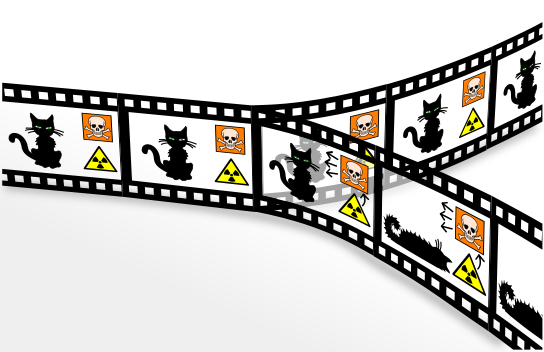
In other words, when the box is opened, the observer and the possibly-dead cat split into an observer looking at a box with a dead cat, and an observer looking at a box with a live cat.
But since the dead and alive states are decoherent, there is no effective communication or interaction between them. We have created parallel universes!
Decoherence interpretation
When opening the box, the observer becomes entangled with the cat.
Therefore “observer states” corresponding to the cat’s being alive and dead are formed; each observer state is entangled or linked with the cat so that the “observation of the cat’s state” and the “cat’s state” correspond with each other.
Quantum decoherence ensures that the different outcomes have no interaction with each other. The same mechanism of quantum decoherence is also important for the interpretation in terms of consistent histories.
Only the “dead cat” or the “alive cat” can be a part of a consistent history in this interpretation.

External resources
https://www.newscientist.com/article/2097199-seven-ways-to-skin-schrodingers-cat/
Learning Standards
SAT Subject Test: Physics
Quantum phenomena, such as photons and photoelectric effect
Atomic, such as the Rutherford and Bohr models, atomic energy levels, and atomic spectra
Nuclear and particle physics, such as radioactivity, nuclear reactions, and fundamental particles
Relativity, such as time dilation, length contraction, and mass-energy equivalence
AP Physics Curriculum Framework
Essential Knowledge 1.D.1: Objects classically thought of as particles can exhibit properties of waves.
a. This wavelike behavior of particles has been observed, e.g., in a double-slit experiment using elementary particles.
b. The classical models of objects do not describe their wave nature. These models break down when observing objects in small dimensions.
Learning Objective 1.D.1.1:
The student is able to explain why classical mechanics cannot describe all properties of objects by articulating the reasons that classical mechanics must be refined and an alternative explanation developed when classical particles display wave properties.
Essential Knowledge 1.D.2: Certain phenomena classically thought of as waves can exhibit properties of particles.
a. The classical models of waves do not describe the nature of a photon.
b. Momentum and energy of a photon can be related to its frequency and wavelength.
Content Connection: This essential knowledge does not produce a specific learning objective but serves as a foundation for other learning objectives in the course.
A Framework for K-12 Science Education: Practices, Crosscutting Concepts, and Core Ideas (2012)
Electromagnetic radiation can be modeled as a wave of changing electric and magnetic fields or as particles called photons. The wave model is useful for explaining many features of electromagnetic radiation, and the particle model explains other features. Quantum theory relates the two models…. Knowledge of quantum physics enabled the development of semiconductors, computer chips, and lasers, all of which are now essential components of modern imaging, communications, and information technologies

Unification

Ruth Fisker, Quanta Magazine
Where do all the forces of nature come from?
All the forces that we see in nature today have been discovered really to be aspects of four basic forces of nature.
Are these four forces totally separate, or are they themselves different aspects of one underlying aspect of reality?

-
Electromagnetism
-
Weak nuclear force
-
Strong nuclear force
-
Gravity
One may ask, why are there four basic forces in nature? Why not 3, or 5?
Why not an infinite number of different forces – or why not just one?
After 200 years of study, physicists have marshaled an amazing array of evidence which shows that three of these basic forces indeed are apparently just different aspects of one greater force.

The technique by which we have unified the first three of these forces has produced what is known as a Grand Unified Theory (GUT).
For the last 70 years physicists have been exploring models which be able to also unify the fourth force, gravity, with the first three. Should this be possible, it would be termed a Theory of Everything (TOE).
There may be no a priori reason why the correct description of nature has to be a unified field theory.
However, this goal has led to a great deal of progress in modern theoretical physics and continues to motivate research.

Grand Unified Theory
A GUT is a model in particle physics in which at high energy, the three gauge interactions of the Standard Model which define the electromagnetic, weak, and strong interactions or forces, are merged into one single force.
This unified interaction is characterized by one larger gauge symmetry and thus several force carriers, but one unified coupling constant.
If Grand Unification is realized in nature, there is the possibility of a grand unification epoch in the early universe in which the fundamental forces are not yet distinct.
Unifying gravity with the other three interactions would provide a theory of everything (TOE), rather than a GUT. Nevertheless, GUTs are often seen as an intermediate step towards a TOE.
The novel particles predicted by GUT models are expected to have masses around the GUT scale, a few orders of magnitude below the Planck scale – and so will be well beyond the reach of any foreseen particle collider experiments.
Therefore, the particles predicted by GUT models will be unable to be observed directly. Instead the effects of grand unification might be detected through indirect observations such as proton decay, electric dipole moments of elementary particles, or the properties of neutrinos. Some GUTs predict the existence of magnetic monopoles.
This section excerpted from https://en.wikipedia.org/wiki/Grand_Unified_Theory

Related articles
http://www.symmetrymagazine.org/article/a-gut-feeling-about-physics
Grand Unification May Be A Dead End For Physics. Ethan Siegel.
http://physics.stackexchange.com/questions/53467/unified-field-theory-in-laymans-terms
https://en.wikipedia.org/wiki/Theory_of_everything
Superstrings: A possible theory of everything
http://www.pbs.org/wgbh/nova/physics/theory-of-everything.html
http://www.smithsonianmag.com/science-nature/string-theory-about-unravel-180953637/
Learning Standards
AP Physics Curriculum Framework
Essential Knowledge 1.D.1: Objects classically thought of as particles can exhibit properties of waves.
a. This wavelike behavior of particles has been observed, e.g., in a double-slit experiment using elementary particles.
b. The classical models of objects do not describe their wave nature. These models break down when observing objects in small dimensions.
Learning Objective 1.D.1.1:
The student is able to explain why classical mechanics cannot describe all properties of objects by articulating the reasons that classical mechanics must be refined and an alternative explanation developed when classical particles display wave properties.
Essential Knowledge 1.D.2: Certain phenomena classically thought of as waves can exhibit properties of particles.
a. The classical models of waves do not describe the nature of a photon.
b. Momentum and energy of a photon can be related to its frequency and wavelength.
Content Connection: This essential knowledge does not produce a specific learning objective but serves as a foundation for other learning objectives in the course.
Gravitational repulsion and the Dipole Repeller
Ask Ethan: If Gravity Attracts, How Can The ‘Dipole Repeller’ Push The Milky Way?
Ethan Siegel, Contributor. Feb 4, 2017
Forbes.com Startswithabang 2017 Ask Ethan The Dipole Repeller

The relative attractive and repulsive effects of overdense and underdense regions on the Milky Way. Image credit: “The Dipole Repeller” by Yehuda Hoffman, Daniel Pomarède, R. Brent Tully, and Hélène Courtois, Nature Astronomy 1, 0036 (2017).
One of the most peculiar things about the Universe is how quickly the Milky Way appears to be moving. Despite having mapped out the cosmic masses nearby to unprecedented accuracy, there still doesn’t appear to be enough to cause the motion we actually experience. The idea of a “great attractor” doesn’t quite match up with what we see; what’s actually present isn’t quite “great” enough. But a new idea — that of a dipole repeller — might finally explain this longstanding conundrum. How would that work, and what it is, exactly? That’s what Darren Redfern wants to know:
What are the mechanics behind a dipole repeller? How can an area of space void of matter repulse galaxies to any meaningful extent (or at all?)?
If you were to look at all the galaxies accessible to us, you’d find, on average, that they were moving away from us at a specific rate: the Hubble rate. The farther away a galaxy is, the faster it appears to move away from us, and that’s a consequence of living in an expanding Universe governed by General Relativity. But that’s only on average. Each individual galaxy has an additional motion on top of that, known as peculiar velocity, and that’s due to the combined gravitational influence of every imperfection in the Universe on it.

The various galaxies of the Virgo Supercluster, grouped and clustered together. On the largest scales, the Universe is uniform, but as you look to galaxy or cluster scales, overdense and underdense regions dominate. Image credit: Andrew Z. Colvin, via Wikimedia Commons.
The closest large galaxy to us, Andromeda, is actually moving towards us, thanks to the Milky Way’s gravitational pull. Galaxies in the closest giant cluster of galaxies — the Virgo cluster — get extra speeds of up to 2,000 km/s on top of the Hubble flow we see. And when we look at the Big Bang’s leftover glow, the Cosmic Microwave Background, we’re able to measure our own peculiar motion through the Universe.

The CMB dipole as measured by COBE, representing our motion through the Universe relative to the CMB’s rest frame. Image credit: DMR, COBE, NASA, Four-Year Sky Map.
This “cosmic dipole” we see is redshifted in one direction (meaning we’re moving away from it) and blueshifted in the other (meaning we’re moving towards it), and we can reconstruct the motion of the entire local group as a result. Us, Andromeda, Triangulum and everything else is moving at a speed of 631 km/s relative to the Hubble flow, and we know that gravitation must be the cause of this. When we look out at where the galaxies are located, we can map out their masses and how much of an attractive force they exert.

two-dimensional slice of the overdense (red) and underdense (blue/black) regions of the Universe nearby us. Image credit: Cosmic Flows Project/University of Hawaii, via http://www.cpt.univ-mrs.fr/.
Thanks to the recent Cosmic Flows project, we’ve not only mapped out the nearby Universe to better precision than ever before, we discovered that the Milky Way lies on the outskirts of a giant collection of galaxies pulling us towards it: Laniakea. This is a significant contributor to our peculiar motion, but it isn’t enough to explain all of it on its own. Gravitational attraction is only half the story. The other half? It comes from gravitational repulsion. Let me explain.
Imagine you have a Universe where you have an equal number of masses evenly spaced everywhere you look. In all directions, at all locations, the Universe is filled with matter of even density. If you put an extra mass a certain distance to your left, you’ll be attracted towards your left, because of gravitational attraction.
But if you remove some of the mass that same distance to your right, you’ll also be attracted towards your left! In a perfectly uniform Universe, you’d be attracted to all directions equally, and that attractive force would cancel out. But if you remove some mass from one particular direction, it can’t attract you as strongly, and so you’re attracted preferentially in the other direction.

Dipoles are most common in electromagnetism, where we think of negative as attractive and positive as repulsive. If you thought of this gravitationally, negative would be ‘extra mass’ and therefore attractive, while positive would be ‘less mass’ and therefore, relative to everything else, repulsive. Image credit: Wikimedia Commons user Maschen.
It’s not technically a gravitational repulsion, since gravitation is always attractive, but you’re less attracted to one direction than all the others, and so an underdense region effectively acts as a gravitational repeller. You can even imagine a situation where you have an overly dense region on one side of you with an underdense region on the other side. You’d experience the greatest magnitude of attraction and repulsion simultaneously. This is what the idea of the dipole repeller is.

The gravitational attraction (blue) of overdense regions and the relative repulsion (red) of the underdense regions, as they act on the Milky Way. Image credit: “The Dipole Repeller” by Yehuda Hoffman, Daniel Pomarède, R. Brent Tully, and Hélène Courtois, Nature Astronomy 1, 0036 (2017).
It’s difficult to measure where an underdense region is, since regions of average density are fairly devoid of galaxies as well as the underdense ones. But a recently discovered cosmic void relatively nearby, and in the opposite direction to the large concentration of galaxies attracting us, seems to be responsible for roughly 50% of our peculiar motion, which is exactly the amount that was unaccounted for by the overdense regions alone.
Youtube video: The Dipole Repeller video, by Daniel Pomarède. produced as part of the following publication: “The Dipole Repeller” by Yehuda Hoffman, Daniel Pomarède, R. Brent Tully, and Hélène Courtois, Nature Astronomy 1, 0036 (2017).
At long last, this could be the solution to why our Sun, galaxy and local group all exhibit the motion that they do. Gravity is never repulsive, but a less attractive force in one direction than all the others behaves indistinguishably from a repulsion. We might distinguish between a pull in one direction and a push in the opposite direction, but in astrophysics, it’s all the same thing: forces and acceleration. It doesn’t have anything to do with dark energy or a mysterious fifth force; it’s simply having an excess of matter in one direction and a dearth of matter in nearly the exact opposite direction. The result? We move through the Universe in our own particular, peculiar fashion.
Reference: The dipole repeller, Yehuda Hoffman, Daniel Pomarède, R. Brent Tully & Hélène M. Courtois, Nature Astronomy 1, Article number: 0036 (2017).
Ethan Siegel, Contributor. Feb 4, 2017
Forbes.com Startswithabang 2017 Ask Ethan The Dipole Repeller
Subtractive color
There are 2 ways to create color:
additive model/RGB:
Make new colors by adding beams of light
RGB: red, green, blue
subtractive model/CMYK:
Making new colors by adding pigments (dyes, inks, paints)
CMYK: Cyan, Magenta, Yellow, Black
This lesson is on the subtractive color model.

Paints/inks/dyes contain pigments, molecules that absorb some frequencies of light, but not others.
When paints/inks/dyes are mixed, the mixture absorbs all the frequencies that each individual one absorbs.
Examples:
Blue paint absorbs red, orange, and yellow light. It reflects the rest (blue, violet, some green)
Yellow paint absorbs blue & violent. It reflects mostly yellow, and some red, orange, and green.
Images by Paul Hewitt

Mixing colored light is called color mixing by addition.
When you cast lights on a stage, you use the rules of color addition, but when you mix paint, you use the rules of color subtraction.
The three colors most useful in color mixing by subtraction are:
• magenta (bluish red)
• yellow
• cyan (greenish blue)
Magenta, yellow, and cyan are the subtractive primary colors, used in printing illustrations in full color.

Color printing is done on a press that prints each page with four differently colored inks (magenta, yellow, cyan, and black).
• Each color of ink comes from a different plate, which transfers the ink to the paper.
• The ink deposits are regulated on different parts of the plate by tiny dots.
• The overlapping dots of three colors plus black give the appearance of many colors.

SlideShare on Color and Light
Learning Standards
Massachusetts Arts Curriculum Framework: The Practice Of Creating
PreK- 4 Visual Arts Standards – Identify primary and secondary colors; predict and demonstrate the effects of blending or overlapping primary colors; demonstrate knowledge of making dark to light values of colors. Identify and use basic two-dimensional hollow and solid geometric shapes (circle, triangle, square, rectangle) and three-dimensional forms (sphere, pyramid, cube).
Grades 5-8 Visual Arts Standards – Create compositions that reflect knowledge of the elements and principles of art, i.e., line, color, form, texture; balance, repetition, rhythm, scale, and proportion. Demonstrate the ability to apply elements and principles of art to graphic, textile, product, and architectural design.
Massachusetts Arts Curriculum Framework, The Arts Disciplines: Visual Arts, PreK–12 STANDARD 2: Elements and Principles of Design
By the end of Grade 4: 2.1 Students will, for color, explore and experiment with the use of color in dry and wet media Identify primary and secondary colors and gradations of black, white and gray in the environment and artwork.
By the end of Grade 8: 2.7 Students will, for color, use and be able to identify hues, values, intermediate shades, tints, tones, complementary, analogous, and monochromatic colors. Demonstrate awareness of color by painting objective studies from life and freeform abstractions that employ relative properties of color.
Additive color
There are 2 ways to create color:
additive model/RGB:
Make new colors by adding beams of light
RGB: red, green, blue
subtractive model/CMYK:
Making new colors by adding pigments (dyes, inks, paints)
CMYK: Cyan, Magenta, Yellow, Black
This lesson is on the additive color model.

This lesson is from Apple Valley High School
http://www.district196.org/avhs/dept/science/physics/physicsweb04/AVHSPhysics/color-notes.html
Additive color: mixing beams of colored light
We start with no light, and add colors of light together to get the final result.
Complementary colors: These are two colors (one primary, one secondary) which, when added together, make white light. They are:
magenta and green
yellow and blue
cyan and red
Three projectors emit the 3 primary colors of light (red, green, blue) on a “white” screen.
Where two of the primary colors overlap you’ll find a secondary color.
Where all three overlap you’ll find white light.
Complementary colors are always across the white spot from each other in this “color wheel”.

Mixing colors of light
We have a white screen. It can reflect any color of light we shine on it.
Now shine red light on the surface – and hold up a hand so we cast a shadow.
The shadow will have no light hitting it so it will be black, while the rest of the screen would reflect the red light.

Now let’s add a green light on the right side of the picture.
Check out what happens now!

Notice how the screen has both green and red which makes yellow.
The shadow on the left blocks the green light, so the red light is the only light that hits that particular shadow.
The right shadow is green for the same reason. Cool, huh?
Now let’s add blue in the center. Check it out!

The screen has gone to white since it has red, green and blue striking it’s surface.
It reflects all 3 colors back to our eyes, so we see white.
The shadows are now the secondary colors (magenta, yellow, cyan).
This is because each shadow has 2 of the 3 primary colors hitting it, so it becomes one of the secondary colors.
Note: All of this is ONLY for mixing rays of light. If you try mixing pigments (the colored chemicals in paints, crayons, dyes, markers, etc) we will get totally different results.
Looking at a white object in a white light:

.

m

m

m

m

m

m

Problems
When three colored lamps, red, blue and green, illuminate a physics instructor in front of a white screen in a dark room, three slightly overlapping shadows appear. Specify the colors in regions 1 through 6.

http://dev.physicslab.org/Document.aspx?doctype=5&filename=Compilations_NextTime_Shadows2.xml
External lessons
PhET lab color vision
Additive and Subtractive Color in early color movies
http://www.widescreenmuseum.com/oldcolor/oldcolor.htm
Learning Standards
Massachusetts Arts Curriculum Framework: The Practice Of Creating
PreK- 4 Visual Arts Standards – Identify primary and secondary colors; predict and demonstrate the effects of blending or overlapping primary colors; demonstrate knowledge of making dark to light values of colors. Identify and use basic two-dimensional hollow and solid geometric shapes (circle, triangle, square, rectangle) and three-dimensional forms (sphere, pyramid, cube).
Grades 5-8 Visual Arts Standards – Create compositions that reflect knowledge of the elements and principles of art, i.e., line, color, form, texture; balance, repetition, rhythm, scale, and proportion. Demonstrate the ability to apply elements and principles of art to graphic, textile, product, and architectural design.
Massachusetts Arts Curriculum Framework: The Arts Disciplines: Visual Arts – PreK–12 STANDARD 2: Elements and Principles of Design
By the end of Grade 4: 2.1 Students will, for color, explore and experiment with the use of color in dry and wet media Identify primary and secondary colors and gradations of black, white and gray in the environment and artwork.
By the end of Grade 8: 2.7 Students will, for color, use and be able to identify hues, values, intermediate shades, tints, tones, complementary, analogous, and monochromatic colors. Demonstrate awareness of color by painting objective studies from life and freeform abstractions that employ relative properties of color
 KaiserScience