
Home » Physics (Page 3)
Category Archives: Physics

When buildings collapse: analysis of structural failures
Engineering is the use of physics to safely design buildings, vehicles, or infrastructure.
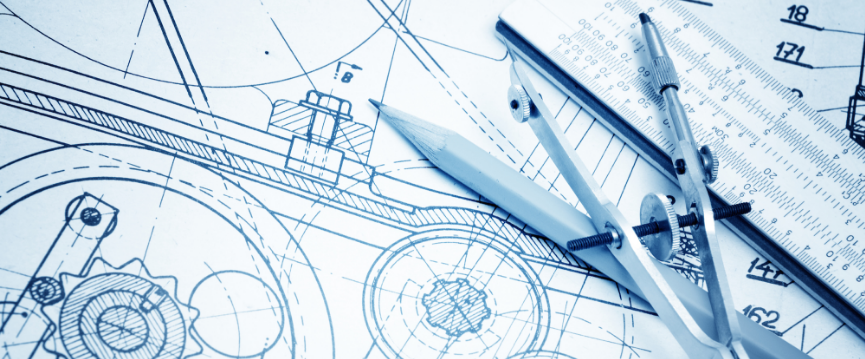
Basic idea: Loads on architectural and civil engineering structures
Structural loads are an important consideration in the design of buildings.
Building codes require that structures be designed and built to safely resist all actions that they are likely to face during their service life.
Minimum loads are specified in these building codes for types of structures, geographic locations, usage and building materials.
A famous example of why we need to understand and calculate forces correctly is the Ponte Morandi (Morandi Bridge) bridge collapse. This was a bridge in Genoa, Italy, constructed in the 1960s over the river Polcevera. In 2018, it collapsed during a rainstorm. 43 people died. This led engineers to engage in extensive analysis of the structural failure.
This diagram shows how engineers use physics – forces and vectors – to model the stress and load on every part of a structure.

from the New York Times article, Genoa Bridge Collapse:
The Road to Tragedy. 9/6/2018
Structural loads are split into categories by their originating cause. In terms of the actual load on a structure, there is no difference between dead or live loading, but the split occurs for use in safety calculations or ease of analysis on complex models.
We have to take many kinds of loads into consideration:
Dead loads, Live loads, Environmental loads,
Changes in loads due to
• Foundation settlement or displacement
• Fire
• Corrosion
• Explosion
• Creep (tendency of a solid material to move slowly or deform permanently under the influence of persistent mechanical stresses)
• Impact from vehicles or machinery vibration
• Construction loads
(This section adapted from Structural load, Wikipedia.)

As science teachers we can use news events about structural collapse to illuminate NGSS Phenomena; this is a storyline approach to teaching physics.
Such phenomenon tie into:
Dynamics – the study of forces and their effects on motion. In high school we learn about this as “Forces” and “Newton’s laws of motion.”
Vectors are ways of showing the magnitude and direction of forces.
Mechanical equilibrium: If civil engineering was religion, the first commandment would be: “Thou shalt always have static equilibrium.” The principle is simple: the sum of all the forces acting on a structure should come to zero.
Free body diagrams – The simplest way to understand how objects are affected by forces: free body diagrams.
Surfside Condominium Florida collapse, 2021
‘Something Off’: Miami Collapse Complex Had Issues, Justin Rohrlich and Zoe Richards, The Daily Beast, 6/25/2017
The Champlain Towers complex was the subject of at least one lawsuit, and it attracted the attention of scientists alarmed over land erosion.

9/11 terrorist attack and destruction of the World Trade Center, 2001
The September 11 attacks, often referred to as 9/11, were a series of four coordinated terrorist attacks by the Wahhabi Islamist terrorist group Al-Qaeda against the United States. This occurred on the morning of Tuesday, September 11, 2001.

FEMA Chapter 2. World Trade Center Building Performance Study: Data Collection, Preliminary Observations, and Recommendations. FEMA 403, May 2002
Image above from FEMA Chapter 2. World Trade Center Building Performance Study: Data Collection, Preliminary Observations, and Recommendations. FEMA 403, May 2002
Engineering analysis of the destruction. Addressing conspiracy theories
Boston, Massachusetts area events
2000 Commonwealth Avenue collapse (in 1971)
Failure case studies – 2000 Commonwealth Avenue, Boston
Collapse of 2000 Commonwealth Avenue: Punching Shear Case Study
Punching shear is usually the critical failure mechanism for flat slab reinforced concrete structures. This mechanism is illustrated in Fig. 5. With this type of failure, the column and part of the slab punch through the slab as it moves downward.
The force acting on the slab around a column overcomes the resistance and the slab falls down around the column. A portion of the slab is left around the column, but the remainder of the slab falls to the next floor. If the lower slab is unable to hold up both floors, then a progressive collapse will begin.
Also, punching shear redistributes forces acting on the failed slab to other columns. If the other columns cannot carry the added weight, then the slab will start punching through the surrounding columns as well. Punching shear at one column can initiate a complete failure of a building.

When the Pickwick Club Collapse Killed 44 in Boston; the Charleston Took the Blame, event in 1925, New England Historical Society
Related articles
Making a Difference when Disaster Strikes: Structural Engineering Emergency Response
William C. Bracken, Structure magazine, 2/2018
Learning from Disasters, Jessica Mandrick, Structure magazine, 11/2016
Structural integrity and failure, Wikipedia
Thanks for visiting my website. We have resources for teachers of Astronomy, Biology, Chemistry, Earth Science, Physics, Diversity and Inclusion in STEM, and connections with reading, books, TV, and film. At this next link are some great resources at Teachers Pay Teachers, including free downloads – KaiserScience TpT resources
Learning Standards
2016 Massachusetts Science and Technology/Engineering Curriculum Framework
HS-PS2-1. Analyze data to support the claim that Newton’s second law of motion is a mathematical model describing change in motion (the acceleration) of objects when acted on by a net force.
HS-PS2-10(MA). Use free-body force diagrams, algebraic expressions, and Newton’s laws of motion to predict changes to velocity and acceleration for an object moving in one dimension in various situations
2016 High School Technology/Engineering
HS-ETS1-1. Analyze a major global challenge to specify a design problem that can be improved. Determine necessary qualitative and quantitative criteria and constraints for solutions, including any requirements set by society.
HS-ETS1-2. Break a complex real-world problem into smaller, more manageable problems that each can be solved using scientific and engineering principles.
HS-ETS1-3. Evaluate a solution to a complex real-world problem based on prioritized criteria and trade-offs that account for a range of constraints, including cost, safety, reliability, aesthetics, and maintenance, as well as social, cultural, and environmental impacts.
HS-ETS1-4. Use a computer simulation to model the impact of a proposed solution to a complex real-world problem that has numerous criteria and constraints on the interactions within and between systems relevant to the problem.
HS-ETS1-5(MA). Plan a prototype or design solution using orthographic projections and isometric drawings, using proper scales and proportions.
HS-ETS1-6(MA). Document and present solutions that include specifications, performance results, successes and remaining issues, and limitations.
A FRAMEWORK FOR K-12 SCIENCE EDUCATION: Practices, Crosscutting Concepts, and Core Ideas
PS2.A: FORCES AND MOTION
How can one predict an object’s continued motion, changes in motion, or stability?
Interactions of an object with another object can be explained and predicted using the concept of forces, which can cause a change in motion of one or both of the interacting objects… At the macroscale, the motion of an object subject to forces is governed by Newton’s second law of motion… An understanding of the forces between objects is important for describing how their motions change, as well as for predicting stability or instability in systems at any scale.
What is chaos? The butterfly effect explained
Chaos theory is a branch of mathematics focusing on chaos.
Chaos is a behavior of any dynamical systems which appear to have random change and irregularities, but which actually follow simple underlying patterns and deterministic laws.
The butterfly effect describes how a small change in one state of a deterministic nonlinear system can result in large differences in a later state. There is nothing random or mysterious – just a very sensitive dependence on initial conditions.
A metaphor for this behavior is that a butterfly flapping its wings in one place can eventually cause a hurricane someplace else.
The discovery of the butterfly effect comes from the work of mathematician and meteorologist Edward Lorenz. He discovered that the details of a tornado (exact time of formation, exact path taken) is very influenced by minor perturbations, such as, just say for example, a distant butterfly flapping its wings several weeks earlier.
Lorenz discovered the effect when he observed runs of his weather model with initial condition data that were rounded in a seemingly inconsequential manner. He noted that the weather model would fail to reproduce the results of runs with the unrounded initial condition data. A very small change in initial conditions had created a significantly different outcome.
Basic idea: Whenever we look at something in the real world – or even in a computer simulation! – we always have either errors in measurements, or problems due to rounding errors in numerical computation.
This leads, over time, to widely diverging outcomes of these systems, making long-term specific prediction of their behavior impossible.
This is true even though such systems are deterministic and is fully determined by their initial conditions, with no random elements involved.
In other words, the deterministic nature of these systems does not make them predictable.
Explainer: What is chaos theory?
Chaos Theory, The Butterfly Effect, And The Computer Glitch That Started It All
What is Chaos? a five-part online course for everyone
Chaos is something that shows up in any complex, classical system.
We can never know the initial conditions of an object (position, speed, momentum, etc.) with complete accuracy.
So small uncertainties over time lead to large uncertainties as time goes by.

IMAGE FROM WIKIPEDIA, DOUBLE-COMPOUND-PENDULUM.GIF
This is an animation of a double compound pendulum showing chaotic behaviour.
The two sections of the pendulum have the same length and mass. The mass is distributed evenly along the length of each section, and the pivots being at the very ends.
Here we see that even planetary orbits are not stable forever.
Chaos orbit of 6Q0B44E orbit around Earth data from NASA’s Horizon’s system.
Prof. Rory Barnes animations of chaos in planetary orbits
See What defines a stable orbit?
History of the field
Joshua Sokol writes
The story of chaos is usually told like this: Using the LGP-30, Lorenz made paradigm-wrecking discoveries. In 1961, having programmed a set of equations into the computer that would simulate future weather, he found that tiny differences in starting values could lead to drastically different outcomes.
This sensitivity to initial conditions, later popularized as the butterfly effect, made predicting the far future a fool’s errand. But Lorenz also found that these unpredictable outcomes weren’t quite random, either. When visualized in a certain way, they seemed to prowl around a shape called a strange attractor.
About a decade later, chaos theory started to catch on in scientific circles. Scientists soon encountered other unpredictable natural systems that looked random even though they weren’t: the rings of Saturn, blooms of marine algae, Earth’s magnetic field, the number of salmon in a fishery.
Then chaos went mainstream with the publication of James Gleick’s Chaos: Making a New Science in 1987.
Before long, Jeff Goldblum, playing the chaos theorist Ian Malcolm, was pausing, stammering and charming his way through lines about the unpredictability of nature in Jurassic Park.
… Yet two women programmers played a pivotal role in the birth of chaos theory. Their previously untold story illustrates the changing status of computation in science. Ellen Fetter and Margaret Hamilton were responsible for programming the enormous 1960s-era computer that would uncover strange attractors and other hallmarks of chaos theory….
The Hidden Heroines of Chaos, Quanta Magazine
Videos
Chaotic Solar System
Chaotic Planets MinuteLabs.io
Apps
Gravity Simulator TestTubeGames
Chaotic Planets app MinuteLabs.io
Articles
The Butterfly Effect: Everything You Need to Know About This Powerful Mental Model
When the Butterfly Effect Took Flight, MIT News Magazine
Chaos Theory, The Butterfly Effect, And The Computer Glitch That Started It All
Edward Norton Lorenz, biography, University of St Andrews, Scotland
The Hidden Heroines of Chaos, Quanta Magazine
Thanks for visiting my website. We have resources for teachers of Astronomy, Biology, Chemistry, Earth Science, Physics, Diversity and Inclusion in STEM, and connections with reading, books, TV, and film. At this next link are some great resources at Teachers Pay Teachers, including free downloads – KaiserScience TpT resources

How to draw elliptical orbits lab
Here’s an easy to do lab that just requires paper, a pencil, some string, thumbtacks, and cardboard to lay the paper on. With this we can demonstrate the path of objects around the sun.
Basic idea: A circle is just a special case of an ellipse!

How to draw elliptical orbits
The next few paragraphs are from “Science Curriculum by Aaron Keller”
Pictures of the Solar System tend to show all the orbits of the planets as circles centered on the Sun [but] no orbit in the solar system is perfectly round.
In reality, the planets orbit the Sun traveling along an oval path. The mathematical term for this shape is an ellipse.
Notice that the Sun in this picture is not right in the center. The Sun is at one of the two ‘centers’ of the ellipse. These are called foci (plural for focus). The closer these foci are together, the more circular the orbit. The orbit of Venus is the closest to a circle of any planet in the Solar System.
Scientists have a name to describe just how much like an ellipse an orbit is. This is called eccentricity and is a measure that uses numbers between 0 and 1.
If an orbit has an eccentricity close to 1 then the ellipse is so long as to be more cigar-shaped than round.
Comets tend to have very elongated, high-eccentricity orbits.
The closer the eccentricity is to zero, the more circular the orbit.
Ellipse = the big oval shape.
Has a major axis (the longer axis) and a minor axis (the shorter one).
Has two foci: in the case of planetary orbits one focus is the Sun.
All the points in an ellipse are defined in relation to the foci.
The sum of the distances from each point on the ellipse to both foci is constant for all points on the ellipse.
Point on an orbit nearest the Sun is called perihelion.
Point farthest from the Sun is called aphelion.

Here is a similar image from a different source.

From Brian Ventrudo, One Minute Astronomy, Kepler’s laws
External links
Introductory Astronomy: Ellipses
Thanks for visiting my website. We have resources for teachers of Astronomy, Biology, Chemistry, Earth Science, Physics, Diversity and Inclusion in STEM, and connections with reading, books, TV, and film. At this next link are some great resources at Teachers Pay Teachers, including free downloads – KaiserScience TpT resources
Learning Standards
Massachusetts Curriculum Frameworks for Mathematics
Expressing Geometric Properties with Equations G-GPE Translate between the geometric description and the equation for a conic section.
3. (+) Derive the equations of ellipses and hyperbolas given the foci, using the fact that the sum or difference of distances from the foci is constant.
MA.3.a. (+) Use equations and graphs of conic sections to model real-world problems.
Expressing Geometric Properties with Equations G-GPE Translate between the geometric description and the equation for a conic section. 3. (+) Derive the equations of ellipses and hyperbolas given the foci, using the fact that the sum or difference of distances from the foci is constant. MA.3.a. (+) Use equations and graphs of conic sections to model real-world problems.
Analytic geometry. The branch of mathematics that uses functions and relations to study geometric phenomena, e.g., the description of ellipses and other conic sections in the coordinate plane by quadratic equations.
2016 Massachusetts Science and Technology/Engineering Curriculum Framework
8.MS-ESS1-2. Explain the role of gravity in ocean tides, the orbital motions of planets, their moons, and asteroids in the solar system.
HS-ESS1-4. Use Kepler’s laws to predict the motion of orbiting objects in the solar system. Describe how orbits may change due to the gravitational effects from, or collisions with, other objects in the solar system.
ESS1.B Earth and the solar system – The solar system contains many varied objects held together by gravity. Solar system models explain and predict eclipses, lunar phases, and seasons.
Do data (information) have mass?
Is data – information – something physically real? As it turns out, yes. All data has physical reality.
What about performing a computation? Computation is a process on data. Since data has physical reality then all computations are physical processes.
This connects with the laws of thermodynamics! In the 1960s Rolf Landauer realized that whenever we manipulate or erase information, entropy increases.
Data can be stored on any physical objects.
Here’s an example in which data is stored with real objects, each of which has mass, but changing data adds no weight:
Get 256 coins. Lay them out on a table.
Use heads to represent a ‘1’ and tails to represent a ‘0’.
Arrange the coins to create a sequence of 1’s and 0’s.
This then encodes 256 bits (32 bytes) of data.
We can erase this data by flipping all of the coins to ‘0’.
The mass of the coins does not change.
Flip the heads and tails all you like. New data, but no added mass.
But now let’s change our storage system. Get 256 empty glasses, lay them out on a table, in a grid. Use an empty glass to represent a 0 and add water to the glass to represent a 1. Here different data would have different mass.
Ways of storing data
Info in ancient cuneiform tablets

(Contract for the sale of a field and a house in the wedge-shaped cuneiform adapted for clay tablets, Shuruppak, Sumer, circa 2600 BC.E)
Letters written on parchment – or any kind of ink on paper, is data.

This is the earliest type of punch card, a way to store data as zeroes and ones.

and here is the Babbage computer, the Difference Engine.
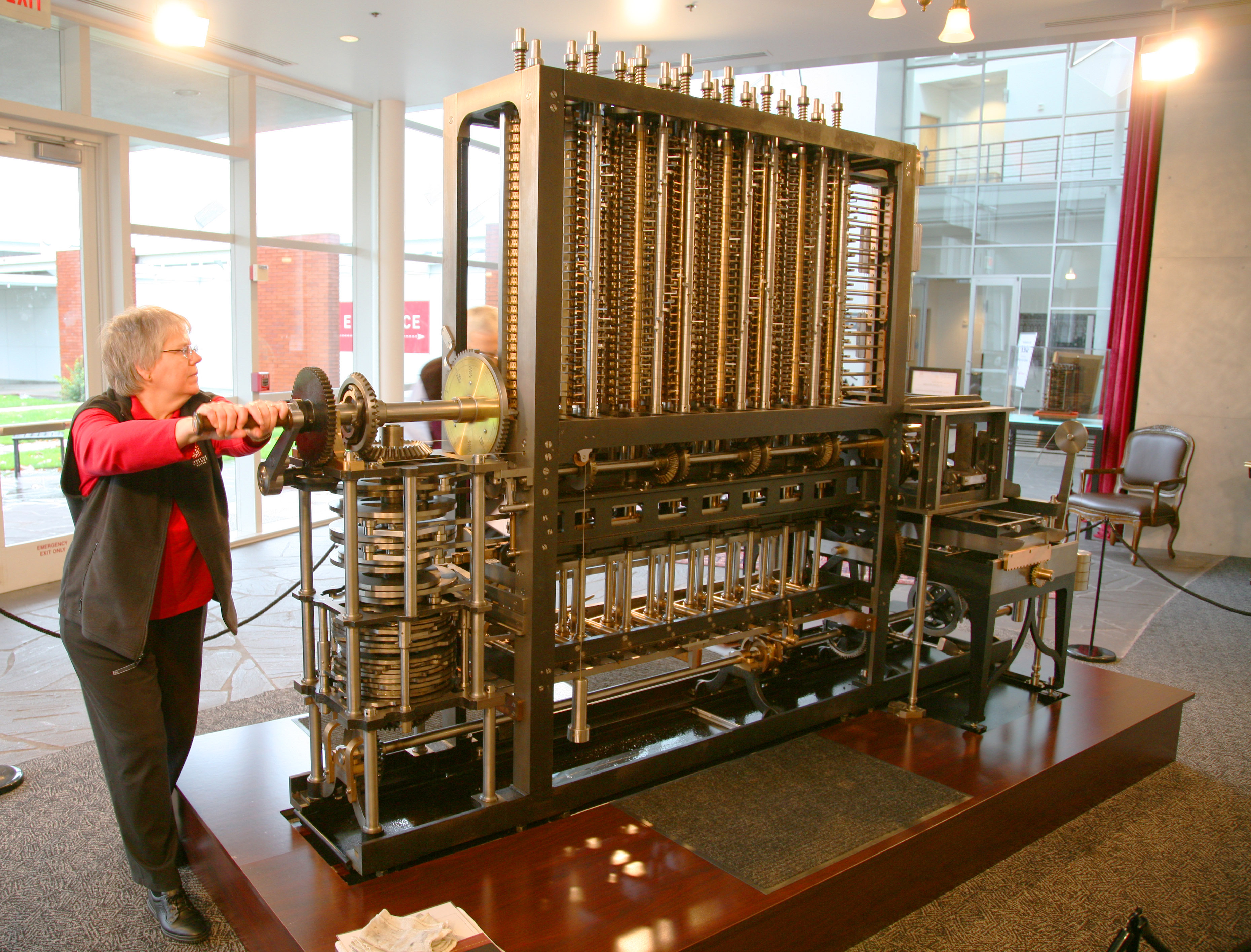
1970s punch card, storing data for a Fortran computer program.

Data can be create and stored with paper and pencil.

Data can be recorded as a series of indentations on a vinyl circular disc, such as a vinyl LP record.
Here we see the needle of a vinyl LP record player going through the grooves.

Hard drives – patterns of magnetized particles

CD, DVD and Blu-Ray disks – burn patterns pits in a disk.

A Flash drive stores information in patterns of electrical charges
Transistors can store information. They trap electrons like a capacitor.
Does adding data to a hard drive or floppy disk drive change its mass?
For the most part, no. Data is stored by switching the magnetic polarity of tiny particles on one part of the disk. No mass is added or taken away.
Switching the polarity of tiny particles on a disk is just analogous to picking up a magnet and turning it around. Nothing added or taken away.
But, if we look at the physics much more closely –
“Hard drives store data by flipping poles in magnetic domains on the disk – at first glance this means nothing is added or subtracted and thus no weight.
However, that’s not the whole picture. The orientation of those domains matter.
There is less total field energy when the domains are 1010101010 than when they are 11111111 or 00000000. I’m sure everyone is familiar with e=mc^2.
Putting energy into the domains DOES mean mass, albeit an incredibly small amount of it. My physics isn’t up to even trying to estimate the mass but I’m sure it’s beyond anything the most sensitive scale could possibly measure.”
from How much does a gigabyte worth of data physically weigh on a hard disk?
Does adding data to RAM change its mass?
Some forms of RAM store data by adding electrons into certain ultra tiny parts. For all practical purposes there is not any noticeable gain in mass. But since when have we ever restricted ourselves to just practical purposes? 🙂
=== begin quote ===
In RAM, however, bits are comprised of electrons (or lack thereof) and they do have a mass which is about 9.10938215 × 10⁻³¹ kg. So for a gigabyte of memory, assuming equal distribution for zero and one bits, we get around
4294967296 n × 9.10938215 × 10−31 kg
4294967296 would be the number of one bits in memory (assumed to be 50 %) and n would be the number of electrons that are on average in one bit.
So we can give an estimate of how much mass 1 GiB (gigabyte) of memory would have:
1 GiB, half filled with ones ≈ 3.91 × 10⁻¹⁶ kg = 391 femtograms
1 GiB, completely filled with ones ≈ 7.82 × 10⁻¹⁶ kg = 782 femtograms
1 GB, half filled with ones ≈ 3.64 × 10⁻¹⁶ kg = 364 femtograms
1 GB, completely filled with ones ≈ 7.29 × 10⁻¹⁶ kg = 729 femtograms
So in general you can assume that weight to be pretty unnoticeable (or, with hard disks to be downright nonexistent).
This explanation is from How much does a gigabyte worth of data physically weigh on a hard disk?
All Computation is a physical process
The Fundamental Physical Limits of Computation
What constraints govern the physical process of computing? Is a minimum amount of energy required, for example, per logic step? There seems to be no minimum, but some other questions are open.
Charles H. Bennett, Rolf Landauer,, Scientific American, v253 n1, p.48-56 7/1985
http://web.eecs.umich.edu/~taustin/EECS598-HIC/public/Physical-Limits.pdf
Does Quantum Mechanics Flout the Laws of Thermodynamics?
Vlatko Vedral, Scientific American, 6/1/2011
Everyone who has ever worked with a computer knows that they get hotter the more we use them. Physicist Rolf Landauer argued that this needs to be so, elevating the observation to the level of a principle. The principle states that in order to erase one bit of information, we need to increase the entropy of the environment by at least as much. In other words we need to dissipate at least one bit of heat into the environment (which is just equal to the bit of entropy times the temperature of the environment).
Landauer’s erasure principle has been considered controversial in physics ever since he proposed it in the early ’60s. Was it a new law of physics or just a consequence of some already existing laws? Our new paper argues that in quantum physics, you can, in fact, erase information and cool the environment at the same time. For many physicists, this is tantamount to saying that perpetual motion is possible! What makes it possible is entanglement, but let me not get too far ahead of myself…
.

Who invented the…Engine, Auto, Radio, TV, Computer, Smartphone, GPS?
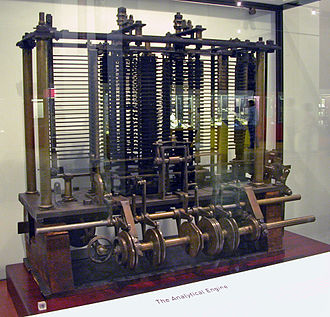
The Difference Engine of Charles Babbage, progenitor to the computer.
Who invented the …
power loom? telephone?
internal combustion engine? automobile?
radio? television? computer?
smartphone? GPS?
technology for organ transplantation?
modern light bulb?
Myth – Each of these was invented by someone.
Reality – None of these were developed by just one person. Instead, each technology developed over time – with contributions from many people.
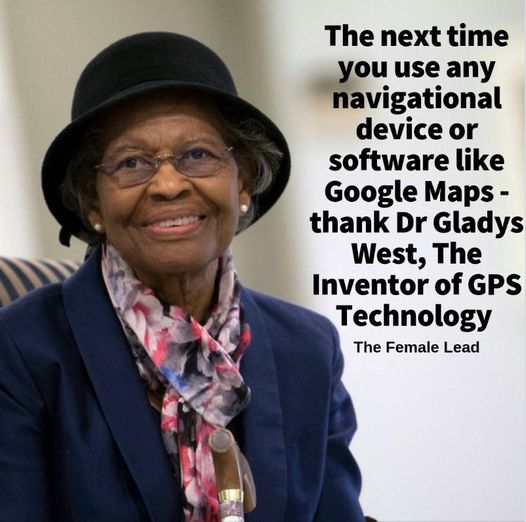
Consider a recent meme shared on social media about Dr. Gladys West. It is well-intentioned, but ends up concealing as much as it reveals.
While doing important work, she didn’t invent GPS – no one person did. Instead, we follow the contributions of many people. Here, from left to right are Friedwardt Winterberg, Bill Guier, Frank McClure, and George Weiffenbach.
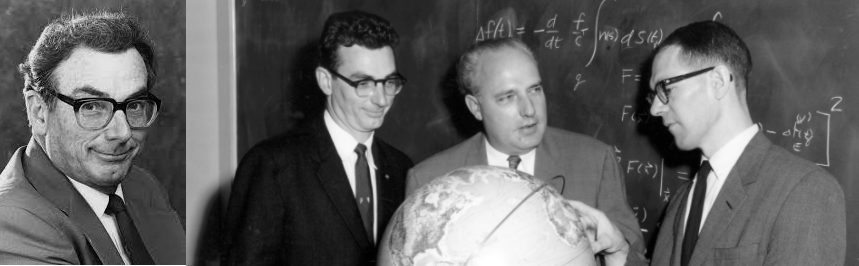
And here are Roger Easton, Ivan Getting, Bradford Parkinson, and Gladys West.

Let’s look at the story more deeply, which covers decades:
One of the fathers of GPS was Friedwardt Winterberg. Back in 1955 he proposed a test of Einstein’s theory of general relativity.
Winterberg realized that it should be possible to detect the predicted slowing of time in a strong gravitational field; this could be done by using atomic clocks placed in Earth orbit inside artificial satellites.
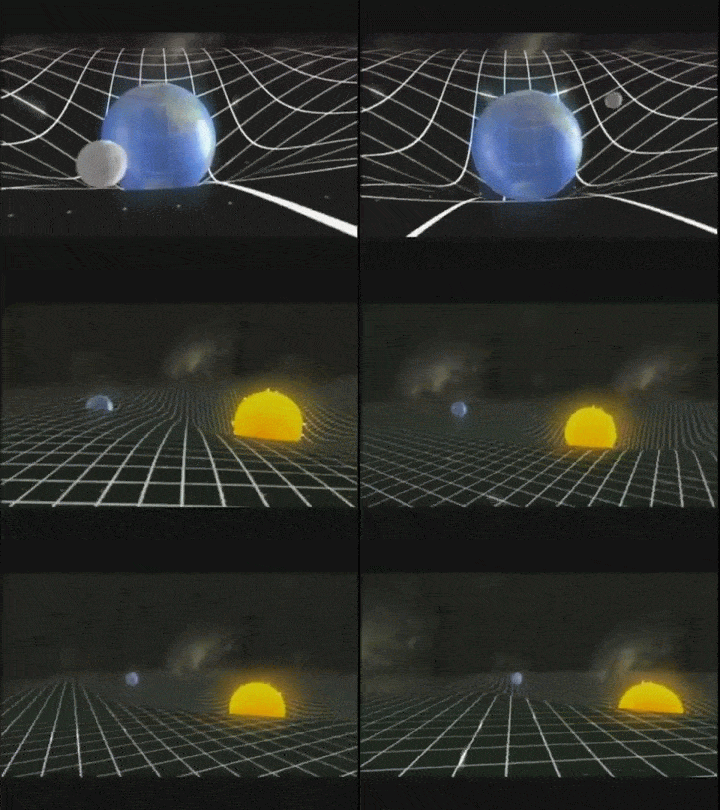
From “The Elegant Universe”, PBS series NOVA. 2003.
Contrary to the predictions of classical physics, relativity predicts that the clocks on the GPS satellites would be seen by the Earth’s observers to run 38 microseconds faster per day than the clocks on the Earth.
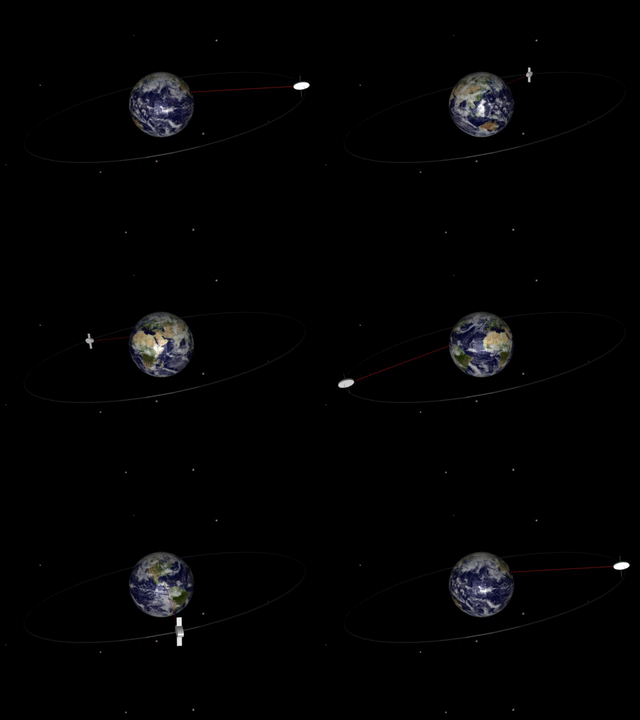
Image found on Gyfcat. Looking for the source.
His experiment was eventually experimentally verified by Hafele and Keating in 1971 by flying atomic clocks on commercial jets.
Without taking such relativistic corrections into account, any position calculated from satellite technology – such as GPS – would quickly drift into error. The error in estimated position would be as much as 10 kilometers per day (6 miles/day.)
The next people who helped create what would become GPS were William Guier and George Weiffenbach. They worked at Johns Hopkins University’s Applied Physics Laboratory (APL.)
When the Soviet Union launched the first artificial satellite (Sputnik 1) in 1957, they decided to monitor its radio transmissions.

Guier and Weiffenbach realized that, because of the Doppler effect, they could pinpoint where the satellite was along its orbit.

In 1958, Frank McClure, the deputy director of the APL, asked Guier and Weiffenbach to investigate the inverse problem – pinpointing the user’s location, given the satellite’s location.
At the time, the US Navy was developing the submarine-launched Polaris missile, which required them to know the submarine’s location.
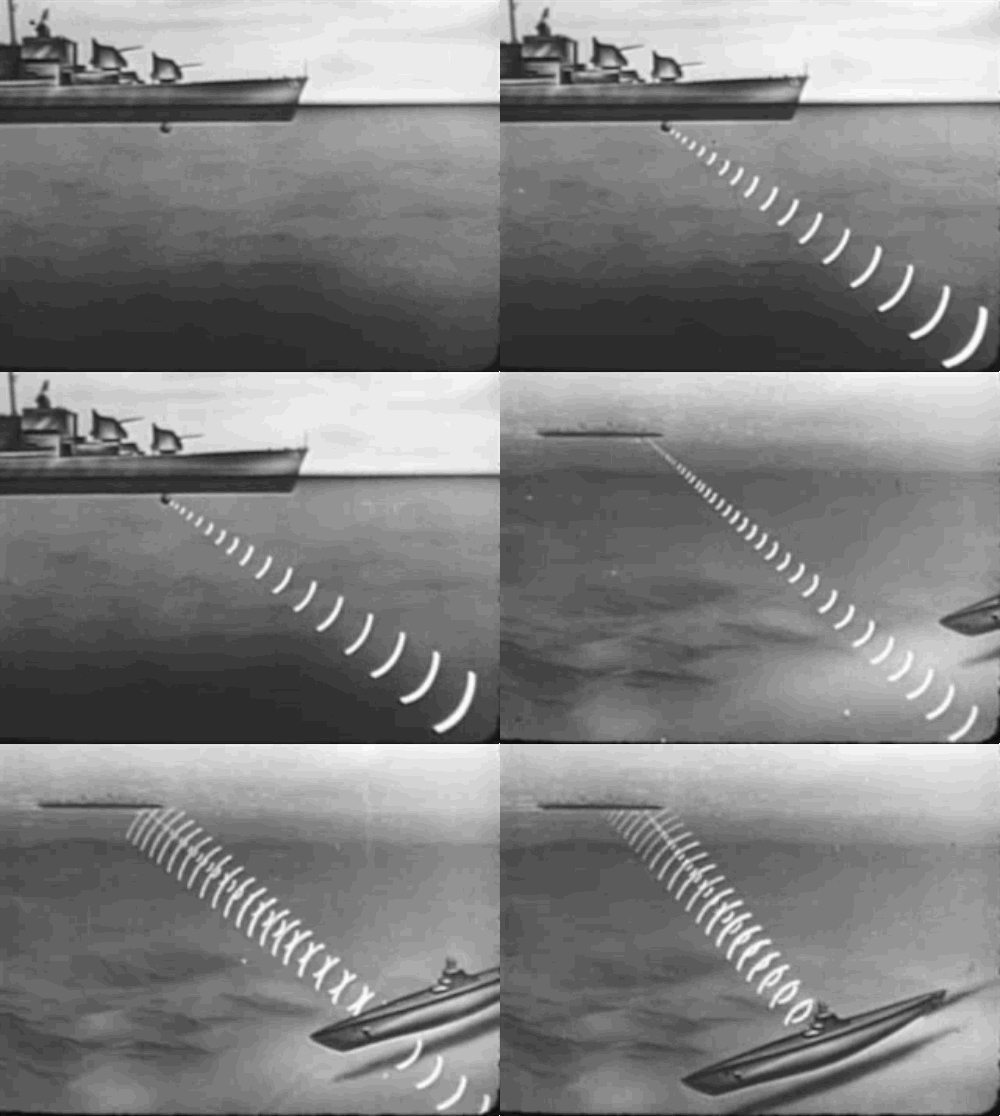
This led Guier and Weiffenbach, along with other scientists at APL to develop the TRANSIT system. Transit was used by the U.S. Navy to provide location information to its Polaris ballistic missile submarines.
It was also used as a navigation system by Navy surface ships, as well as for surveying. This system went online in 1960.
The next father of GPS would be Roger L. Easton of the Naval Research Laboratory. During the 1960s and early 1970s he developed a navigational system with passive ranging, circular orbits, and space-borne high precision clocks placed in satellites.
Ivan A. Getting of The Aerospace Corporation
In the 1950s, as head of research and engineering at Raytheon Corp., Waltham, Mass., Getting led a project to develop a mobile ballistic missile guidance system called Mosaic, which was to work like the Loran system.
But Getting envisioned another concept. Though the railroad mobile version of the intercontinental ballistic missile was cancelled, he realized that if a similar system were used, one that based the transmitters on satellites, and if enough satellites were lofted so that four were always in sight, it would be possible to pinpoint locations in three dimensions anywhere on earth. This theory led to Navstar.
For GPS, Also Thank Ivan Getting; He Got “the Damn Thing Funded, Tekla Perry, IEEE Spectrum, 4/19/2018
Bradford Parkinson of the Applied Physics Laboratory was the lead architect, advocate and developer of GPS. He was given full, direct control of the development of the demonstration system, which included satellites, a global ground control system, nine types of user receivers, and an extensive land, sea and air test program
Gladys West analyzed data from satellites, putting together altimeter models of the Earth’s shape. She became project manager for the Seasat radar altimetry project, the first satellite that could remotely sense oceans.
From the mid-1970s through the 1980s, West worked on precise calculations to model the shape of the Earth – a geoid – an ellipsoid with irregularities.
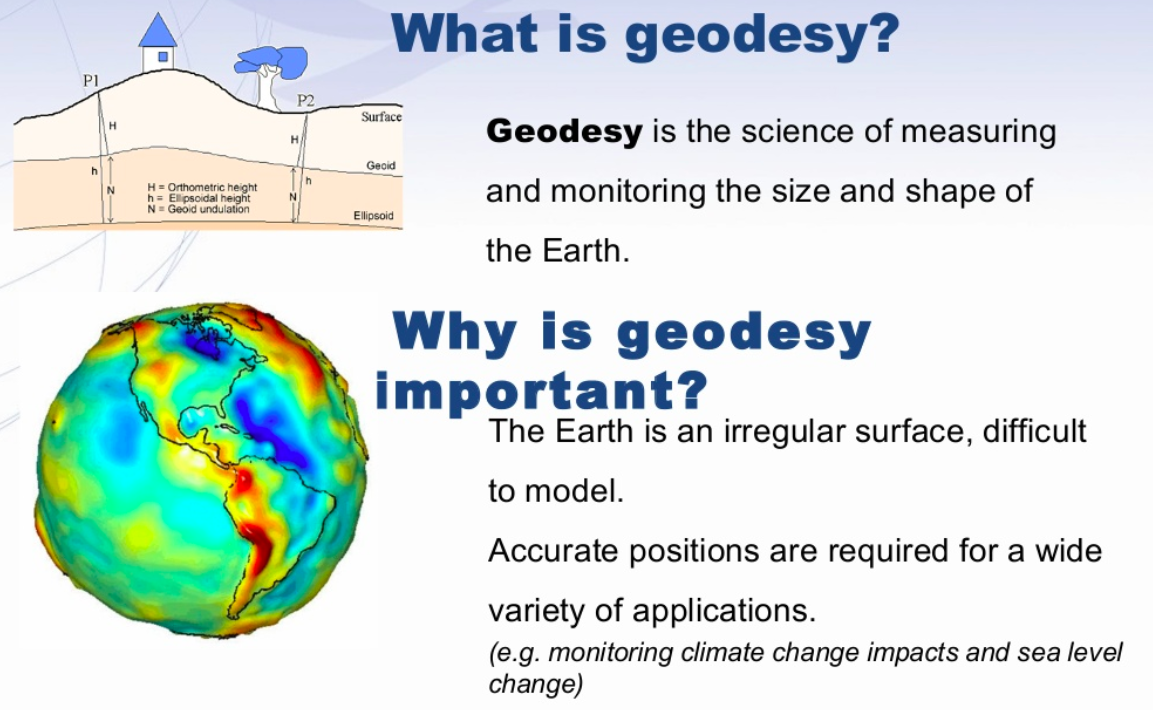
NOAA National Geodetic Survey, from a PPT by Hawaii Geographic Information Coordinating Council
Generating an extremely accurate model required her to employ complex algorithms to account for variations in gravitational, tidal, and other forces that distort Earth’s shape. This was essential for the Global Positioning System (GPS).
Whew…. and all that is just the short version of who invented the GPS. The longer version would literally take a book, a dozen hours of video, and include dozens more people.
Student project
Students will work individually or in groups, researching, and then creating a presentation on the evolution of any of these technologies.
You may propose another technology to investigate; clear it with your teacher first.
power loom? telephone?
internal combustion engine? automobile?
radio? television? computer?
smartphone? GPS?
technology for organ transplantation?
modern light bulb?
Many ways to create your report!
Select one of these options
Create a written report using MS Word/Google Docs. This will have images, text, perhaps short animations if you like. If you like, you can use the built-in voice-to-text; this will transcribe your words.
Create a video, using your favorite software & apps. This will have images, text, perhaps short animations if you like. You’ll narrate it. Share the project as a video file with us.
Create a PowerPoint/Google Slides presentation. This will have images, text, perhaps short animations if you like.
Create an Infographic. There are many websites and apps out there to do this. Choose your favorite apps. This will have images, text, perhaps short animations if you like.
Resources
Engineering & Technology History, People, and Milestones PBS Learning Media
Learning Standards
NGSS Science
HS-PS3-3. Design, build, and refine a device that works within given constraints to convert one form of energy into another form of energy.*
Crosscutting concepts – Influence of Science, Engineering and Technology on Society and the Natural World. Modern civilization depends on major technological systems. Engineers continuously modify these technological systems by applying scientific knowledge and engineering design practices to increase benefits while decreasing costs and risks.
Disciplinary Core Idea Progression Matrix – ETS2.B Manufacturing
Grade 6-8. The design and structure of any particular technology product reflects its function. Products can be manufactured using common processes controlled by either people or computers.
Grade 9-10 – Manufacturing processes can transform material properties to meet a need. Particular manufacturing processes are chosen based on the product design, materials used, precision needed, and safety.
History C3 Framework and the National Social Studies Standards
D2.Eco.13.9-12. Explain why advancements in technology and investments in capital goods and human capital increase economic growth and standards of living.
D2.Geo.7.6-8. Explain how changes in transportation and communication technology influence the spatial connections among human settlements and affect the diffusion of ideas and cultural practices.
D2.His.1.9-12. Evaluate how historical events and developments were shaped by unique circumstances of time and place as well as broader historical contexts.
Common Core
CCSS.ELA-LITERACY.W.8.4
Produce clear and coherent writing in which the development, organization, and style are appropriate to task, purpose, and audience.
CCSS.ELA-Literacy.WHST.9-10.6
CCSS.ELA-Literacy.WHST.11-12.6
Use technology, including the Internet, to produce, publish, and update individual or shared writing products, taking advantage of technology’s capacity to link to other information and to display information flexibly and dynamically.
Thanks for visiting my website. We have resources for teachers of Astronomy, Biology, Chemistry, Earth Science, Physics, Diversity and Inclusion in STEM, and connections with reading, books, TV, and film. At this next link are some great resources at Teachers Pay Teachers, including free downloads – KaiserScience TpT resources

Types of time travel
Before discussing the physics and science of time travel, we first have to define what we mean by time travel. Here I am presenting several possible types of time travel.
I. What is time? Does time really even exist?
What is time? Where does time come from? In what way is time objective, something actually out there? In what ways is time not real, but just a way that humans use to describe our perception of the universe?
To some extent, understanding these questions requires knowing something about thermodynamics especially the second law of thermodynamics. Beyond that, a deeper understanding of the nature of time may rely on understanding modern physics, especially quantum mechanics .
The following article discusses entropy and the thermodynamic arrow of time; the question of ‘does time really flow?, the concept of a block universe, and presentism versus eternalism – What is time?
II. Types of time Travel
This text is currently based on the 2008 version of the Wikipedia article.
1. There is a single fixed history, which is self-consistent and unchangeable.
In this view, everything happens on a single timeline which doesn’t contradict itself.
1.1 This can be simply achieved by applying the Novikov self-consistency principle, named after Dr. Igor Dmitrievich Novikov, Professor of Astrophysics at Copenhagen University. The principle states that the timeline is totally fixed, and any actions taken by a time traveler were part of history all along, so it is impossible for the time traveler to “change” history in any way.
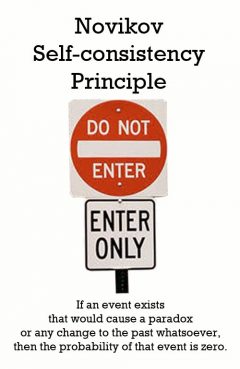
from paradoxparkway.com
The time traveler’s actions may be the cause of events in their own past though, which leads to the potential for circular causation and the predestination paradox; for examples of circular causation, see Robert A. Heinlein’s story “By His Bootstraps”.
The Novikov consistency principle assumes certain conditions about what sort of time travel is possible. Specifically, it assumes either that there is only one timeline, or that any alternative timelines (such as those postulated by the many-worlds interpretation of quantum mechanics) are not accessible.
Given these assumptions, the constraint that time travel must not lead to inconsistent outcomes could be seen merely as a tautology, a self-evident truth that can not possibly be false.
However, the Novikov self-consistency principle is intended to go beyond just the statement that history must be consistent, making the additional nontrivial assumption that the universe obeys the same local laws of physics in situations involving time travel that it does in regions of space-time that lack closed timelike curves. This is clarified in the paper “Cauchy problem in spacetimes with closed timelike curves”, where the authors write:
That the principle of self-consistency is not totally tautological becomes clear when one considers the following alternative: The laws of physics might permit CTCs; and when CTCs occur, they might trigger new kinds of local physics which we have not previously met. … The principle of self-consistency is intended to rule out such behavior. It insists that local physics is governed by the same types of physical laws as we deal with in the absence of CTCs: the laws that entail self-consistent single valuedness for the fields. In essence, the principle of self-consistency is a principle of no new physics. If one is inclined from the outset to ignore or discount the possibility of new physics, then one will regard self-consistency as a trivial principle.
1.2 Alternatively, new physical laws take effect regarding time travel that thwarts attempts to change the past (contradicting the assumption mentioned in 1.1 above that the laws that apply to time travelers are the same ones that apply to everyone else).
These new physical laws can be as unsubtle as to reject time travelers who travel to the past to change it by pulling them back to the point from when they came as Michael Moorcock’s The Dancers at the End of Time or where the traveler is rendered an noncorporeal phantom unable to physically interact with the past such as in some Pre-Crisis Superman stories and Michael Garrett’s “Brief Encounter” in Twilight Zone Magazine May 1981.
2. History is flexible and is subject to change (Plastic Time)
2.1 Changes to history are easy and can impact the traveler, the world, or both
Examples include Back to the Future, Back to the Future II, and Doctor Who.
In some cases (such as Doctor Who) any resulting paradoxes can be devastating, threatening the very existence of the universe. In other cases the traveler simply cannot return home. The extreme version of this (Chaotic Time) is that history is very sensitive to changes with even small changes having large impacts such as in Ray Bradbury’s A Sound of Thunder
2.2 History is change resistant in direct relationship to the importance of the event i.e. small trivial events can be readily changed but large ones take great effort.
In the Twilight Zone episode “Back There” a traveler tries to prevent the assassination of President Lincoln and fails but his actions have turned what had originally been the butler of the club that the traveler belonged to into a rich tycoon.
In The Time Machine (2002 film) it is explained via a vision why Hartdegen could not save his sweetheart Emma–doing so would have resulted in him never developing the time machine he used to try and save her.
The Saga of Darren Shan, where major events in the past cannot be changed, but minor events can be affected. Under this model, if a time traveler were to go back in time and kill Hitler, another Nazi would simply take his place and commit his same actions, leaving the broader course of history unchanged.
3. Many-worlds interpretation and Parallel universe (fiction)
These terms are often used interchangeably in fiction but mechanically they differ:
The Many Worlds interpretation says time travel creates a coexisting alternate history –
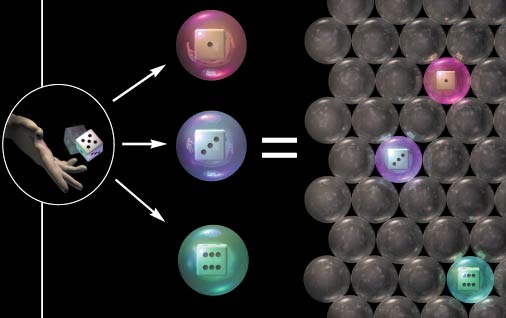
while the second idea says that the traveler actually goes to an already existing parallel world.
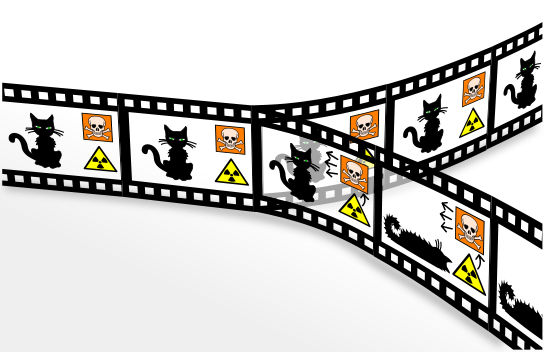
In either case the traveler’s original home reality continues to exist unaffected. These versions of time travel are sometimes placed under one of the two above categories.
James P. Hogan’s The Proteus Operation fully explains parallel universe time travel in chapter 20 where it has Einstein explaining that all the outcomes already exist and all time travel does is change which already existing branch you will experience.
Star Trek has a long tradition of using the 2.1 mechanic, as seen in the episodes City on the Edge of Forever, Tomorrow is Yesterday, Time and Again (Star Trek: Voyager), Future’s End, Before and After (Star Trek: Voyager), Endgame (Star Trek: Voyager) and as late as Enterprise’s Temporal Cold War,

The Star Trek episode Parallels had an example of what Data called a quantum realities. His exact words on the matter were “But there is a theory in quantum physics that all possibilities that can happen do happen in alternate quantum realities.” leaving it up the viewer as to the exact nature of these quantum realities.
Michael Crichton’s novel Timeline takes the approach that all time travel really is is travel to an already existing parallel universe where time passes at a slower rate than our own but changes in any of these parallel universe effects the main timeline making it behave as it if was a type 2 universe.
Discussion
While a Type 1 universe will prevent a grandfather paradox it doesn’t prevent paradoxes in other aspects of physics such as the predestination paradox and the ontological paradox (GURPS Infinite Worlds calls this Free Lunch Paradox).
The predestination paradox is where the traveler’s actions create some type of causal loop, in which some event A in the future helps cause event B in the past via time travel, and the event B in turn is one of the causes of A.
For instance, a time traveler might go back to investigate a specific historical event like the Great Fire of London, and their actions in the past could then inadvertently end up being the original cause of that very event.
Examples of this kind of causal loop are found in Timemaster, a novel by Dr. Robert Forward, the Twilight Zone episode “No Time Like the Past”, the 1980 Jeannot Szwarc film Somewhere In Time (based on Richard Matheson’s novel Bid Time Return), the Michael Moorcock novel Behold the Man, and Harry Potter and the Prisoner of Azkaban.
The Novikov self-consistency principle can also result in an ontological paradox (also known as the knowledge or information paradox) where the very existence of some object or information is a time loop.
The philosopher Kelley L. Ross argues in Time Travel Paradoxes that in an ontological paradox scenario involving a physical object, there can be a violation of the second law of thermodynamics. Ross uses Somewhere in Time as an example where Jane Seymour’s character gives Christopher Reeve’s character a watch she has owned for many years, and when he travels back in time he gives the same watch to Jane Seymour’s character 60 years in the past.
Time travel to the future in standard physics
There are various ways in which a person could “travel into the future” in a limited sense: the person could set things up so that in a small amount of his own subjective time, a large amount of subjective time has passed for other people on Earth.
For example, an observer might take a trip away from the Earth and back at relativistic velocities, with the trip only lasting a few years according to the observer’s own clocks, and return to find that thousands of years had passed on Earth.
This form of “travel into the future” is theoretically allowed using the following methods:
Using velocity-based time dilation under the theory of special relativity, for instance:
Traveling at almost the speed of light to a distant star, then slowing down, turning around, and traveling at almost the speed of light back to Earth. (see the Twin paradox)
Using gravitational time dilation under the theory of general relativity, for instance:
Residing inside of a hollow, high-mass object;
Residing just outside of the event horizon of a black hole, or sufficiently near an object whose mass or density causes the gravitational time dilation near it to be larger than the time dilation factor on Earth.
Additionally, it might be possible to see the distant future of the Earth using methods which do not involve relativity at all, although it is even more debatable whether these should be deemed a form of “time travel”:
Hibernation
Suspended animation
Time Dilation
Time dilation is permitted by Albert Einstein’s special and general theories of relativity. These theories state that, relative to a given observer, time passes more slowly for bodies moving quickly relative to that observer, or bodies that are deeper within a gravity well. For example, a clock which is moving relative to the observer will be measured to run slow in that observer’s rest frame; as a clock approaches the speed of light it will almost slow to a stop, although it can never quite reach light speed so it will never completely stop.

stars rotating overhead camping timelapse
http://i.imgur.com/SLf5dW1.gifv
For two clocks moving inertially (not accelerating) relative to one another, this effect is reciprocal, with each clock measuring the other to be ticking slower. However, the symmetry is broken if one clock accelerates, as in the twin paradox where one twin stays on Earth while the other travels into space, turns around (which involves acceleration), and returns—in this case both agree the traveling twin has aged less.
General relativity states that time dilation effects also occur if one clock is deeper in a gravity well than the other, with the clock deeper in the well ticking more slowly; this effect must be taken into account when calibrating the clocks on the satellites of the Global Positioning System, and it could lead to significant differences in rates of aging for observers at different distances from a black hole.
Time perception
Time perception can be apparently sped up for living organisms through hibernation, where the body temperature and metabolic rate of the creature is reduced. A more extreme version of this is suspended animation, where the rates of chemical processes in the subject would be severely reduced.
Time dilation and suspended animation only allow “travel” to the future, never the past, so they do not violate causality, and it’s debatable whether they should be called time travel.
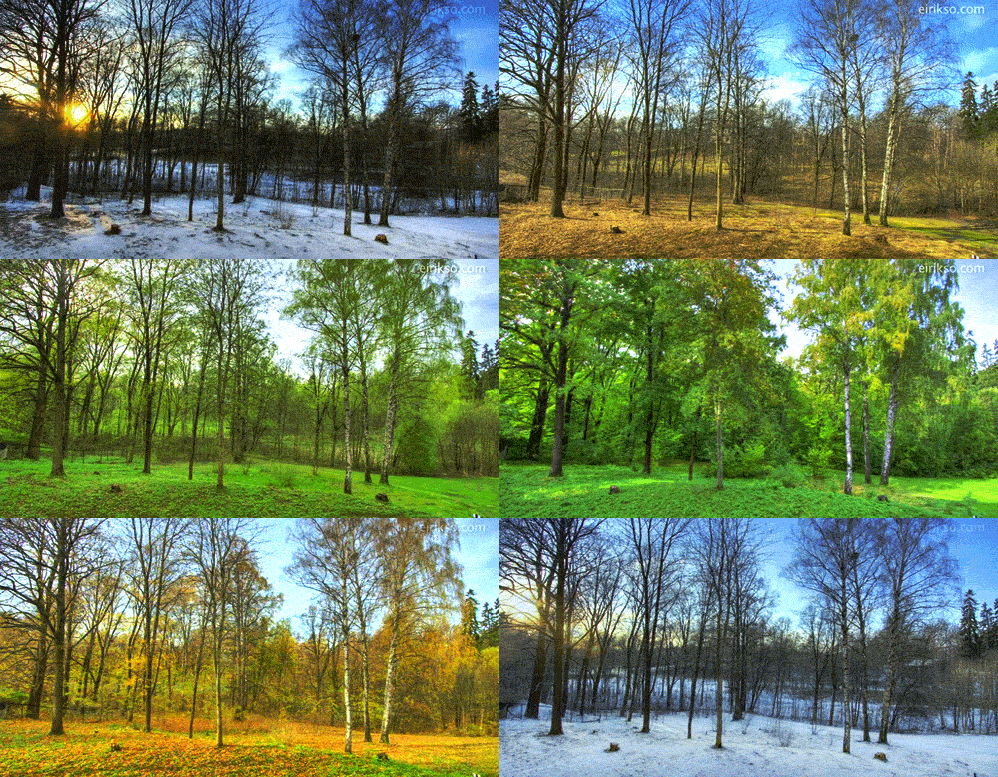
However time dilation can be viewed as a better fit for our understanding of the term “time travel” than suspended animation, since with time dilation less time actually does pass for the traveler than for those who remain behind, so the traveler can be said to have reached the future faster than others, whereas with suspended animation this is not the case.
Mutable timelines
Time travel in a Type 2 universe is much more complex. The biggest problem is how to explain changes in the past. One method of explanation is that once the past changes, so too do the memories of all observers. This would mean that no observer would ever observe the changing of the past (because they will not remember changing the past).
This would make it hard to tell whether you are in a Type 1 universe or a Type 2 universe.
You could, however, infer such information by knowing if a) communication with the past were possible or b) it appeared that the time line had never been changed as a result of an action someone remembers taking, although evidence exists that other people are changing their time lines fairly often.
An example of this kind of universe is presented in Thrice Upon a Time, a novel by James P. Hogan. The Back to the Future trilogy films also seem to feature a single mutable timeline (see the Back to the Future FAQ for details on how the writers imagined time travel worked in the movies’ world). By contrast, the short story “Brooklyn Project” by William Tenn provides a sketch of life in a Type 2 world where no one even notices as the timeline changes repeatedly.
In type 2.1, attempts are being made at changing the timeline, however, all that is accomplished in the first tries is that the method in which decisive events occur is changed; final conclusions in the bigger scheme cannot be brought to a different outcome.
As an example, the movie Deja Vu depicts a paper note sent to the past with vital information to prevent a terrorist attack. However, the vital information results in the killing of an ATF agent, but does not prevent the terrorist attack; the very same agent died in the previous version of the timeline as well, albeit under different circumstances. Finally, the timeline is changed by sending a human into the past, arguably a “stronger” measure than simply sending back a paper note, which results in preventing both a murder and the terrorist attack. As in the Back to the Future movie trilogy, there seems to be a ripple effect too as changes from the past “propagate” into the present, and people in the present have altered memory of events that occurred after the changes made to the timeline.
The science fiction writer Larry Niven suggests in his essay “The Theory and Practice of Time Travel” that in a type 2.1 universe, the most efficient way for the universe to “correct” a change is for time travel to never be discovered, and that in a type 2.2 universe, the very large (or infinite) number of time travelers from the endless future will cause the timeline to change wildly until it reaches a history in which time travel is never discovered.
However, many other “stable” situations might also exist in which time travel occurs but no paradoxes are created; if the changeable-timeline universe finds itself in such a state no further changes will occur, and to the inhabitants of the universe it will appear identical to the type 1.1 scenario.[citation needed] This is sometimes referred to as the “Time Dilution Effect”.
Few if any physicists or philosophers have taken seriously the possibility of “changing” the past except in the case of multiple universes, and in fact many have argued that this idea is logically incoherent, so the mutable timeline idea is rarely considered outside of science fiction.
Also, deciding whether a given universe is of Type 2.1 or 2.2 can not be done objectively, as the categorization of timeline-invasive measures as “strong” or “weak” is arbitrary, and up to interpretation: An observer can disagree about a measure being “weak”, and might, in the lack of context, argue instead that simply a mishap occurred which then led to no effective change.
An example would be the paper note sent back to the past in the film Deja Vu, as described above. Was it a “too weak” change, or was it just a local-time alteration which had no extended effect on the larger timeline? As the universe in Deja Vu seems not entirely immune to paradoxes (some arguably minute paradoxes do occur), both versions seem to be equally possible.
Alternate histories
In Type 3, any event that appears to have caused a paradox has instead created a new time line. The old time line remains unchanged, with the time traveler or information sent simply having vanished, never to return. A difficulty with this explanation, however, is that conservation of mass-energy would be violated for the origin timeline and the destination timeline.
A possible solution to this is to have the mechanics of time travel require that mass-energy be exchanged in precise balance between past and future at the moment of travel, or to simply expand the scope of the conservation law to encompass all timelines. Some examples of this kind of time travel can be found in David Gerrold’s book The Man Who Folded Himself and The Time Ships by Stephen Baxter, plus several episodes of the TV show Star Trek: The Next Generation.

Plotting Coulomb’s law or the law of gravity – not quite hyperbolas
Here’s a graph of force versus distance using an inverse square law. This is Coulomb’s law, showing the magnitude of the force between two electrically charged particles.

It looks hyperbolic – but does this actually qualify as a hyperbola?

What is a hyperbola? There are many different yet equivalent definitions for hyperbolas, see those definitions here:
Hyperbola, Math Is Fun, The Hyperbola, Lumen, Graphs of Hyperbolas Centered at the Origin, CK-12

For our graph:
Force is plotted on the Y-axis.
‘r’ is the distance between two charged objects, plotted on the X-axis.
In the above example we used Coulomb’s law, but mathematically it is the same form as Newton’s law of universal gravitation:
K is just a constant. With gravity this constant is extremely small.
With electric attraction/repulsion the constant is many orders of magnitude larger.

So for any of these cases, is this curve a hyperbola? No. Hyperbolas – by definition – are conic sections.
And by definition conic sections must be able to be put into this format:
Ax2 + Bxy + Cy2 +Dx + Ey + F = 0
The above equations – Coulomb’s law and Newton’s law – can’t be put into this format. Thus these curves cannot be hyperbolic.
Rational functions
So what kind of curve are these force vs distance curves?
They are not hyperbolas but they are rational functions: the ratio of two polynomials. It is called “rational” because one is divided by the other, like a ratio.
Notice that rational functions have horizontal and vertical asymptotes, and inverse relationships, so they visually approximate hyperbolas.
A special case of rational functions
Although not applicable for Coulomb’s law, one may note that rational functions of the form (ax+b)/(cx+d) are hyperbolas
As long as determinant, ad-bc, and c, are non-zero.
So hyperbolas are special cases of rational functions.
_______________________________________
Thanks for visiting. While you are here see our other articles on mathematics.
#hyperbolas #conic #rationalequations
The Eötvös effect
The Eötvös effect is the change in perceived gravitational force caused by the change in centrifugal acceleration resulting from eastbound or westbound velocity.
The measured effect is caused by the motion of the object traveling with, or against, the rotation of the Earth.

When moving eastbound, the object’s angular velocity is increased (in addition to Earth’s rotation)
thus the centrifugal force also increases, causing a perceived reduction in gravitational force.
When moving westbound, the object’s angular velocity is decreased,
thus the centrifugal force decreases, causing a perceived increase in gravitational force.

From flatearth.ws, debunking flat earth misconceptions
In the early 1900s (decade), a German team from the Institute of Geodesy in Potsdam carried out gravity measurements on moving ships in the Atlantic, Indian, and Pacific oceans.
While studying their results, the Hungarian nobleman and physicist Baron Roland von Eötvös (Loránd Eötvös) noticed that the readings were lower when the boat moved eastwards, higher when it moved westward. He identified this as primarily a consequence of Earth’s rotation.
In 1908, new measurements were made in the Black Sea on two ships, one moving eastward and one westward. The results substantiated Eötvös’ understanding.
Relationship between eötvös effect and Coriolis effect
Some people say that the Eötvös effect is the vertical component of the Coriolis effect. Max on Physics StackExchange explains to us
In many science disciplines, casual versus formal usages become intermixed, and this is certainly one area.
Eötvös is not the vertical component of Coriolis.
The earth is both (a) spherical and (b) spinning. This produces a number of phenomena that affect bodies in motion on or near the surface of the Earth.
In casual usage these phenomena tend to be lumped together into all being called “Coriolis,” but they are actually discrete physical properties that are not related, except for the fact that they are artifacts of (a), (b), or both.
Coriolis is a conservation of angular momentum consideration when objects move north/south across a spinning sphere.
As you move away from the equator latitudinally, the same angular rate of rotation around the Earth’s C/G results in a different velocity in the east/west component, and the effects of this difference is the Coriolis Effect.
Were the Earth a cylinder instead of a sphere, there’d be no Coriolis Force. (*)
Eötvös on the other hand is a centrifugal force/orbital mechanics problem. Eötvös would still occur on a cylinder, where Coriolis would not.
There is an angular momentum force that acts east/west based on the height of an object’s trajectory or orbit, and thus would affect the vertical component of a projectile’s trajectory at long distances involving high trajectories.
But this isn’t Eötvös at all. If I shoot a projectile perfectly vertically a few miles into the air, conservation of angular momentum dictates the projectile will not land back on me, it will land several feet west of me, opposite the direction of the Earth’s spin. It may be more correct to think of this motion as the vertical component of Coriolis.
(*) This gets addressed later on this page. There would be some force, but it would different from what we see on a spherical Earth.

Safer nuclear power
Is nuclear as dangerous as we have heard?
We’ve all heard things like this:
“by now close to 1 million people have died of causes linked to the Chernobyl disaster. They perished from cancers, congenital deformities, immune deficiencies, infections, cardiovascular diseases, endocrine abnormalities and radiation-induced factors that increased infant mortality.”
Helen Caldicott, Australian medical doctor, After Fukushima: Enough Is Enough, The New York Times.
But is that correct? Michael Shellenberger writes:
Radiation from Chernobyl will kill, at most, 200 people, while the radiation from Fukushima and Three Mile Island will kill zero people. In other words, the main lesson that should be drawn from the worst nuclear accidents is that nuclear energy has always been inherently safe.
The truth about nuclear power’s safety is so shocking that it’s worth taking a closer look at the worst accidents, starting with the worst of the worst: Chernobyl. The nuclear plant is in Ukraine which, in 1986, the year of the accident, was a Soviet Republic. Operators lost control of an unauthorized experiment that resulted in the reactor catching fire.
There was no containment dome, and the fire spewed out radioactive particulate matter, which went all over the world, leading many to conclude that Chernobyl is not just the worst nuclear accident in history but is also the worst nuclear accident possible.
Twenty-eight firefighters died after putting out the Chernobyl fire. While the death of any firefighter is tragic, it’s worth putting that number in perspective. … [People predicted that hundreds of thousands of people would die]
The World Health Organization claims on its web site that Chernobyl could result in the premature deaths of 4,000 people [due to cancer]…. [yet no studies so far have shown anything like this at all.]

He continues
Even relatively high doses of radiation cause far less harm than most people think. Careful, large, and long-term studies of survivors of the atomic bombings of Hiroshima and Nagasaki offer compelling demonstration.
Cancer rates were just 10 percent higher among atomic blast survivors, most of whom never got cancer. Even those who received a dose 1,000 times higher than today’s safety limit saw their lives cut short by an average of 16 months.
What about Three Mile Island? After the accident in 1979, Time Magazine ran a cover story that superimposed a glowing headline, “Nuclear Nightmare,” over an image of the plant. Nightmare? More like a dream. What other major industrial technology can suffer a catastrophic failure and not kill anyone?
Remember when the Deepwater Horizon oil drilling rig caught on fire and killed 11 people? Four months later, a Pacific Gas & Electric natural gas pipeline exploded just south of San Francisco and killed eight people sleeping in their beds. And that was just one year, 2010.
The worst energy accident of all time was the 1975 collapse of the Banqiao hydroelectric dam in China. It collapsed and killed between 170,000 and 230,000 people.
Nuclear’s worst accidents show that the technology has always been safe for the same, inherent reason that it has always had such a small environmental impact: the high energy density of its fuel.
Splitting atoms to create heat, rather than than splitting chemical bonds through fire, requires tiny amounts of fuel. A single Coke can of uranium can provide enough energy for an entire high-energy life.
When the worst occurs, and the fuel melts, the amount of particulate matter that escapes from the plant is insignificant in contrast to both the fiery explosions of fossil fuels and the daily emission of particulate matter from fossil- and biomass-burning homes, cars, and power plants, which kill seven million people a year.
It’s not that nuclear energy never kills. It’s that nuclear’s death toll is vanishingly small. Consider nuclear’s global death toll in context. These are just annual deaths.
– walking: 270,000
– driving: 1,350,000
– working: 2,300,000
– air pollution: 4,200,000
By contrast, nuclear’s death total is likely to be around 200.
It Sounds Crazy, But Fukushima, Chernobyl, And Three Mile Island Show Why Nuclear Is Inherently Safe, Michael Shellenberger, Forbes, 3/11/2019
Thorium nuclear power
The general idea here is the same as for uranium.
We just use a different radioactive metal, thorium.
Thorium is far more abundant, easier to process, and much safer to use.

It doesn’t sustain the kind of reactions that occur in an atomic or nuclear bomb.
Thorium reactors can’t blow up.
Makes very little radioactive waste, and the little that it does make degrades safely, in a shorter period of time.
It’s waste can’t be used to make nuclear weapons, so there is no fear of nuclear weapons proliferation.
So why aren’t we using it?
… research into the mechanization of nuclear reactions was initially driven not by the desire to make energy, but by the desire to make [atomic] bombs. The $2 billion Manhattan Project that produced the atomic bomb sparked a worldwide surge in nuclear research, most of it funded by governments embroiled in the Cold War.
And here we come to it: Thorium reactors do not produce plutonium, which is what you need to make a nuke. How ironic.
The fact that thorium reactors could not produce fuel for nuclear weapons meant the better reactor fuel got short shrift, yet today we would love to be able to clearly differentiate a country’s nuclear reactors from its weapons program.
… Thorium’s advantages start from the moment it is mined and purified, in that all but a trace of naturally occurring thorium is Th232, the isotope useful in nuclear reactors. That’s a heck of a lot better than the 3% to 5% of uranium that comes in the form we need.
Then there’s the safety side of thorium reactions. Unlike U235, thorium is not fissile. That means no matter how many thorium nuclei you pack together, they will not on their own start splitting apart and exploding.
If you want to make thorium nuclei split apart, though, it’s easy: you simply start throwing neutrons at them.
Then, when you need the reaction to stop, simply turn off the source of neutrons and the whole process shuts down, simple as pie….
… There are at least seven types of reactors that can use thorium as a nuclear fuel, five of which have entered into operation at some point. Several were abandoned not for technical reasons but because of a lack of interest or research funding (blame the Cold War again). So proven designs for thorium-based reactors exist and need but for some support.
– The Thing About Thorium: Why The Better Nuclear Fuel May Not Get A Chance, by Marin Katusa , Forbes, 2/16/2012
Safer uranium nuclear fission
Fail-Safe Nuclear Power, Richard Martin, MIT Technology Review, 8/2/2016
Pebble Bed nuclear reactors
Molten Salt Reactors, World Nuclear Association, 12/2020
Are these tiny, ‘inherently safe’ nuclear reactors the path to a carbon-free future?
Andrew Maykuth, The Philadelphia Inquirer

Inherently Safe Nuclear Reactors
Inherently Safe Nuclear Reactors, article 2
Nuclear fusion
How does nuclear fusion work? See here
Next, as a class we should discuss this infographic.

Thanks for visiting my website. We have resources for teachers of Astronomy, Biology, Chemistry, Earth Science, Physics, Diversity and Inclusion in STEM, and connections with reading, books, TV, and film. At this next link are some great resources at Teachers Pay Teachers, including free downloads – KaiserScience TpT resources


 KaiserScience


