Parallel universes in quantum mechanics
Intro
New quantum mechanics theory says parallel universes exist and interact, 4 Nov, 2014
To the average person, quantum mechanics is the convoluted, science fiction-y branch of physics. A radical new theory plays into that, proposing that parallel universes exist and interact with each other ‒ and that scientists may be able to test for them.
Prof. Howard Wiseman, a physicist at Griffith University in Brisbane, Australia, along with his collaborators Dr. Michael Hall, also of Griffith University, and University of California, Davis mathematician Dr. Dirk-Andre Deckert, published their new “many interacting worlds” (MIW) theory in the journal Physical Review X.
They posited that other universes are real, exist in vast numbers and exert influence on each other.
“The idea of parallel universes in quantum mechanics has been around since 1957,” Wiseman said in a statement. “In the well-known ‘Many-Worlds Interpretation’, each universe branches into a bunch of new universes every time a quantum measurement is made. All possibilities are therefore realised – in some universes the dinosaur-killing asteroid missed Earth. In others, Australia was colonised by the Portuguese.”
“But critics question the reality of these other universes, since they do not influence our universe at all,” he added. “On this score, our “Many Interacting Worlds” approach is completely different, as its name implies.”

There are three main points to the MIW theory, according to the Griffith statement.
First, that the universe we live in is just one of an unknown “gigantic” number of worlds, some of which are “almost identical to ours,” but most are “very different.”
Second, all of the worlds are “equally real,” existing continuously through time with precisely defined properties.
Third, quantum phenomena arise from “a universal force of repulsion between ‘nearby’ (i.e. similar) worlds, which tends to make them more dissimilar.”
“All quantum effects arise from, and only from, the interaction between worlds,“ the physicists explained in their abstract.
Hall said the radical new theory may even create the extraordinary possibility of testing for the existence of other worlds.

“The beauty of our approach is that if there is just one world our theory reduces to Newtonian mechanics, while if there is a gigantic number of worlds it reproduces quantum mechanics,” he said in the statement. “In between it predicts something new that is neither Newton’s theory nor quantum theory. We also believe that, in providing a new mental picture of quantum effects, it will be useful in planning experiments to test and exploit quantum phenomena.”
image from “Parallel Universes”, Max Tegmark, Scientific American, May 2003
American theoretical physicist Richard Feynman once noted: “I think I can safely say that nobody understands quantum mechanics.” And the MIW group admits that their theory is a bit out there.
“Any explanation of quantum phenomena is going to be weird, and standard quantum mechanics does not really offer any explanation at all ‒ it just makes predictions for laboratory experiments,” Wiseman told the Huffington Post in an email.“Our new explanation… is that there are ordinary [non-quantum] parallel worlds which interact in a particular and subtle way.”
Motherboard asked if the theory suggests that humans might someday be able to interact with other universes.
“It’s not part of our theory,” Wiseman replied. “But the idea of [human] interactions with other universes is no longer pure fantasy.”
Others in the quantum mechanics field ranged from skepticism to excitement, Huffington Post reported, noting there is no consensus on whether “many interacting worlds” exist or interact.
“There are some who are completely happy with their own interpretations of QM, and we are unlikely to change their minds,”Wiseman said in his email. “But I think there are many who are not happy with any of the current interpretations, and it is those who will probably be most interested in ours. I hope some will be interested enough to start working on it soon, because there are so many questions to answer.”
https://www.rt.com/usa/202255-many-interacting-worlds-quantum-mechanics/
Learning Standards
AP Physics Curriculum Framework
Essential Knowledge 1.D.1: Objects classically thought of as particles can exhibit properties of waves.
a. This wavelike behavior of particles has been observed, e.g., in a double-slit experiment using elementary particles.
b. The classical models of objects do not describe their wave nature. These models break down when observing objects in small dimensions.
Learning Objective 1.D.1.1:
The student is able to explain why classical mechanics cannot describe all properties of objects by articulating the reasons that classical mechanics must be refined and an alternative explanation developed when classical particles display wave properties.
Essential Knowledge 1.D.2: Certain phenomena classically thought of as waves can exhibit properties of particles.
a. The classical models of waves do not describe the nature of a photon.
b. Momentum and energy of a photon can be related to its frequency and wavelength.
Content Connection: This essential knowledge does not produce a specific learning objective but serves as a foundation for other learning objectives in the course.
A Framework for K-12 Science Education: Practices, Crosscutting Concepts, and Core Ideas (2012)
Electromagnetic radiation can be modeled as a wave of changing electric and magnetic fields or as particles called photons. The wave model is useful for explaining many features of electromagnetic radiation, and the particle model explains other features. Quantum theory relates the two models…. Knowledge of quantum physics enabled the development of semiconductors, computer chips, and lasers, all of which are now essential components of modern imaging, communications, and information technologies
The Writing Revolution
The Atlantic, October 2012
By Peg Tyre
in 2009, when Monica DiBella entered New Dorp, a notorious public high school on Staten Island, her academic future was cloudy. Monica had struggled to read in early childhood, and had repeated first grade. During her elementary-school years, she got more than 100 hours of tutoring, but by fourth grade, she’d fallen behind her classmates again. In the years that followed, Monica became comfortable with math and learned to read passably well, but never seemed able to express her thoughts in writing. During her freshman year at New Dorp, a ’70s-style brick behemoth near a grimy beach, her history teacher asked her to write an essay on Alexander the Great. At a loss, she jotted down her opinion of the Macedonian ruler: “I think Alexander the Great was one of the best military leaders.” An essay? “Basically, that wasn’t going to happen,” she says, sweeping her blunt-cut brown hair from her brown eyes. “It was like, well, I got a sentence down. What now?” Monica’s mother, Santa, looked over her daughter’s answer—six simple sentences, one of which didn’t make sense—with a mixture of fear and frustration. Even a coherent, well-turned paragraph seemed beyond her daughter’s ability. An essay? “It just didn’t seem like something Monica could ever do.”
For decades, no one at New Dorp seemed to know how to help low-performing students like Monica, and unfortunately, this troubled population made up most of the school, which caters primarily to students from poor and working-class families. In 2006, 82 percent of freshmen entered the school reading below grade level. Students routinely scored poorly on the English and history Regents exams, a New York State graduation requirement: the essay questions were just too difficult. Many would simply write a sentence or two and shut the test booklet. In the spring of 2007, when administrators calculated graduation rates, they found that four out of 10 students who had started New Dorp as freshmen had dropped out, making it one of the 2,000 or so lowest-performing high schools in the nation. City officials, who had been closing comprehensive high schools all over New York and opening smaller, specialized ones in their stead, signaled that New Dorp was in the crosshairs.
And so the school’s principal, Deirdre DeAngelis, began a detailed investigation into why, ultimately, New Dorp’s students were failing. By 2008, she and her faculty had come to a singular answer: bad writing. Students’ inability to translate thoughts into coherent, well-argued sentences, paragraphs, and essays was severely impeding intellectual growth in many subjects. Consistently, one of the largest differences between failing and successful students was that only the latter could express their thoughts on the page.
If nothing else, DeAngelis and her teachers decided, beginning in the fall of 2009, New Dorp students would learn to write well. “When they told me about the writing program,” Monica says, “well, I was skeptical.” With disarming candor, sharp-edged humor, and a shy smile, Monica occupies the middle ground between child and adult—she can be both naive and knowing. “On the other hand, it wasn’t like I had a choice. I go to high school. I figured I’d give it a try.”
New Dorp’s Writing Revolution, which placed an intense focus, across nearly every academic subject, on teaching the skills that underlie good analytical writing, was a dramatic departure from what most American students—especially low performers—are taught in high school. The program challenged long-held assumptions about the students and bitterly divided the staff. It also yielded extraordinary results. By the time they were sophomores, the students who had begun receiving the writing instruction as freshmen were already scoring higher on exams than any previous New Dorp class. Pass rates for the English Regents, for example, bounced from 67 percent in June 2009 to 89 percent in 2011; for the global-history exam, pass rates rose from 64 to 75 percent. The school reduced its Regents-repeater classes—cram courses designed to help struggling students collect a graduation requirement—from five classes of 35 students to two classes of 20 students.
…[Why were the students previously failing?]
…. New Dorp students were simply not smart enough to write at the high-school level. You just had to listen to the way the students talked, one teacher pointed out—they rarely communicated in full sentences, much less expressed complex thoughts… Scharff, a lecturer at Baruch College, a part of the City University of New York, kept pushing, asking: “What skills that lead to good writing did struggling students lack?” …
Maybe the struggling students just couldn’t read, suggested one teacher.
A few teachers administered informal diagnostic tests the following week and reported back. The students who couldn’t write well seemed capable, at the very least, of decoding simple sentences. A history teacher got more granular. He pointed out that the students’ sentences were short and disjointed. What words, Scharff asked, did kids who wrote solid paragraphs use that the poor writers didn’t? Good essay writers, the history teacher noted, used coordinating conjunctions to link and expand on simple ideas—words like for, and, nor, but, or, yet, and so. Another teacher devised a quick quiz that required students to use those conjunctions. To the astonishment of the staff, she reported that a sizable group of students could not use those simple words effectively. The harder they looked, the teachers began to realize, the harder it was to determine whether the students were smart or not—the tools they had to express their thoughts were so limited that such a judgment was nearly impossible.
The exploration continued. One teacher noted that the best-written paragraphs contained complex sentences that relied on dependent clauses like although and despite, which signal a shifting idea within the same sentence. Curious, Fran Simmons devised a little test of her own. She asked her freshman English students to read Of Mice and Men and, using information from the novel, answer the following prompt in a single sentence:
“Although George …”
She was looking for a sentence like: Although George worked very hard, he could not attain the American Dream.
Some of Simmons’s students wrote a solid sentence, but many were stumped. More than a few wrote the following: “Although George and Lenny were friends.”
A lightbulb, says Simmons, went on in her head. These 14- and 15-year-olds didn’t know how to use some basic parts of speech. With such grammatical gaps, it was a wonder they learned as much as they did. “Yes, they could read simple sentences,” but works like the Gettysburg Address were beyond them—not because they were too lazy to look up words they didn’t know, but because “they were missing a crucial understanding of how language works. They didn’t understand that the key information in a sentence doesn’t always come at the beginning of that sentence.”
Some teachers wanted to know how this could happen. “We spent a lot of time wondering how our students had been taught,” said English teacher Stevie D’Arbanville. “How could they get passed along and end up in high school without understanding how to use the word although?”
…The Hochman Program, as it is sometimes called, would not be unfamiliar to nuns who taught in Catholic schools circa 1950. Children do not have to “catch” a single thing. They are explicitly taught how to turn ideas into simple sentences, and how to construct complex sentences from simple ones by supplying the answer to three prompts—but, because, and so. They are instructed on how to use appositive clauses to vary the way their sentences begin. Later on, they are taught how to recognize sentence fragments, how to pull the main idea from a paragraph, and how to form a main idea on their own. It is, at least initially, a rigid, unswerving formula. “I prefer recipe,” Hochman says, “but formula? Yes! Okay!”
…Within months, Hochman became a frequent visitor to Staten Island. Under her supervision, the teachers at New Dorp began revamping their curriculum. By fall 2009, nearly every instructional hour except for math class was dedicated to teaching essay writing along with a particular subject. So in chemistry class in the winter of 2010, Monica DiBella’s lesson on the properties of hydrogen and oxygen was followed by a worksheet that required her to describe the elements with subordinating clauses—for instance, she had to begin one sentence with the word although.
Although … “hydrogen is explosive and oxygen supports combustion,” Monica wrote, “a compound of them puts out fires.”
Unless … “hydrogen and oxygen form a compound, they are explosive and dangerous.”
If … This was a hard one. Finally, she figured out a way to finish the sentence. If … “hydrogen and oxygen form a compound, they lose their original properties of being explosive and supporting combustion.”
As her understanding of the parts of speech grew, Monica’s reading comprehension improved dramatically. “Before, I could read, sure. But it was like a sea of words,” she says. “The more writing instruction I got, the more I understood which words were important.”
Classroom discussion became an opportunity to push Monica and her classmates to listen to each other, think more carefully, and speak more precisely, in ways they could then echo in persuasive writing.
PEG TYRE is the director of strategy at the Edwin Gould Foundation and the author of The Good School: How Smart Parents Get Their Kids the Education They Deserve.
http://www.theatlantic.com/magazine/archive/2012/10/the-writing-revolution/309090/
Van Gogh’s Starry Night
Physicist Werner Heisenberg said, “When I meet God, I am going to ask him two questions: why relativity? And why turbulence? I really believe he will have an answer for the first.” As difficult as turbulence is to understand mathematically, we can use art to depict the way it looks.
Natalya St. Clair illustrates how Van Gogh captured this deep mystery of movement, fluid and light in his work.
The unexpected math behind Van Gogh’s “Starry Night”

https://www.youtube.com/watch?v=PMerSm2ToFY
Natalya St. Clair, Educator
Avi Ofer , Animator
Addison Anderson, Script Editor
http://ed.ted.com/lessons/the-unexpected-math-behind-van-gogh-s-starry-night-natalya-st-clair
The new Hi-Fi debate and the science of sound
Music today is listened to almost exclusively through digital compression. The most common digital compression format is called MP3 (MPEG-2 Audio Layer III.) A competing digital compression format is FLAC (Free Lossless Audio Codec.)
Many audio enthusiasts believe that FLAC provides significantly more accurate sound reproduction, which can be heard by listeners. Most audio enthusiasts, however, hold that more is not always better, and that the FLAC format does not produce any audible benefits for listeners. PONO is a highly publicized FLAC-based digital music player, a high-tech MP3 player of sorts, that promises significantly better music reproduction.
Both FLAC proponents and skeptics use math and physics based arguments to explain their position. Here’s a brief overview, with links to articles that have more detail.
Our physics article on sound :
Sources of sound
The physics of sound.

On Cnet, Stephen Shankland writes about the science of sound, in the latest generation of audio devices:
Pono Music’s roaring success on Kickstarter, raising $4.3 million so far, shows that thousands of people believe better audio quality is worth paying for. The company — backed by star musician Neil Young and selling a $400 digital audio player along with accompanying music — promises people will hear a difference between Pono Music and ordinary music that’s “surprising and dramatic.” The company’s promise is based in part on music files that can contain more data than not only conventional MP3 files, but also compact discs.
… Just as some skeptics think 4K TVs is wasted on human eyes, which mostly can’t perceive an image quality improvement over mainstream HD 1080p under normal viewing conditions, others think CD audio technology that’s now more than three decades old is actually very well matched to human hearing abilities. For playback, they’re fine with two key aspects of CD audio encoding: its 16-bit dynamic range, which means audio is measured with a precision of 65,536 levels, and its 44.1kHz “sampling” frequency that means those levels are measured 44,100 times each second.
“From a scientific point of view, there’s no need to go beyond,” said Bernhard Grill, leader of Fraunhofer Institute’s audio and multimedia division and one of the creators of the MP3 and AAC audio compression formats. “It’s always nice to have higher numbers on the box, and 24 bits sounds better than 16 bits. But practically, I think people should much more worry about speakers and room acoustics.”
Pono’s recordings will range from CD-quality 16-bit/44.1kHz to 24-bit/192kHz “ultra-high resolution.” To house the data, Pono follows in the footsteps of the digital audiophile industry by sticking with a file format called FLAC (Free Lossless Audio Codec) that compresses files for smaller sizes but not to the degree of alternatives including MP3 and AAC that throw away some of the original data. The company also is betting its success on a player with better electronics and a catalog of HD music designed to let listeners hear music true to its original sound in the recording studio.
…The idea is that more data allows a higher dynamic range — the span between the loudest and quietest passages of music — and comes closer to the detail of live, original sound….
A prominent part of the case against high-resolution audio is a 2007 study by E. Brad Meyer and David Moran of the Boston Audio Society – that concluded listeners couldn’t tell the difference between SACD and DVD-A music on the one hand and CD-quality versions of the same recordings on the other.
Results of a blind audio test. By E. Brad Meyer and David R. Moran
In that experiment’s 554 tests, listeners correctly identified when a SACD or DVD-A recording compared to a CD only 49.8 percent of the time — in other words, they didn’t do better than randomly guessing.…
Another high-profile non-believer is Christopher “Monty” Montgomery, an engineer who writes codec software for the Xiph.Org Foundation and who works for Firefox developer Mozilla. The most prominent part of his effort is a video arguing that CD quality sound is good enough. Montgomery’s video, illustrated with lucid demonstrations and backed by a blog post, persuasively debunks misconceptions such as the idea that encoding music digitally reduces it to a series of jagged stairsteps instead of the original smooth curves.
24/192 Music Downloads …and why they make no sense:
Video on 24/192 music downloads: D/A and A/D | Digital Show and Tell (Monty Montgomery @ xiph.org)
Montgomery and his allies have yet to persuade everyone on two points, including the idea that 16-bit resolution and 44.1kHz is sufficient.
“Monty is wrong. Twenty-four bits does matter — but for a very small sliver of the music business,” said Mark Waldrep, an audio engineer who’s founder and chief executive of AIX Records and iTrax.com and who focuses on high-resolution audio — including efforts of his own to debunk some claims. And of the sampling frequency he said, “I’d rather err on having those frequencies in the signal rather than assuming we don’t need them.”
But Grill thinks any purported benefit would be lost in the real world. “The limiting factor is the loudspeaker, the room acoustics, and the human ear,” he said.
From “The Digital Myth: Why Digital Audio Sounds Better Than You Think”
By Gordon Reid
Now, perhaps the greatest myth in digital audio relates to the misconception that digital signals are shaped like staircases, and that much of their ‘brittleness’ is a consequence of the steps. This is nonsense. Digital signals are not shaped like anything — they are sequences of numbers. Unfortunately, the type of representation in diagram 8 has led many people to confuse graphics with reality.
Let’s be clear. When the samples in a digital signal are converted back into an analogue signal, they pass through a device called a reconstruction filter. This is the process that makes the Sampling Theorem work in the real world. If there are enough samples and they are of sufficient resolution, the signal that emerges is not only smooth but virtually identical to the analogue signal from which the samples were originally derived. Of course, it’s possible to design a poor reconstruction filter that introduces unwanted changes and artifacts but, again, this is an engineering consideration, not a deficiency in the concept itself.
__
Source: Sound bite: Despite Pono’s promise, experts pan HD audio
Another great article on this topic
What is FLAC? The high-def MP3 explained. C|Net
Here is a detailed physics experiment showing an analysis of FLAC and MP3 audio files. The result is that there is no audible difference between any of these formats! Each is equally good. There are, however, significant problems in how iTunes engineers (and probably engineers from other companies) are choosing to compress original recordings. many times they make choices which negatively affect the music. However, those errors are independent of whether one ends up using MP3, FLAC or other formats.
Also see “There are no “stair steps” in digital audio ! What The Matrix can teach us about “resolution””
There are no “stair steps” in digital audio ! What The Matrix can teach us about “resolution”
Scientists solve the mystery of where feathers, fur and scales come from
By Sarah Kaplan
The current diversity of feathers, fur and scales is part of what made their origins so mystifying to scientists. There are almost no known intermediate forms to illustrate how they might be related to one another. That’s largely because the features are so fragile — while bone and teeth can be preserved as fossils, delicate skin appendages are usually lost to time. In the absence of physical evidence from the past, scientists try to interpret the present, for instance by studying developing embryos, for clues to how traits evolved.
Early on in embryonic development, feathers and fur look startlingly similar — both begin as tiny, thick accumulations of cells on the skin known as anatomical placodes. This shared morphology indicates that the features have the same evolutionary roots, which would seem to make sense, since birds and mammals evolved from a common ancestor some 320 million years ago.
But that ancestor was also the predecessor of modern reptiles; in fact, reptiles and birds are far more closely related than birds and mammals. Yet reptile scales develop very differently than feathers and fur — or they seemed to, at any rate. Not a lot of scientists study reptile embryos, Milinkovitch noted (“model species” like fruit flies and mice tend to get most of the attention), but those who did generally couldn’t find evidence of anatomical placodes.

Enter a caption
The placodes — dark blue spots corresponding to groups of cells expressing a specific early developmental gene — are visible on the embryonic skin of (from left to right) a mouse, a snake, a chicken and a Nile crocodile. Each of these placodes will develop into a hair, scale, or a feather. (UNIGE 2016 Tzika, Di-Poï, Milinkovitch)
That left with biologists with two possible explanations, Milinkovitch noted, neither of which was particularly satisfying.
“Either the placode was ancestral for everyone and then it was lost multiple times in independent lineages of reptile … or birds and mammals invented placodes independently,” he said. The second possibility seemed particularly unlikely because research had revealed that the same exact gene, called EDA, controlled placode development in both groups.
That’s where things stood when Di-Poï began parsing the genome of the naked bearded dragon his adviser had brought back to the lab. He pinpointed the mutation that prevented scales from developing, only to discover that it was EDA — the same gene responsible for feathers and fur.
That prompted the duo to take a closer look at the embryos of normal bearded dragons during development. They realized that the tiny creatures did have anatomical placodes, they just appeared and dispersed differently than the versions biologists are accustomed to seeing in mammals and birds.
“You have to look at the right places at the right time otherwise you don’t see them,” Milinkovitch said. “Now of course, once you know this it’s much easier to to find them because you know where to look and when to look, but before people didn’t know and they overlooked them.”
Eventually, he and Di-Poï identified placodes in several species of snake, lizard and crocodile.
“They obviously inherited this from a common ancestor,” Milinkovitch said.
“That makes sense, ecologically speaking, when you think about, ‘what is the innovation of amniotes?'” he continued, using the term to describe creatures like reptiles, birds and mammals, whose fetuses develop in membrane-bound amniotic sac that allows their mothers to lay fertilized eggs on land (or nurture them inside the uterus, as most mammals do).
Unlike amphibians and lobe-finned fish, amniotes aren’t anchored to water by the need to lay their eggs there. That meant it was worth investing in adaptations that allowed us to live entirely terrestrial lives, like skin or scales that keep us from drying out. Hundreds of millions of years after reptiles, birds, and mammals diverged from this original amniote, we united by the outcomes of this innovation.
“They are extremely different morphologically, but if you look past that you can see the homology,” Milinkovitch said. “That’s the beauty of it.”
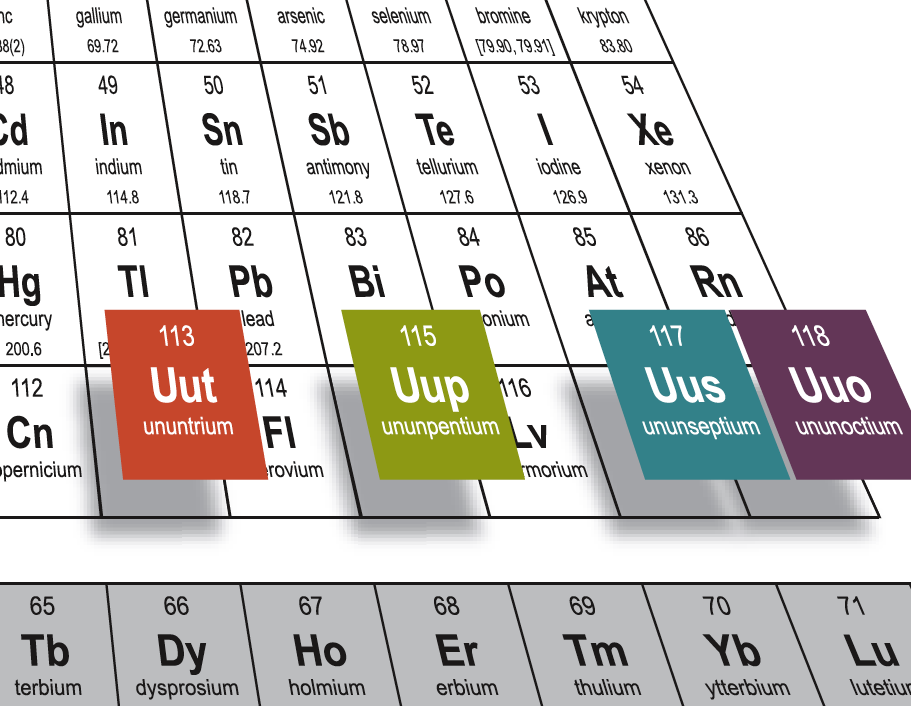
Four new elements named by IUPAC
IUPAC is naming the four new elements nihonium, moscovium, tennessine, and oganesson.
Nihonium and symbol Nh, for the element 113,
Moscovium and symbol Mc, for the element 115,
Tennessine and symbol Ts, for the element 117, and
Oganesson and symbol Og, for the element 118.

…The guidelines for the naming the elements were recently revised [3] and shared with the discoverers to assist in their proposals. Keeping with tradition, newly discovered elements can be named after:
(a) a mythological concept or character (including an astronomical object),
(b) a mineral or similar substance,
(c) a place, or geographical region,
(d) a property of the element, or
(e) a scientist.
The names of all new elements in general would have an ending that reflects and maintains historical and chemical consistency. This would be in general “-ium” for elements belonging to groups 1-16, “-ine” for elements of group 17 and “-on” for elements of group 18. Finally, the names for new chemical elements in English should allow proper translation into other major languages.
For the element with atomic number 113 the discoverers at RIKEN Nishina Center for Accelerator-Based Science (Japan) proposed the name nihonium and the symbol Nh. Nihon is one of the two ways to say “Japan” in Japanese, and literally mean “the Land of Rising Sun”. The name is proposed to make a direct connection to the nation where the element was discovered. Element 113 is the first element to have been discovered in an Asian country. While presenting this proposal, the team headed by Professor Kosuke Morita pays homage to the trailblazing work by Masataka Ogawa done in 1908 surrounding the discovery of element 43. The team also hopes that pride and faith in science will displace the lost trust of those who suffered from the 2011 Fukushima nuclear disaster.
For the element with atomic number 115 the name proposed is moscovium with the symbol Mc and for element with atomic number 117, the name proposed is tennessine with the symbol Ts. These are in line with tradition honoring a place or geographical region and are proposed jointly by the discoverers at the Joint Institute for Nuclear Research, Dubna (Russia), Oak Ridge National Laboratory (USA), Vanderbilt University (USA) and Lawrence Livermore National Laboratory (USA).
Moscovium is in recognition of the Moscow region and honors the ancient Russian land that is the home of the Joint Institute for Nuclear Research, where the discovery experiments were conducted using the Dubna Gas-Filled Recoil Separator in combination with the heavy ion accelerator capabilities of the Flerov Laboratory of Nuclear Reactions.
Tennessine is in recognition of the contribution of the Tennessee region, including Oak Ridge National Laboratory, Vanderbilt University, and the University of Tennessee at Knoxville, to superheavy element research, including the production and chemical separation of unique actinide target materials for superheavy element synthesis at ORNL’s High Flux Isotope Reactor (HFIR) and Radiochemical Engineering Development Center (REDC).
For the element with atomic number 118 the collaborating teams of discoverers at the Joint Institute for Nuclear Research, Dubna (Russia) and Lawrence Livermore National Laboratory (USA) proposed the name oganesson and symbol Og. The proposal is in line with the tradition of honoring a scientist and recognizes Professor Yuri Oganessian (born 1933) for his pioneering contributions to transactinoid elements research. His many achievements include the discovery of superheavy elements and significant advances in the nuclear physics of superheavy nuclei including experimental evidence for the “island of stability”.
…Ultimately, and after the lapse of the public review, the final Recommendations will be published in the IUPAC journal Pure and Applied Chemistry. The Provisional Recommendation regarding the naming of the four new elements can be found on the IUPAC website at http://www.iupac.org/recommendations/under-review-by-the-public/.
Finally, laboratories are already working on searches for the elements in the 8th row of the periodic table, and they are also working to consolidate the identification of copernicium and heavier elements….
Engineering
Engineering is the use of physics to design buildings, vehicles, or infrastructure. We’ll examine real world engineering projects, and see how these techniques may be extended to proposed mega-engineering projects.
Objectives
-
Ask questions that arise from examining models or a theory, to clarify and/or seek additional information and relationships.
-
Ask questions to clarify and refine a model, an explanation, or an engineering problem.
-
Evaluate a question to determine if it is testable and relevant.
-
Ask and/or evaluate questions that challenge the premise(s) of an argument, the interpretation of a data set, or the suitability of the design
– Science and engineering practices: NSTA National Science Teacher Association
– Next Generation Science Standards Appendix F: Science and Engineering Practices
https://kaiserscience.wordpress.com/physics/forces/extreme-engineering/
Using forces
Introduction: When engineers design a building, they have to consider all of the forces on every element in the structure.
It doesn’t matter if they are designing a building, airplane, overpass or tunnel – it all comes down to using Newton’s laws of physics & forces.
What kind of engineering – applied physics – was used in Boston’s Big Dig? Let’s use an app to study the effect of changing forces, loads, materials and shapes, on a structure.
-
Forces: Forces act on big structures in many ways. Click on one of the actions to explore the forces at work and to see real-life examples. Squeezing, stretching. bending, sliding, twisting
-
Loads: All structures must withstand loads or they’ll fall apart. In order to build a structure, you need to know what kinds of external forces will affect it. The weight of the structure, weight of objects (live load), soft soil, temperature, earthquakes, wind, vibration
-
Materials: What you build a structure out of is just as important as how you build it: Put these to the test – wood, plastic, aluminum, brick, concrete, reinforced concrete, cast iron, steel
-
Shapes: The shape of a support affects its ability to resist loads.
App: “Building Big: Forces Lab” PBS

Subways
In the late 19th century, as America’s teeming cities grew increasingly congested, the time had come to replace the nostalgic horse-drawn trolleys with a faster, cleaner, safer, and more efficient form of transportation.
Ultimately, it was Boston — a city of so many firsts — that overcame a litany of engineering challenges, interests of businessmen, and the fears of its citizenry to construct America’s first subway.
Based in part on Doug Most’s acclaimed non-fiction book of the same name, The Race Underground tells the dramatic story of an invention that changed the lives of millions.
Introduction: The Race Underground
Main page: The Race Underground
Slide Show: The Race underground Boston in the early 1900’s
Video: The Race Underground, Chapter 1: Building Boston’s Subways
-
Then & Now: Boston in the Early 1900s
-
Preview: The Race Underground
-
Bonus Video: MBTA Signal School
-
Map, interactive: What the Maps Miss
-
General Article: The Forgotten Hero of the American Subway
-
Bonus Video: Chapter 1

Engineering An Empire

—
Our related article on Extreme Engineering.
External resources
Walkinator app, by Bryce Summer. Biomechanical evolution.
Learning Standards
2016 Massachusetts Science and Technology/Engineering Curriculum Framework
HS-PS2-1. Analyze data to support the claim that Newton’s second law of motion is a mathematical model describing change in motion (the acceleration) of objects when acted on by a net force.
HS-PS2-10(MA). Use free-body force diagrams, algebraic expressions, and Newton’s laws of motion to predict changes to velocity and acceleration for an object moving in one dimension in various situations
2016 High School Technology/Engineering
HS-ETS1-1. Analyze a major global challenge to specify a design problem that can be improved. Determine necessary qualitative and quantitative criteria and constraints for solutions, including any requirements set by society.
HS-ETS1-2. Break a complex real-world problem into smaller, more manageable problems that each can be solved using scientific and engineering principles.
HS-ETS1-3. Evaluate a solution to a complex real-world problem based on prioritized criteria and trade-offs that account for a range of constraints, including cost, safety, reliability, aesthetics, and maintenance, as well as social, cultural, and environmental impacts.
HS-ETS1-4. Use a computer simulation to model the impact of a proposed solution to a complex real-world problem that has numerous criteria and constraints on the interactions within and between systems relevant to the problem.
HS-ETS1-5(MA). Plan a prototype or design solution using orthographic projections and isometric drawings, using proper scales and proportions.
HS-ETS1-6(MA). Document and present solutions that include specifications, performance results, successes and remaining issues, and limitations.

The nature of reality
What is the ultimate nature of reality? This the core questions of physics, as well as of classical, rationalist philosophy. We now know that this question relates to interpretations of quantum mechanics.
“Those are the kind of questions in play when a physicist tackles the dry-sounding issue of, “what is the correct interpretation of quantum mechanics?” About 80 years after the original flowering of quantum theory, physicists still don’t agree on an answer. Although quantum mechanics is primarily the physics of the very small – of atoms, electrons, photons and other such particles – the world is made up of those particles. If their individual reality is radically different from what we imagine then surely so too is the reality of the pebbles, people and planets that they make up.”
The Many Interpretations of Quantum Mechanics, Graham P. Collins, Scientific American, November 19, 2007
To what can we compare our knowledge of the universe?
The allegory of Plato’s cave
The Allegory of the Cave was presented by the Greek philosopher Plato the Republic (380 BCE) He retells an analogy created by Socrates, about people who think that they know the true nature of reality – however, as the analogy progresses, we find that they have no idea what the real world is like at all.
The idea is that most people don’t actually understand our own real world – and that we never will without philosophical and scientific inquiry.
Socrates says to imagine a cave where people have been imprisoned from childhood. They are chained so that their legs and necks are fixed, forcing them to gaze at the wall in front of them, and not look around at the cave, each other, or themselves
Behind the prisoners is a fire, and between the fire and the prisoners is a raised walkway with a low wall, behind which people walk carrying objects or puppets “of men and other living things”
The masters walk behind the wall – so their bodies do not cast shadows for the prisoners to see. But the objects they carry cast shadows. The prisoners can’t see anything behind them : they only able see the shadows cast on the cave wall in front of them. The sounds of people talking echo off the wall, so the prisoners falsely believe these sounds come from the shadows.
The shadows constitute reality for the prisoners – because they have never seen anything else. They do not realize that what they see are shadows of objects in front of a fire, much less that these objects are inspired by real living things outside the cave
The philosopher (or scientist) is like a prisoner who is freed from the cave and comes to understand that the shadows on the wall do not make up reality at all, for he can perceive the true form of reality – rather than the mere shadows seen by the prisoners.
Plato then supposes that one prisoner is freed: he turns to see the fire. The light would hurt his eyes and make it hard for him to see the objects that are casting the shadows. If he is told that what he saw before was not real but instead that the objects he is now struggling to see are, he would not believe it. In his pain the freed prisoner would turn away and run back to what he is accustomed to, the shadows of the carried objects.
Plato continues: “suppose…that someone should drag him…by force, up the rough ascent, the steep way up, and never stop until he could drag him out into the light of the sun.” The prisoner would be angry and in pain, and this would only worsen when the light of the sun overwhelms his eyes and blinds him.” The sunlight represents the new knowledge that the freed prisoner is experiencing.
Slowly, his eyes adjust to the light of the sun. First he can only see shadows. Gradually he can see reflections of people and things in water, and then later see the people and things themselves. Eventually he is able to look at the stars and moon at night until finally he can look upon the sun itself (516a). Only after he can look straight at the sun “is he able to reason about it” and what it is.
- adapted from “Allegory of the Cave.” Wikipedia, The Free Encyclopedia. 29 May. 2016. Web. 3 Jun. 2016

Another illustration of Plato’s cave.

Are the laws of physics really absolute?
One of the major goals of physics is to emerge from the relative ignorance of the cave, and venture out into an understanding of the real world – how our universe really works.
We have made remarkable progress in doing so – everything we have learned in classical physics over the last two millennia is part of the human adventure.
What we have learned is, in an important sense, “real.” Physics lets us ask specific questions and then use math to make specific answers. We then compare our predictions to the way that universe really works.
Yet we need to be careful – we could make the mistake of using physics equations as if they are absolutely true. Yes, they certainly are true in the sense that they work. But are these math equations the absolute truth themselves – or are they really emerging from a deeper phenomenon? See The laws of physics are emergent phenomenon.
Is nature a simulation?
The simulation hypothesis proposes that our reality is actually some kind of super detailed computer simulation. This hypothesis relies on the development of a simulated reality, a proposed technology that would seem realistic enough to convince its inhabitants. The hypothesis has been a central plot device of many science fiction stories and films.
Simulation hypothesis (Wikipedia)
Video Why Elon Musk says we’re living in a simulation: YouTube, Vox
Elon Musk thinks we’re characters in a computer simulation. He might be right.
Is the Universe a Simulation? Scientists Debate
Nick Bostrom: Are you living in a computer simulation?
Is the universe a hologram?
The holographic principle is a principle of string theories and a supposed property of quantum gravity that states that the description of a volume of space can be thought of as encoded on a lower-dimensional boundary to the region—preferably a light-like boundary like a gravitational horizon.
First proposed by Gerard ‘t Hooft, it was given a precise string-theory interpretation by Leonard Susskind who combined his ideas with previous ones of ‘t Hooft and Charles Thorn.
As pointed out by Raphael Bousso, Thorn observed in 1978 that string theory admits a lower-dimensional description in which gravity emerges from it in what would now be called a holographic way. In a larger sense, the theory suggests that the entire universe can be seen as two-dimensional information on the cosmological horizon. – Wikipedia
Our Universe May Be a Giant Hologram
Study reveals substantial evidence of holographic universe
Space’The Holy Grail for Physicists’: First Evidence Universe is a Hologram Uncovered
To learn more about quantum mechanics
The Cosmic Code: Quantum Physics as the Language of Nature, Heinz R. Pagels
One of the best books on quantum mechanics for general readers. Heinz Pagels, an eminent physicist and science writer, discusses the core concepts without resorting to complicated mathematics. He covers the development of quantum physics. And although this is an intellectually challenging topics, he is one of the few popular physics writers to discuss the development and meaning of Bell’s theorem.

Quantum Reality: Beyond the New Physics, Nick Herbert
Herbert brings us from the “we’ve almost solved all of physics!” era of the early 1900s through the unexpected experiments which forced us to develop a new and bizarre model of the universe, quantum mechanics. He starts with unexpected results, such as the “ultraviolet catastrophe,” and then brings us on a tour of the various ways that modern physicists developed quantum mechanics.
And note that there isn’t just one QM theory – there are several! Werner Heisenberg initially developed QM using a type of math called matrix mechanics, while Erwin Schrödinger created an entirely different way of explaining things using wave mechanics. Yet despite their totally different math languages – we soon discovered that both ways of looking at the world were logically equivalent, and made the same predictions. Herbert discussed the ways that Paul Dirac and Richard Feynman saw QM, and he describes eight very different interpretations of quantum mechanics, all of which nonetheless are consistent with observation…

In Search of Schrödinger’s Cat: Quantum Physics and Reality, John Gribbon
“John Gribbin takes us step by step into an ever more bizarre and fascinating place, requiring only that we approach it with an open mind. He introduces the scientists who developed quantum theory. He investigates the atom, radiation, time travel, the birth of the universe, superconductors and life itself. And in a world full of its own delights, mysteries and surprises, he searches for Schrodinger’s Cat – a search for quantum reality – as he brings every reader to a clear understanding of the most important area of scientific study today – quantum physics.”

External links
The Many Interpretations of Quantum Mechanics, Scientific American
Tom’s Top 10 interpretations of quantum mechanics
Learning Standards
SAT Subject Test: Physics
Quantum phenomena, such as photons and photoelectric effect – Atomic, such as the Rutherford and Bohr models, atomic energy levels, and atomic spectra. Nuclear and particle physics, such as radioactivity, nuclear reactions, and fundamental particles.
AP Physics Curriculum Framework
Essential Knowledge 1.D.1: Objects classically thought of as particles can exhibit properties of waves.
a. This wavelike behavior of particles has been observed, e.g., in a double-slit experiment using elementary particles.
b. The classical models of objects do not describe their wave nature. These models break down when observing objects in small dimensions.
Learning Objective 1.D.1.1:
The student is able to explain why classical mechanics cannot describe all properties of objects by articulating the reasons that classical mechanics must be refined and an alternative explanation developed when classical particles display wave properties.
Essential Knowledge 1.D.2: Certain phenomena classically thought of as waves can exhibit properties of particles.
a. The classical models of waves do not describe the nature of a photon.
b. Momentum and energy of a photon can be related to its frequency and wavelength.
Content Connection: This essential knowledge does not produce a specific learning objective but serves as a foundation for other learning objectives in the course.
A Framework for K-12 Science Education: Practices, Crosscutting Concepts, and Core Ideas (2012)
Electromagnetic radiation can be modeled as a wave of changing electric and magnetic fields or as particles called photons. The wave model is useful for explaining many features of electromagnetic radiation, and the particle model explains other features. Quantum theory relates the two models…. Knowledge of quantum physics enabled the development of semiconductors, computer chips, and lasers, all of which are now essential components of modern imaging, communications, and information technologies
Scaling and biophysics
From Math Bench Biology Modules:
Scaling examines how form and function change as organisms get larger – in other words, how do biological features scale across size? Do they change in meaningful ways as organisms get bigger or smaller? Of course, you can’t even ask these types of questions without having a way of measuring how relationships change mathematically.
Why study these relationships? Well, if you understand how form or functions change as organisms get bigger or smaller, it is possible to learn something fundamental about what underlies the processes or learn about what factors place evolutionary limits on organism growth and adaptations. For instance, determining at what size arthropods can no longer support the weight of their exoskeleton gives us clues about the limits of their growth.
Let’s use a concrete example so you’ll know what we mean. Here is some data on body size and metabolic rate for mammals….

- metabolic rate increases as animals get bigger. That’s because we are specifically interested in total energy consumed (here measured through oxygen consumption). Of course, bigger animals will use more oxygen than smaller ones (think about how big a breath a lion takes compared to a mouse).
- But look at the values adjusted for body size (the last value listed for each species). Mice use a lot more oxygen per gram than a lion. This means that lions use oxygen more efficiently than mice.
- As mammals get bigger, this increase in efficiency is not linear (notice how the steepness of the slope decreases as size increases).
- This means that metabolism does not scale linearly with body size.
“Who cares?” Well, it turns out that how metabolism (and other factors) scales with body size can give important information about which factors are most important in limiting these biological functions. If we can understand that, we understand a lot more about biology!
Math Bench Biology Modules, University of Maryland: Scaling and Power laws
– – –
How scaling affects biology
There are species of animals such as the deer and the elk that are closely related but of different size. Galileo took notice that the bones of the elk are not just proportionally thicker to the bones of the deer – but instead the elk’s bones are even much thicker.
The elk’s bone has to be much thicker to lower the stress in the bone below the breaking point of the bone. Even so, elk and all the other large vertebrates are still more likely of breaking their bones than the more active smaller animals.

http://www.dinosaurtheory.com/scaling.html

Enter a caption

External links
http://www.av8n.com/physics/scaling.htm
The Principle of Scale: A fundamental lesson they failed to teach us at school
The Biology of B-Movie Monsters, Michael C. LaBarbera
Scaling: Why Giants Don’t Exist, Michael Fowler, UVa 10/12/06
Science of Jurassic Park
Jurassic Park is a 1993 film directed by Steven Spielberg. The first installment of the Jurassic Park franchise, it is based on the 1990 novel of the same name by Michael Crichton.
Next Generation Science Standards: Science & Engineering Practices
● Ask questions that arise from careful observation of phenomena, or unexpected results, to clarify and/or seek additional information.
● Ask questions that arise from examining models or a theory, to clarify and/or seek additional information and relationships.
● Evaluate a question to determine if it is testable and relevant.
● Ask and/or evaluate questions that challenge the premise(s) of an argument, the interpretation of a data set, or the suitability of the design
Science and engineering practices: NSTA National Science Teacher Association
Next Gen Science Standards Appendix F: Science and engineering practices
1. When did dinosaurs live? Investigate the geological eras.

Another view of the relationship between geological eras and the Earth’s strata.

2. What are chromosomes/genes/DNA nucleotides?
DNA is like an alphabet: Analogies to explain nucleotides, genes and chromosomes
3. How might DNA possibly be preserved for long periods of time?
4. What is the scientific premise of the film: How did they recreate ancient dinosaurs?
Did they (according to the film) create dinosaurs at all?

5. According to the book & film, not enough intact DNA was recovered to create a true dinosaur. How then were the theme park dinosaurs created?
http://jurassicpark.wikia.com/wiki/Filling_the_sequence_gaps
6. Have scientists ever actually discovered preserved soft tissue, and/or protein, in dinosaur fossils?
http://www.livescience.com/41537-t-rex-soft-tissue.html
http://www.smithsonianmag.com/science-nature/dinosaur-shocker-115306469/?no-ist
https://www.theguardian.com/science/2015/jun/09/75-million-year-old-dinosaur-blood-and-collagen-discovered-in-fossil-fragments
https://student.societyforscience.org/article/more-dinosaur-bones-yield-traces-blood-soft-tissue
7. Have scientists ever actually discovered preserved DNA in dinosaur fossils?
http://www.livescience.com/23861-fossil-dna-half-life.html
http://www.sci-news.com/paleontology/science-dinosaur-dna-amber-01383.html
http://www.slate.com/articles/health_and_science/explainer/2013/02/dna_testing_richard_iii_how_long_does_dna_last.html
http://scitechdaily.com/researchers-calculate-that-dna-has-a-521-year-half-life/
http://www.nature.com/news/dna-has-a-521-year-half-life-1.11555
https://en.wikipedia.org/wiki/Ancient_DNA
8. Some scientists have proposed that we can realistically reverse engineer dinosaurs from living birds. What is their biological, and evolutionary reasoning for why this could make sense?
http://www.nytimes.com/2015/05/12/science/reverse-engineering-birds-beaks-into-dinosaur-bones.html?_r=0
http://news.softpedia.com/news/Scientist-Working-on-Reverse-Engineering-Chickens-into-Dinosaurs-484679.shtml
http://www.livescience.com/17642-chickenosaurus-jack-horner-create-dinosaur.html
http://news.softpedia.com/news/Rise-of-the-Dino-Chickens-Velociraptor-Snouts-Grown-on-Baby-Chicks-480898.shtml
Can Scientists Turn Birds Back Into Dinosaur Ancestors? National Geographic
TED Talks: Jack Horner on building a dinosaur from a chicken
A molecular mechanism for the origin of a key evolutionary innovation, the bird beak and palate, revealed by an integrative approach to major transitions in vertebrate history
9. How would these scientists actually go about doing this? (Summarize in a clearly written paragraph, describing several steps.)
Additional resources
Are Movies Science? DINOSAURS, MOVIES, AND REALITY Univ. of California Museum of Paleontology
Real-Life ‘Jurassic World’ Dinos May Be Possible, Scientist Says: LiveScience
Can scientists clone dinosaurs? How Stuff Works
Scrappy Fossils Yield Possible Dinosaur Blood Cells: National Geographic
DNA has a 521-year half-life, Nature (scientific journal)
The final nail in the Jurassic Park coffin. Research just published in the journal The Public Library of Science ONE (PLOS ONE)
Absence of Ancient DNA in Sub-Fossil Insect Inclusions Preserved in ‘Anthropocene’ Colombian Copal. (scientific journal)
Science of Jurassic Park: JurassicWikia
Book: The Science of Jurassic Park: And the Lost World Or, How to Build a Dinosaur
Latest Posts
-

Importance of art education
Why is teaching art intrinsically important to being human? Some would have us believe that we should have art education in our schools because it…
-

What are broken symmetries?
Symmetry is an important concept for understanding how our universe works. Symmetry lets us see what stays the same when certain conditions change. Symmetries are…
-

Native Americans in New England
When did the ancestors of native Americans arrive in what we now call New England? Their earliest confirmed presence in New England is about 12,000–13,000…
-
Why is music education important
Why is music intrinsically important to being human? Every year I read yet another article trying to persuade us that we should have music education…
 KaiserScience